







Cyberheist City and the Resetting 100x Wild
My Verdict Starts With the Reset
Cyberheist City looks built for instant impact: a neon bank district, a getaway car, five sharply drawn characters, tumbling symbols, and Wild multipliers that can show values as high as 100x. The crucial detail is quieter. In the base game, the accumulated Wild multiplier belongs to one tumble sequence. When that sequence ends, the total disappears. Free Spins change that rule by keeping the total across the bonus. That reset line, not the bright 100x label, determines how the slot feels.
My rating is 8.1 out of 10 for readers who like compact grids and multiplier chains that are simple to audit after each fall. The 5 by 3 layout remains readable, 243 ways are less cluttered than a large cluster grid, and the two bonus modes create a clear step up from the base round. The drawback is concentration. Most of the advertised force sits behind special Wilds and bonus access, while an ordinary spin can pass with very little happening. A high display value is possible, but it is neither a forecast nor a minimum result.
For an adult Filipino reader, I would treat Cyberheist City first as a free-demo study. Confirm the exact game symbol, the installed RTP, the total stake, the currency, and every optional bet inside the operator client before risking cash. Pragmatic Play identifies this title as vswayscyhecity. That matters because PAGCOR material available during this review lists a different game called Cyber Heist under vs20cbrhst. Similar names do not prove that Cyberheist City is approved at a particular Philippine operator. Game identity and operator legitimacy need separate checks.
What the Current Build Actually Is
The review target is Pragmatic Play's Cyberheist City, released on 29 January 2026 and identified in the official demo by the symbol vswayscyhecity. Five reels carry three visible rows. The game counts 243 ways and uses a tumble system. Any source describing a six-row layout, fixed paylines, or the older Cyber Heist mechanics is describing something else. The distinction is more than a spelling issue because the reel map, win calculation, bonus logic, and internal game symbol all change.
The title page describes a 5 by 3 slot in which glamour and grit meet on neon streets. The screen itself supports that identity: the frame resembles a night-time bank district, a sports car sits near the spin control, and the reel symbols depict members of a robbery crew alongside card-suit icons. The visual theme is direct enough that a reader does not need a story summary to understand the scene.
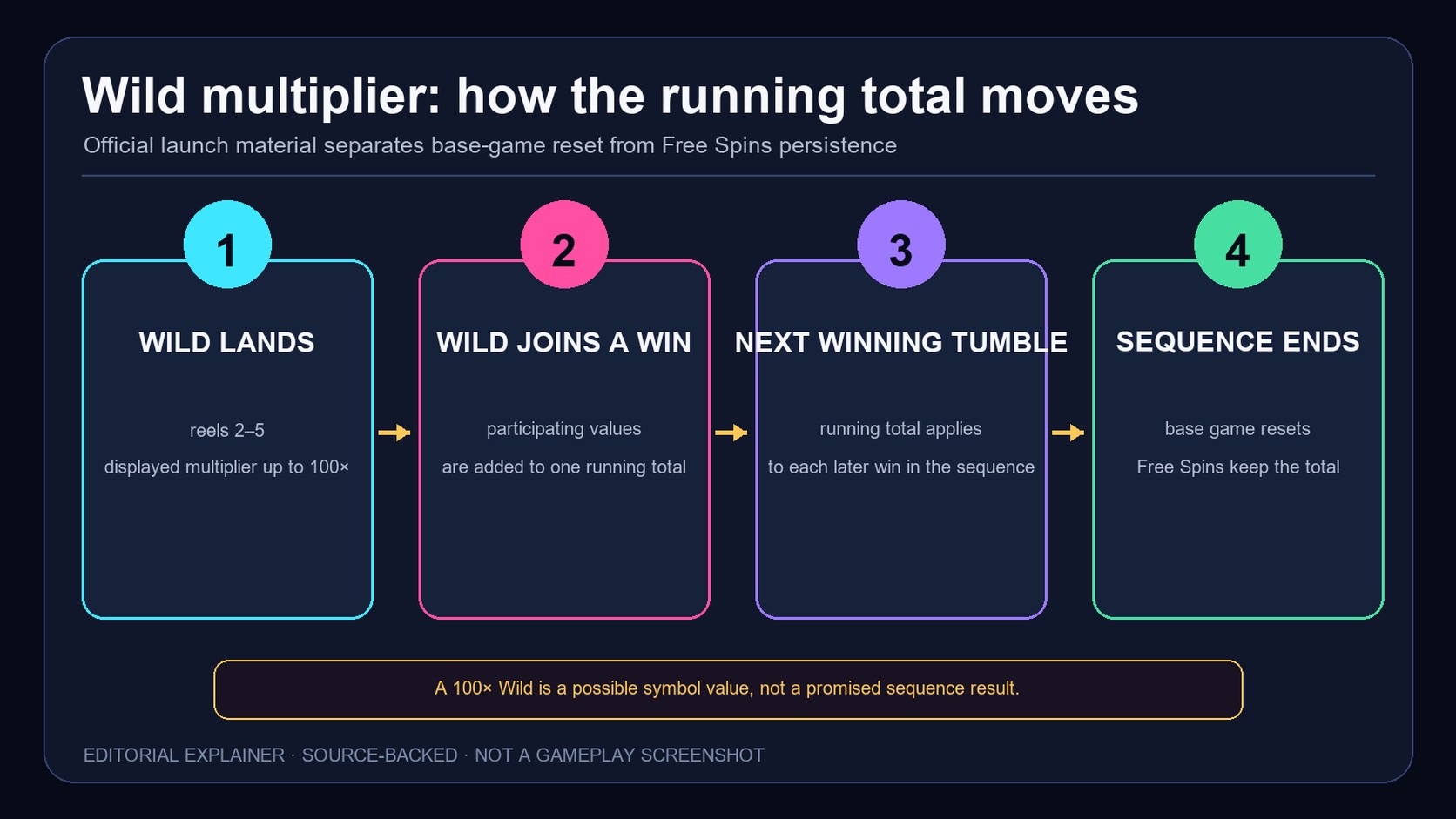
Mechanically, the title is a ways game; fixed paylines are absent. Matching symbols need to occupy adjacent reels from the left. A winning arrangement clears. Replacement symbols fall before another evaluation takes place. Wilds appear only on reels two through five. Some carry multiplier values. When one or more participating multiplier Wilds are part of a win, their values are added into a running total for that tumble sequence. They are not multiplied together.
The official ceiling is 5,000 times the stake. The showcased return setting is 96.50 percent, but a deployed operator build may differ. Optional modes can also be absent or priced differently by market. The soundest reading is therefore specific: these figures describe the reviewed configuration and official material, not every copy carrying the same artwork.
A Short Demo Session Changed the Emphasis
The archived exact-title demo log is unusually useful because it separates what appeared on screen from what the mathematics might do over time. Fifteen settled base spins were recorded at a fixed EUR 2.00 demo stake. Fourteen showed no payout, while one showed EUR 0.40. The balance moved from EUR 100,000.00 to EUR 99,970.40 after EUR 30.00 in total demo wagers. That tiny sample says nothing reliable about hit rate, expected return, or the probability of a bonus. It does show how bare the base game can look when no useful Wild chain develops.
One direct entry into the basic feature was also completed with demo funds. At the same EUR 2.00 base stake, the displayed price was EUR 200.00, or 100 times the base wager. Ten free spins were granted and the round settled at EUR 304.96. That result cannot be promoted as typical, profitable, or repeatable. Its practical value is narrower: the interface deducted the shown demo cost, awarded the stated spin count, preserved the bonus state through the round, and returned to the base screen with consistent arithmetic.
That evidence shifts the review away from spectacle. The best questions are not how often a 100x Wild appears or how much one purchased round returned. Fifteen spins and one feature are far too small for those claims. Better questions are visible and repeatable: can the player tell when a multiplier joins a win, does the running total persist or reset, is the full cost shown before confirmation, and does the final balance agree with the event log? Cyberheist City answers those interface questions more clearly than it answers any question about short-session value.

Reading 243 Ways on a 5 by 3 Grid
The compact reel map is the game's strongest usability choice. A 243-way arrangement sounds more complex than twenty fixed paylines, but the on-screen reading is straightforward once the left-to-right rule is understood. A matching symbol on reel one starts the possibility. The same symbol on reel two keeps it alive, and matches on later adjacent reels extend it. More matching positions on a reel create more routes through the same reel sequence.
Suppose a high-value character appears once on reel one, twice on reel two, and once on reel three. Those counts form two three-reel ways before any Wild substitution is considered. The screen does not need to draw diagonal line overlays because the combinations arise from positions on consecutive reels. This makes the outcome easier to inspect on a phone than a large line map with dozens of highlighted paths.
Ways still leave room for confusion. The displayed count describes possible routes; it does not promise that 243 combinations are active on each spin. A symbol still needs a valid left-edge chain. Two matching characters stranded on reels four and five do not form a standard win by themselves. The Tumble button can also make the board look busier than it is, because a replacement drop remains part of the same paid spin. No new base wager is charged for that fall.
The useful habit is to read one settled stage at a time. First identify the leftmost symbol group. Then trace matching positions across adjacent reels. Next check if a Wild joined that particular settlement. Finally read the multiplier total before the next fall. This sequence turns the neon animation back into arithmetic. It has no influence on the random result. Its value lies in making the settlement easier to verify.
How Tumbles Create the Game's Rhythm
A winning combination removes its symbols and leaves gaps. Existing symbols fall downward, replacements enter from above, and the board is checked again without charging a second base wager for that fall. A chain ends when the refreshed board contains no further win. The next paid spin then begins from a clean state.
That rule creates two very different tempos. A losing base spin ends almost immediately. A winning spin can expand into several visual beats as the same wager produces more than one settlement. The design therefore feels quiet for stretches and suddenly busy during a chain. It is tempting to call a long tumble sequence momentum, yet each replacement state is simply another random board within the current paid event. It does not make the following paid spin due for anything.
Cyberheist City's Wild total sits inside this sequence. A multiplier that joins an early win may matter again if a later tumble also wins. Landing alone cannot transform the whole board; the Wild has to participate in the settlement. The exact relationship between the Wild, the winning route, and the current running total matters more than the number printed on the symbol.
This is also where autoplay deserves caution. Rapid successive spins can blur the boundary between a tumble and a new wager, especially on a narrow screen. The controls may show turbo-style or automatic options in some deployments, but speed does not change the return model. Slowing the client down long enough to see the balance after a completed sequence is a better way to understand the charge and settlement. If the animation begins to feel like one uninterrupted stream, stop the sequence and read the history before making another input.
Why a 100x Wild Is Not a 100x Spin
The 100x figure is the most marketable number on the rules page and the easiest to misread. It describes the maximum displayed value that a Wild may carry. It says nothing about how often the symbol appears. The label also cannot show that a particular Wild will join a win or make a spin settle at 100x. The symbol must be relevant to a valid settlement, and the underlying win still matters.
If a participating Wild carries 5x and another participating Wild carries 10x, the running value is 15x, not 50x. That sum applies according to the tumble rules. A later winning fall in the same base-game sequence can use the accumulated total. Once the base sequence ends, the meter resets. The design rewards chain length in presentation, but the random symbol arrangement still decides if another qualifying win exists.
The difference between symbol value and spin result is especially important near the top of the range. A 100x Wild can land in a dead position. It may also miss a left-to-right route or arrive after the sequence is effectively over. Even when it contributes, its multiplier acts on a particular win amount. It is not a direct 100x credit award. The official 5,000x game cap remains a separate boundary on the whole outcome.
For review purposes, this creates a strong transparency test. The interface should make the relevant Wild visible, show the accumulated value, apply it to the correct settlement, and reset it at the correct moment. Those are facts a demo user can inspect. Any claim about frequency requires a far larger and controlled data set than a short play session. The sensible verdict is that the Wild system is legible, not that it is frequent or generous.
Base Game Multiplier Logic in Plain Terms
The base round can be reduced to four states. First, the paid spin lands. Second, a ways win is found. Third, any relevant Wild values join the running sum. Fourth, symbols tumble and the board is checked again. If the replacement board wins, the current sum remains relevant inside that sequence. If it loses, the sequence closes and the meter returns to its base condition for the next paid spin.
This structure makes early Wilds more interesting than late ones. A useful multiplier on the first settlement has more theoretical room to affect later falls because the chain has not yet ended. A Wild arriving on the final winning fall may apply once and disappear when the refreshed board fails. That is a timing observation, not a strategy. The player has no control over where the symbol lands or how many tumbles follow.
There is also no valid chase logic. A long dry spell does not make a multiplier Wild more likely on the next spin, and a near miss with two car symbols does not signal that the third is approaching. The random number generator resolves each event under the installed rules. Visual repetition can make the reel history feel patterned, but the interface does not turn previous losses into future credit.
The base round therefore fits readers who enjoy tracking a temporary meter without maintaining a collection across many paid spins. It may frustrate anyone who prefers persistent progress, because nothing meaningful survives an unsuccessful sequence. That reset is deliberate. It keeps the base game compact while reserving persistent multiplier growth for the bonus.
Free Spins Change the Reset Rule
Standard Free Spins begin when three to five sportscar Scatter symbols appear. Three cars award 10 spins, four award 15, and five award 20. During the bonus, qualifying Wild values collect into a running total that persists across the remaining free spins. A weak early spin can therefore leave behind a multiplier state that still matters later, even if the immediate payout is small.
Persistence is the core upgrade. In the base round, a tumble chain must keep winning to retain its total. In the bonus, the accumulated value stays for the round. The meter becomes a session-level state that survives the end of one sequence. Each relevant Wild can change how subsequent wins settle, so the order of events matters more than it does in ordinary play.
Extra Scatter symbols can extend the feature. The official rule set links two through five bonus Scatters to five through twenty extra spins. The exact mapping should be read in the current help panel because operator builds and labels can change. A retrigger adds time for the existing state to matter; it does not guarantee that later spins will win.
The archived demo purchase began with ten spins, matching the displayed regular entry. Its positive demo settlement is useful only as a transaction check. Another round could finish below its displayed cost, and an organically triggered round has no separate purchase cost to compare. The persistent multiplier makes the bonus mechanically deeper, but it does not place a floor under the result.
Super Free Spins Raise the Wild Floor
Super Free Spins require a qualifying Scatter combination that includes at least one airplane Super Scatter. In that mode, multiplier Wilds begin at a minimum of 10x. The ordinary bonus can show lower Wild values, so the super version starts each special Wild from a stronger visible base. The maximum displayed Wild value remains part of the same 100x framework.
A higher floor changes the multiplier input, not the certainty of a win. The Wild still needs to matter to a valid ways settlement, and the board still needs compatible symbols. An airplane symbol on the trigger screen opens the stronger ruleset, but the resulting round remains random. The word super describes its feature configuration, not a guaranteed return.
This distinction becomes more important if a Buy Super Free Spins button is present. Some reviewed configurations price direct access at a large multiple of the base wager. The button shortens the path to the mode; it does not change the fact that the purchased round can settle below its price. Before confirmation, the screen should show the full demo or cash cost, the selected base stake, and the exact feature name. Similar orange and purple panels can be easy to confuse on a small phone.
For readers comparing the two bonuses, the choice is not simply weak versus strong. The regular bonus uses the same persistence rule at a lower access cost where buying is enabled. Super Free Spins attach a minimum 10x value to multiplier Wilds but may require a far higher upfront amount. Concentrating many base wagers into one click increases short-session exposure. Free mode is the cleanest place to compare their interfaces without turning that concentration into a money decision.
Three Car Counts Create Three Starting Lengths
The sportscar Scatter is easy to identify because it matches the getaway theme and differs clearly from the airplane symbol used for Super Free Spins. Three cars award 10 free spins, four award 15, and five award 20. That ladder is more informative than a generic three-plus rule because the fifth car changes the opening duration substantially.
More starting spins create more time for multiplier collection, but they do not establish a proportional return. Twenty spins do not carry twice the value of a ten-spin result by default. Symbol paths and Wild participation shape the actual settlement. Multiplier timing and retriggers matter too. The count describes duration; it is no payout schedule.
The airplane changes mode instead of merely adding another car. A qualifying trigger that contains at least one Super Scatter enters Super Free Spins, where the Wild minimum becomes 10x. Readers should therefore distinguish quantity from identity. Five ordinary cars describe the longest standard start. A valid mix that includes the airplane changes the rules applied to the entire feature.
Near-miss presentation deserves the same skeptical reading. Two cars on screen do not make the next spin more likely to complete the set. A car sliding past a reel window has no mathematical memory once the event settles. The only useful information is the final stopped arrangement and the help-page mapping. If the game celebrates a trigger with a large transition, the history panel and awarded counter remain the clearest records of what was actually granted.
The Extra Bet Buttons Need Local Verification
The reviewed demo shows a Buy Feature panel and a Special Bets panel. Archived rules record Ante Bet, Super Spin, a regular Free Spins purchase, and a Super Free Spins purchase in that configuration. The observed regular-bonus purchase cost was 100 times the EUR 2.00 base wager. Other labels and prices can vary by operator or jurisdiction, so the article does not treat any optional control as globally available.
Ante Bet changes the total amount at risk per paid spin in exchange for a modified feature setup or trigger chance described by the client. Super Spin concentrates still more exposure into one event. A feature purchase jumps directly to a bonus for a displayed multiple. These controls change cost and variance; none of them turns the game into a skill contest.
Philippine users should verify the total stake after selecting any special mode. A button may show a multiple while the footer shows the actual amount deducted. PHP display, credit conversion, minimums, and caps belong to the installed operator build. A euro demo screenshot cannot prove that a peso client uses the same range or even carries the same options.
There is also a behavioral reason to slow down. Feature-buy buttons compress a long sequence of ordinary wagers into one confirmation. Repeating the purchase after a poor round can escalate losses much faster than the base spin control suggests. If the cost feels like an attempt to recover the previous result, close the panel. A purchase is a new random event, not a repair mechanism for the last one.
RTP Is a Build Fact, Not a Brand Promise
Pragmatic Play's product material shows a default RTP of 96.50 percent for Cyberheist City. The archived demo rules displayed 96.50 percent for the base setting, 96.48 for Ante Bet, 96.50 for Super Spin, 96.47 when buying the basic feature, and 96.50 for Super Free Spins Buy. Those small differences matter because changing modes can change the theoretical model as well as the stake.
RTP is a long-run mathematical ratio for a specific configuration. It cannot predict the next spin or describe a fifteen-spin sample. A player is never promised recovery of 96.50 percent of a deposit. Short sessions can finish far above or below the published percentage. Volatility determines how unevenly results may be distributed, while RTP describes the long-run average under the tested model.
Operator copies may use other certified settings. A third-party range reported for this title extends below the official showcase figure, which is another reason to inspect the active information panel. The provider name and game artwork cannot prove which setting is installed. If the RTP is absent, hidden behind inaccessible terms, or materially lower than expected, stop. Assuming the best version is unjustified.
Optional modes should be checked separately. The base-game number cannot automatically be assigned to Ante Bet or a purchase button. The archived rules demonstrate that several figures can coexist inside one client. A careful comparison records the exact mode, total stake, currency, and shown return value together. Without that context, an isolated percentage is incomplete.
Maximum Win and Volatility Need Separate Readings
The official maximum multiplier is 5,000x. That ceiling describes the largest permitted settlement under the game rules, not the size of an ordinary bonus and not the probability of reaching the cap. A multiplier Wild can show up to 100x, yet the game maximum is a separate whole-result limit. Neither number tells the reader how frequently meaningful chains appear.
The provider positions this title as a high-variance slot. The base-game demo log is consistent with what a sparse short sample can look like, but fifteen spins are nowhere near enough to estimate variance. The same caution applies to the purchased feature that happened to settle above its demo price. One positive round cannot establish typical feature value, just as fourteen blank base results cannot establish a hit rate.
The practical consequence of higher variance is session instability. Results can cluster around small or zero settlements while a smaller share of events carries much of the theoretical return. That distribution makes chasing especially hazardous because the rare upper tail is visible in promotional numbers but not scheduled to arrive after a run of losses.
A sensible limit is defined outside the game, before the first wager, and is not raised after a miss. For Philippine adults, legal eligibility and operator verification come first. PAGCOR's responsible-gaming page excludes people under 21 and other restricted groups. Anyone experiencing loss of control should avoid the game and use formal support or self-exclusion channels. Autoplay limits alone are inadequate.
The Philippine Approval Check Cannot Be Skipped
The current PAGCOR provider list includes Pragmatic Play material, but title-level identity still matters. The regulator document available during this review lists Cyber Heist under the internal symbol vs20cbrhst. Cyberheist City uses vswayscyhecity. Those identifiers are different, and the older title must not be used as proof for the 2026 game reviewed here.
This leaves local availability unresolved; it does not prove a nationwide absence. The exact-title confirmation was not established from the cited public list. A regulated operator may update its catalogue, and PAGCOR may publish newer records. The safe check is current and specific: verify the operator domain through PAGCOR's tools, then match the title and internal identifier in the newest approved-game material or in a regulator-linked client.
A provider logo is insufficient. So is a copied seal, a social-media advertisement, or a mirror domain that resembles a licensed brand. PAGCOR has warned about unauthorized sites using its name and fabricated credentials. Navigate from the regulator's own records instead of trusting a logo inside the casino page.
Payment and account questions also sit outside this reel review. No GCash flow, deposit, withdrawal, KYC process, or peso settlement was tested. A playable demo proves only that a game client loads in fun mode. It does not validate the operator handling real funds. Keep the two decisions separate. Confirm the game build first. After that, confirm the business receiving money.
Mobile Readability for Filipino Users
The 5 by 3 grid is a good fit for a phone because each symbol remains large and the running multiplier can sit outside the reel area. Character portraits are distinct, card-suit icons use strong shape differences, and the sportscar and airplane Scatters have separate silhouettes. Those choices reduce the chance of confusing a regular symbol with a trigger symbol.
The weak point is control density. Buy Feature and Special Bets panels occupy the left side of the landscape screen, while stake controls, spin, autoplay, information, and sound controls line the bottom. On a smaller display, the reel action may remain clear while cost controls become cramped. Landscape orientation gives the labels more room and makes the total credit and bet easier to read at the same time.
Network interruption is another concern for mobile use. A spin result is resolved by the game server even if an animation freezes locally. Reopening the game and checking transaction history is safer than pressing spin repeatedly while the interface is unresponsive. The client animation is a presentation of the server result, not the authoritative ledger.
Data use and battery heat can also change the practical experience during long autoplay runs. The neon background and tumbles keep the renderer active. Transitions and the soundtrack add more work. Those factors do not alter the math, but they can make a phone session uncomfortable or cause the screen to dim. Short manual inspection in demo mode is a clearer readability test than a long unattended autoplay sequence.

The Neon Heist Theme Works Because It Stays Legible
The art direction uses magenta, violet, blue, and electric green against a dark city. A bank facade, palm silhouettes, lasers, a vault, and two getaway vehicles carry the robbery theme. Five human characters occupy the premium-symbol tier, while glossy suit icons handle lower-value positions. The result resembles a stylized crime poster, far removed from a realistic casino floor.
That clarity matters during tumbles. Portraits have different hairstyles, clothing, and color blocks, so a falling replacement is easy to distinguish from the removed symbol. The green club and blue spade are separated by both hue and shape. Multiplier Wilds need the strongest visual priority, and the interface gives them a numeric badge that can be read before the next settlement.
Pragmatic Play describes the soundtrack as synthwave. The music suits the neon setting, but sound is optional information. A player should be able to understand the win, multiplier total, and feature counter with audio muted. The demo screen retains those visual records, which helps on public transport or in shared spaces where sound is inappropriate.
The style may still divide readers. Anyone who prefers traditional fruit machines or restrained backgrounds may find the pink glow busy. The important point is that the reel border remains visually separate from the city behind it. Theme does not obscure the 5 by 3 grid. For a game that relies on rapid falls and small multiplier badges, that separation is more valuable than cinematic detail.
Who This Design Fits and Who Should Skip It
Cyberheist City fits an adult who likes a compact ways grid, short base events, and a bonus whose main state can be watched numerically. The running Wild total has a clear lifecycle. The regular round preserves it. Super Free Spins raise the minimum Wild value. Three, four, and five car symbols map to visibly different starting lengths. The mechanic has enough structure to study without requiring a complicated collector map.
It fits poorly for someone seeking low-variance play. Persistent progress across ordinary spins is absent, and meaningful player decisions are absent as well. Choosing a stake or buying a feature is not strategic control over the random result. The game also deserves a pass when the operator does not disclose RTP, the total special-bet cost is hard to see, or the exact title cannot be matched to current Philippine approval material.
The strongest use case is free mode with manual spins. Watch one tumble sequence from start to finish, note how the multiplier total changes, then open the rules and compare the base reset with bonus persistence. That short exercise explains the entire product more honestly than a montage of maximum-win clips.
Real-money play adds risks that the demo cannot answer. Currency conversion, account security, withdrawal handling, operator conduct, and local authorization belong to separate checks. No reel mechanic compensates for a questionable domain. If any identity or payment detail is unclear, leaving the site is the correct decision.
A Practical Checklist Before Any Paid Spin
Use the following checks in the operator client. A review screenshot cannot replace them:
- Match the exact title Cyberheist City and the game symbol vswayscyhecity. - Verify the operator domain through current PAGCOR records. - Open the information panel and record the active RTP for the selected mode. - Confirm the currency and full total stake after activating any special bet. - Read the car Scatter and aircraft-marked Super Scatter rules separately. - Check the feature-purchase price before the final confirmation screen. - Make sure the balance and transaction history remain accessible after reconnection. - Avoid autoplay if it makes individual wager boundaries hard to follow. - Stop if play is being used to recover prior losses or if the planned time has expired.
None of these steps changes the house edge or predicts a result. Their purpose is narrow. They identify the correct build and make the actual cost visible. They also reduce avoidable confusion. The game remains chance-based after every box is checked.
Final Assessment for Filipino Players
Cyberheist City earns its 8.1 score through a precise mechanical contrast. The base round resets the Wild total after each tumble sequence. The regular Free Spins round keeps the total across the bonus. Super Free Spins add a 10x minimum to multiplier Wilds. That progression is coherent, visible, and more interesting than the generic robbery theme suggests.
The compact 5 by 3 screen and 243-way map are strong on landscape mobile. Tumbles make each paid spin easy to segment when played manually. The multiplier display explains why one fall affects the next. At the same time, the 100x Wild label and 5,000x ceiling can dominate attention even though neither says anything about the next result. The short archived demo sample reinforces that warning: sparse base settlements and one profitable demo purchase are observations, not probability estimates.
My recommendation is conditional. Use the official free demo to learn the reset rule, then verify the installed RTP, total wager, currency, optional modes, operator domain, and exact Philippine title status. Do not substitute the older Cyber Heist listing for Cyberheist City. If the exact game and operator are current, the math panel is visible, and temporary multiplier chains are the kind of slot structure you enjoy, the design is worth examining in free mode. If approval, RTP, or total cost is unclear, the neon getaway should end before a paid spin begins.
The slot has no betting system to master. Its useful skill is accurate interface reading: ways from the left, relevant Wilds only, and values that are added instead of multiplied. The base-game reset, bonus persistence, and separate super mode complete the rule set. Understanding those rules can prevent false assumptions. It cannot turn a random game into income, erase the house edge, or guarantee that a bonus repays its price.