
Fairy
Casino NewsGame Guides

Philippines Casino Games Guides

Philippines Casino Games Guides offers practical tips and guides for popular casino games in the Philippines, including Super Ace.

Athena's Glory – Twilight of the Gods Review: Four Ways the Reels Change
Athena's Glory – Twilight of the Gods
Athena's Glory – Twilight of the Gods Review: Four Ways the Reels Change

The First Chapter Paid More Than It Cost

My clearest memory from Athena's Glory - Twilight of the Gods is not a giant total or a dramatic final spin. It is the moment a small win stopped being the end of a round. The reels shifted one column to the right, a new reel entered from the left, and the same paid turn became another chance to connect. That Moving Reels chapter began at a 0.50 total stake, cost 21.00 to enter, and finished at 34.07. The result put the purchase 13.07 ahead in that one round, but the way it got there mattered more than the number.

At one point, the win field rose from 5.36 to 20.70 while the rightward movement kept opening new layouts. The ten-spin counter did not tell the whole story because a settled win could add a free respin. That mechanic made the first Journey chapter feel less like ten isolated boards and more like a chain whose length depended on each new connection. The next three chapters changed a Wild in different ways, yet none recreated that exact rhythm. This review follows those changes in the order I played them and keeps each result tied to what was visible on the reels.

Athena Fills a Wide but Readable Screen

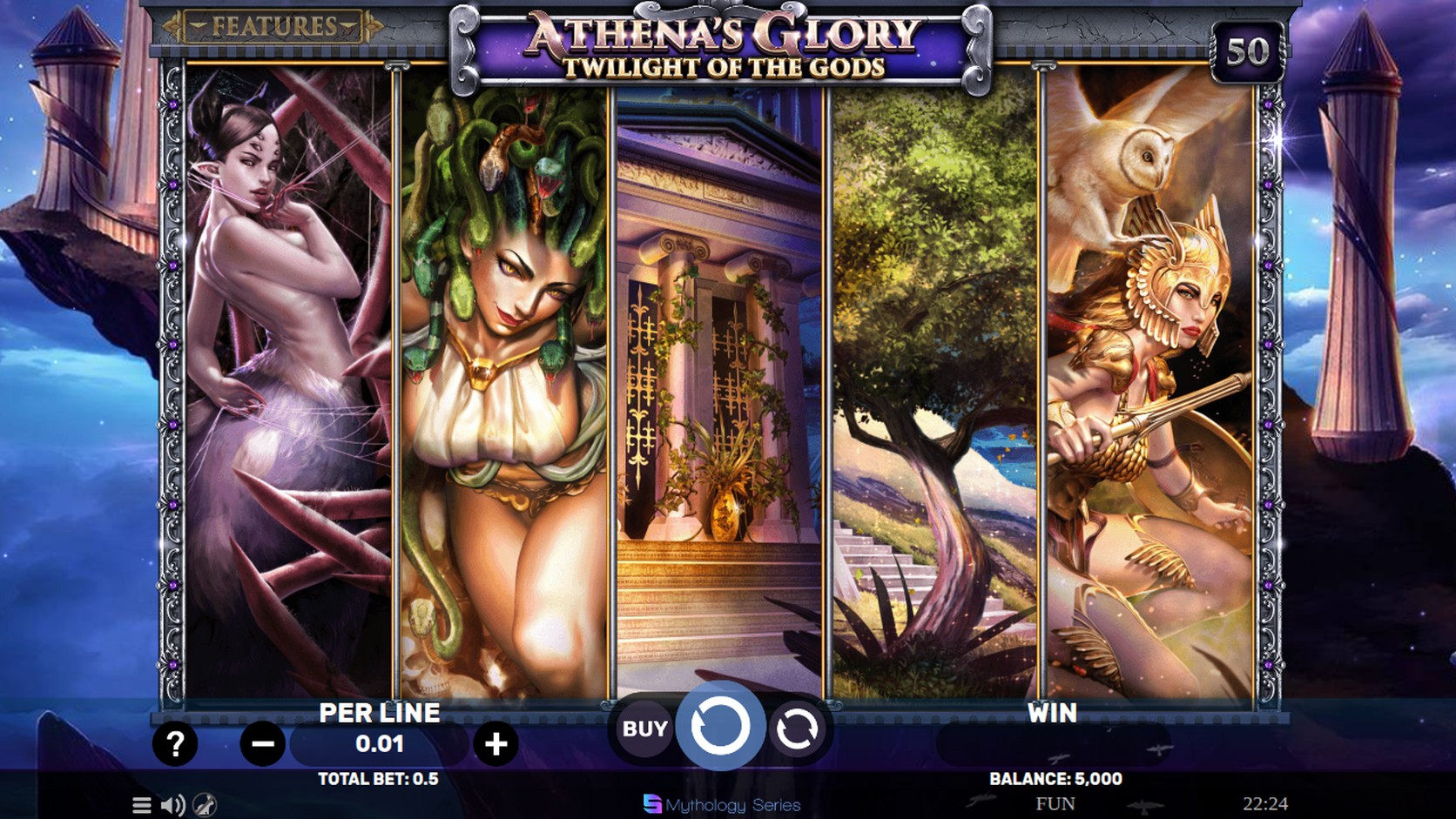
The base screen uses five reels and three rows, framed by pale stone, gold trim, clouds, and a deep blue sky. Athena stands at the left edge while the title occupies the upper-right corner. The central grid stays clear because the frame does not cover any reel position. Mythic character portraits sit above decorated card ranks in the visual hierarchy, while the owl, Wild, and Free Spins orb are easy to separate from ordinary symbols.

The landscape layout gave every control enough room at 1280 by 720. The per-line stake appeared at the lower left, the total stake sat beside it, and the central spin button remained apart from autoplay and turbo. The balance and win fields were readable without opening another panel. Gold is used heavily, yet the important numbers stay pale against dark plates. I never had to guess which value was the line unit and which was the full debit.

The theme feels formal and restrained. Character portraits hold still for most ordinary outcomes, then the feature screens add larger movement and brighter flashes. That restraint helps because the later chapters already alter reel positions, Wild placement, or entire columns. A busier base frame would make those changes harder to read.

Fifty Lines Turn 0.01 Into 0.50

My selected line stake was 0.01. The total shown beside it was 0.50 because all 50 fixed lines were active. This is the first calculation worth making before a spin. The smallest-looking number on the control strip is not the full round cost. Multiply the line unit by fifty to reach the amount removed when the reels start.

That relationship also governs line awards. A paytable value expressed against the line stake does not use the full 0.50 as its starting unit. The help pages list 150 times the per-line stake for five Wilds on one qualifying line. At 0.01 per line, that specific line award would be 1.50 before other eligible lines or a base-game multiplier are added. Seeing many Wild faces across the full board still does not justify multiplying 150 by the total stake.

The fixed-line model makes stake changes larger than they first appear. Moving the line unit from 0.01 to 0.02 would move the complete debit from 0.50 to 1.00. No extra line appears; the same fifty paths simply carry twice the value. I kept the display at 0.01 per line because it made every later purchase and result easy to translate back into base bets.

Fixed Paths Matter More Than Symbol Count

A crowded board can look strong and still settle modestly because Athena's Glory reads predefined routes. Adjacent clusters are irrelevant. A qualifying line begins from the left and follows one of the fifty patterns across neighbouring reels. If several lines win, their awards are added. If more than one combination could be read on the same line, only the highest one on that path counts.

This became important whenever a chapter placed Wilds across several rows. Six visible Wild tiles do not create a universal six-symbol award. Each tile must sit on a route that also contains the needed matching symbols. A full Wild reel has broad influence because many fixed paths pass through it, but later reels still decide how far each line extends. The board may look almost full while the useful identities split across incompatible paths.

The line model also explains why the Moving Reels chapter can turn a modest layout into a much larger sequence. Shifting every column to the right preserves part of the old board while changing the left edge. Existing matches may gain a better starting symbol, lose their route, or form new combinations after the replacement reel enters. The visual motion is simple. Its consequence is a fresh evaluation of all fifty paths without another paid base spin.

The Symbol Ladder Keeps the Grid Legible

Ordinary symbols divide into character portraits and decorated card ranks. Their exact line values remain inside the paytable, but the relative visual order is clear: large mythic faces carry more screen weight than the smaller letter and number tiles. This lets the eye find a promising path quickly, even when several gold frames meet across adjacent reels.

The lower symbols use different colours and strong outlines, so two similar ranks do not merge during turbo play. Character art is more detailed, but each portrait has a separate background tone and silhouette. I could follow a matching run through reels one, two and three without pausing the animation. That matters in a fifty-line slot because the winning-line display may cycle through several paths after one result.

Functional symbols are more direct. The Wild carries a clear label. The Free Spins orb is round and pale against the rectangular symbol field. The owl appears outside the ordinary ladder as a base-round multiplier event. It needs no left-to-right match. None of those elements relies on tiny explanatory text while the reels are moving. The paytable is still needed for exact values, but the grid states themselves remain understandable.

The Wild Has One Important Exclusion

A Wild replaces an ordinary paying symbol when needed. The Free Spins orb never takes part in Wild substitution. Line completion and Journey entry stay separate. If two orbs land with a Wild beside them, the Wild does not become the third trigger. Three real orb symbols are still needed.

The exclusion was easy to remember because the orb has a completely different shape and role. Wilds live inside ordinary line arithmetic; orbs are scattered entry symbols. A Wild can bridge character portraits or card ranks along one of the fifty paths, and several Wilds may support several paths at the same time. The highest qualifying result on each line is then used before separate line wins are added.

This distinction carries into every Journey chapter. Moving Wild slides one stacked substitute across the grid. Expanding Wilds turns a landed Wild into a full column. Extra Wilds injects several of them while limiting the remaining symbol pool. Those changes improve coverage, not the orb count. A screen filled with substitutes cannot retrigger the Journey unless the actual rules also place enough qualifying Free Spins symbols. Keeping that separation in mind stopped the feature screens from looking more powerful than their settled totals.

The Owl Multiplier Belongs to Base Play

The owl may appear while an ordinary paid round is spinning. When it activates beside a winning base result, the settled amount is multiplied by 2x or 3x. It is not a permanent meter, and it does not follow the Journey chapters into their free spins. It serves as a short intervention beside the Journey.

I liked the separation. The base game has one reason to watch beyond the orb count, while each later chapter keeps its own Wild rule clean. If the owl were active inside Moving Reels, a long respin chain could mix two different sources of growth and make the result much harder to read. Instead, the chapter totals come from their stated reel or Wild behaviour.

The multiplier also works on a completed round win, not on the stake or on an isolated symbol. A 2x mark beside a blank grid has nothing to multiply. A 3x event after several line awards uses the summed qualifying win as its practical base. I did not see enough ordinary paid play to attach any frequency judgment to the owl. Its role is still clear from the screen. The owl adds a brief 2x or 3x turn to base play and then leaves the four-part Journey to its own rules.

Three Orbs Begin a Four-Part Journey

A scattered set of at least three Free Spins orbs opens the Journey. The line paths do not matter for this entry; the symbols may land in different rows because their trigger is scattered. The line stake stays the same as the paid round that opened the chapter, so changing the wager before the trigger changes the value of every later free-spin settlement.

The unusual part is what happens after the first entry. Athena's Glory does not use one repeating bonus package. Each new Journey visit advances to the next chapter in a fixed sequence: Moving Reels, Moving Wild, Expanding Wilds, then Extra Wilds. After the fourth stage, the cycle returns to the beginning. That structure gives repeated visits a sense of progression even though every spin remains random.

I entered the four stages through the Buy Feature panel, which let me see the full cycle without waiting for four natural orb landings. The panel named the next chapter and showed its starting spin count before confirmation. The selected line and total stakes remained visible behind the purchase decision. This made the cost and the next reel rule clear before any animation began.

The Journey Advances in a Fixed Order

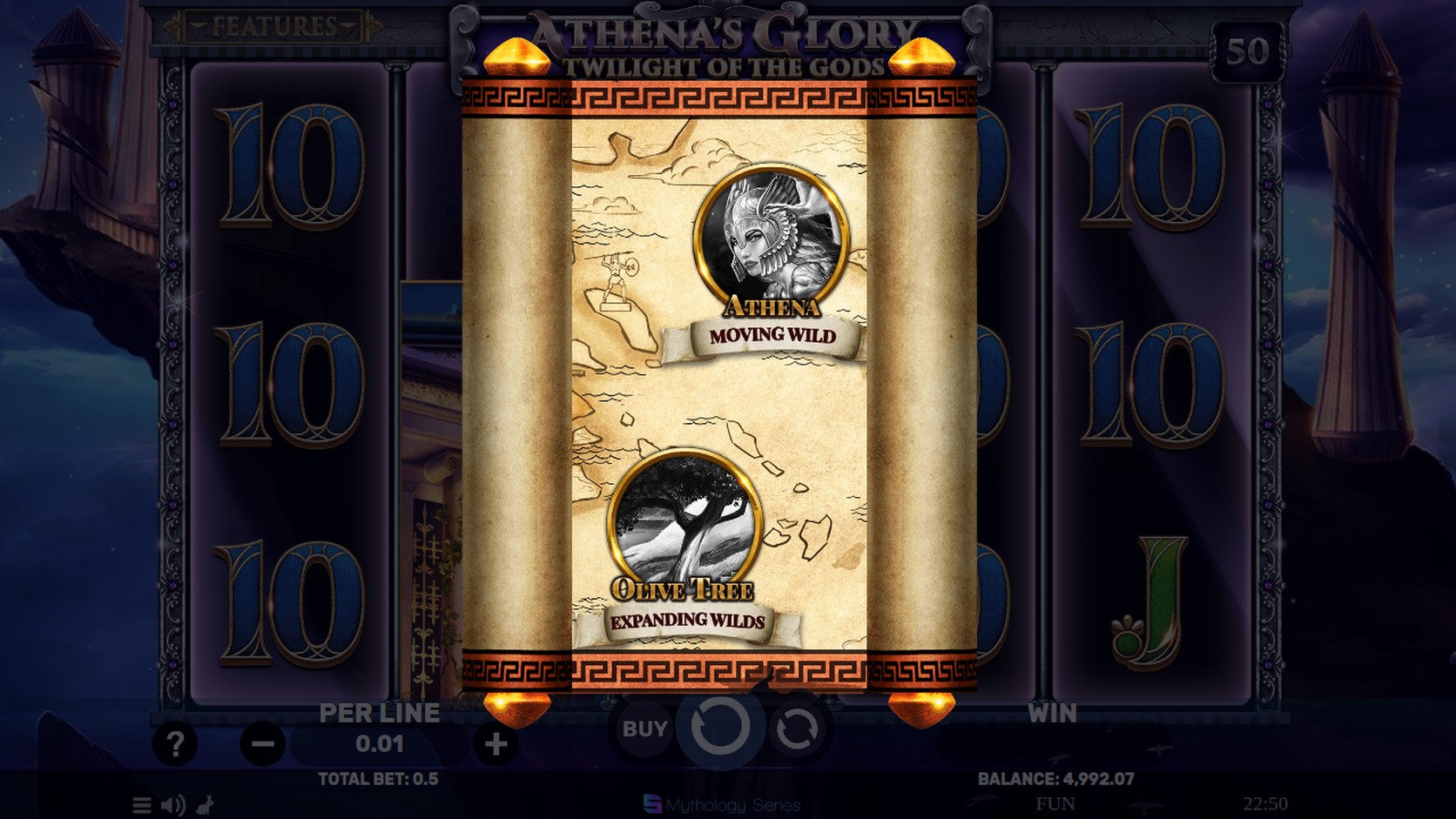
The map between chapters is one of the most useful screens in the client. It draws a route through four illustrated stops and marks the next destination. After Moving Reels, the path points toward Athena Moving Wild. The next handoff leads to the Olive Tree Expanding Wilds stage, followed by Extra Wilds before the route loops back.

This order matters because the next trigger is not a free choice. Someone who prefers Expanding Wilds cannot select it every time a natural Journey entry appears. Earlier chapters must be passed in sequence. The purchase panel followed that same order in my play, so each 21.00 entry moved the marker forward. No four-button menu appeared.

The fixed progression also changes how results feel. A weak Expanding Wilds round does not mean the next trigger repeats the same setup; it moves to Extra Wilds, where three to six substitutes may enter during a spin. A strong Moving Reels chain is followed by a five-spin Moving Wild chapter instead of another right-shifting board. The game keeps variety by changing rules, not by asking the player to rank four unknown probability models. I found that more interesting than a picker because every stage had to be understood on its own terms.

Buying a Chapter Cost Forty-Two Base Bets

At 0.01 per line and 0.50 total, every purchase panel showed 21.00. Divide 21.00 by the 0.50 base debit and the entry equals 42 ordinary bets. The same price appeared before Moving Reels, Moving Wild, Expanding Wilds, and Extra Wilds, even though their starting counters and mechanics differed.

That repeated forty-two-bet cost gave me a clean comparison point. Moving Reels needed more than 21.00 to finish ahead of its doorway, not merely more than the 0.50 base stake. Its 34.07 total cleared that mark. Moving Wild also cleared it at 27.38. Expanding Wilds returned only 0.28, while Extra Wilds reached 18.54 and remained 2.46 short of its purchase.

The button changes time, not the underlying uncertainty. It skips the wait for three orbs and concentrates forty-two base debits into one confirmation. A short feature can still return a fraction of one base bet, as my Expanding Wilds result showed. I treated 21.00 as the real comparison line on every summary screen. Celebratory animation above a smaller amount could not turn it into a profitable purchase.

Moving Reels Changes the Board After a Win

Moving Reels starts with ten free spins. After any win, the result is paid and a free respin begins. The full grid moves one reel to the right. The old far-right reel leaves as a new column enters from the far left. The feature then checks the new arrangement across all fifty fixed lines.

The rightward direction is more important than it sounds. Ordinary line wins need useful starting positions near the left edge. A new far-left reel can introduce the symbol that an existing middle group needs, while the shifted symbols preserve much of the board. A promising match on reels two through four may become a full left-to-right path after the incoming column arrives. The same motion can also break a previous pattern by pushing a needed late symbol off the grid.

Because a respin costs no additional base stake, a winning screen may buy itself another chance to extend the chain. The original ten-spin counter and the number of visible board changes are therefore different quantities. My strongest run grew through those extra shifts. I was not watching only for a high portrait or Wild. I was watching the left edge, because every incoming reel could decide if the preserved middle positions remained useful.

A Respin Can Push the Chain Forward Again

A respin is allowed to win and create another respin. That rule turns one settled connection into a possible sequence instead of a single replay. The reels keep moving right one column at a time, so each link carries some symbols forward and discards others. A chain ends when the new board has no qualifying line win.

The most instructive stretch in my round began with 5.36 in the win field. Repeated shifts lifted the displayed amount to 20.70 while six free spins were still shown. The counter had not been consumed by every movement because the paid chapter spin and its free respins were being treated separately. That gave the feature more visible boards than the starting ten alone would suggest.

There is no skill choice inside the chain. I could not hold a reel, swap a symbol, or choose the incoming column. My role was to read the result and understand why it persisted. The mechanic builds suspense through preservation. Much of the prior grid stays in view. A near match can remain alive for the next shift. Yet each new left reel is random, and a good-looking middle group can disappear after a blank connection just as quickly as it formed.

Moving Reels Closed at 34.07

The first 21.00 purchase finished at 34.07, equal to 68.14 base bets at the selected 0.50 total stake. Subtracting the entry leaves 13.07 above cost for that chapter. The final number was built across the starting spins and free respins, not paid as one isolated line result.

This was the strongest gross total among my four Journey stages. It was also the clearest example of a rule doing more than changing artwork. The shift altered which columns could start a line. It preserved useful middle symbols. Each winning board earned another evaluation. I could see the mechanism creating the path from a smaller accumulated amount to 20.70 and then to the final 34.07.

One successful chapter does not make Moving Reels the best long-run stage. A chain needs repeated winning layouts, and the game does not reveal how often those sequences reach two, three, or more respins. What I can say is narrower: this particular ten-spin package lasted beyond ten visible reel actions and returned more than its forty-two-bet purchase. It gave the Journey a strong opening and set a standard that the next three chapters met in very different ways.

Moving Wild Turns Five Spins Into a March

Moving Wild begins with only five spins, the smallest starting count in the Journey. A stacked Wild appears at the far-left reel and advances one column to the right after each spin. The stack route is known in advance. Its neighbouring symbols remain random. The first spin places maximum substitution coverage at the point where fixed-line wins must begin; later spins move that support toward the middle and far side.

Five rounds felt compact after the extended Moving Reels chain. There was less time for the feature to find its shape, but the marching stack gave every board a clear focal point. On reel one, it could start many paths. On reel two or three, it could bridge a matching symbol from the left into a group farther right. Near the final columns, it needed useful early symbols already in place because fixed lines do not begin from the right.

That movement creates a natural rise and fall in practical influence. Early placement is broad, middle placement is connective, and late placement is more dependent on what the first reels already hold. The stack itself does not grow, and it does not stay where it landed. I found the feature easiest to read by following its column. Scanning all fifteen cells at once added little.

The Stack Starts Where Line Wins Need It

Beginning on the far left gives the moving stack immediate value under a left-to-right pay system. Every qualifying route begins there, so a full stack of substitutes can support the first symbol identity on many paths. A portrait or card rank on reel two may use the Wild as its missing first reel, then seek matching tiles across reels three, four, and five.

Once the stack reaches reel three, its job changes. It can connect a real match across reels one and two to another symbol on reel four. That middle position often looks less dramatic than a full Wild first reel, yet it may bridge more specific near-wins. On reel five, the stack cannot rescue a blank start. It can only extend combinations that already run through the first four columns.

This directional logic kept the five-spin chapter from feeling like five copies of the same Wild screen. Each step changed which part of the line was easiest to complete. The motion was completely visible, so there was no need to infer where the substitute would appear next. Randomness sat in the ordinary symbols around it. That balance between a known Wild path and unknown supporting reels gave this stage a calmer rhythm than Moving Reels, even though the counter was shorter.

The Five-Spin March Reached 27.38

The Moving Wild purchase cost the same 21.00 and settled at 27.38. At a 0.50 base stake, that is 54.76 base bets in gross return and 6.38 above the doorway. It ranked second among the four totals I saw, behind Moving Reels and ahead of Extra Wilds and Expanding Wilds.

The five-spin length made the result feel concentrated. There were fewer starting boards, and every one had a known full-stack position. I could anticipate the substitute moving right, but I could not predict which portrait or card rank would surround it. Those random matches created the settled total. The motion alone did not.

I preferred the readability of this chapter. The moving element was always obvious, the spin count was short, and the fixed-line consequence changed from start support to middle bridge to late extension. Its 27.38 result was good enough to clear the purchase in this round, yet the number does not prove that five spins carry more value than ten. It only shows that one marching stack found enough compatible paths to finish 6.38 ahead of its entry.

Expanding Wilds Makes One Symbol Occupy a Reel

Expanding Wilds starts with ten free spins. Whenever a Wild lands, it stretches across all three visible positions of that reel. One symbol becomes a complete column of substitutes, giving every fixed path that crosses the reel a Wild at its row. The expansion changes vertical coverage. Lines still have to progress from reel one toward reel five.

A full reel looks powerful because all three rows light up at once. Its actual value still depends on the column and the matching symbols around it. An expanded reel one can start many identities. An expanded reel two can support three rows after a real start. A far-right expansion needs a valid chain to reach it. Two expanded reels can cover a much larger section of the route map, but even that state needs compatible symbols on the remaining columns.

The animation makes the transformation clear: a normal Wild appears, then occupies the whole reel before the win is read. Unlike Moving Wild, it does not march through a predetermined set of columns on later spins. Unlike Moving Reels, it does not preserve most of the prior board after a win. Each free spin begins a fresh search for a Wild, and each landed position determines how much of that board it can support.

Ten Spins Can Still End With Almost Nothing

The starting counter can create a false sense of security. Expanding Wilds begins with ten spins, twice the count of Moving Wild, yet spin quantity does not guarantee useful expansion positions or matching neighbours. A full Wild column may appear beside symbols that split into different identities across the line paths. Some boards may not expand a Wild at all.

This chapter exposed the difference between visible power and settled value. A three-cell Wild reel dominates the screen, but its vertical reach cannot repair every horizontal gap. If a line begins with one portrait and the later reels carry another, the substitute covers only its own column. The remaining identities still have to agree.

The ten-spin package also carried the same 21.00 entry as the five-spin Moving Wild stage. More starting rounds did not reduce the purchase price per chapter or place a floor under the return. I watched each expansion resolve cleanly, but the summary never built into a meaningful recovery of the cost. It was the sharpest reminder in the four-stage cycle that a named bonus mechanic is still a random wager outcome, not a promise attached to the number of spins.

A 0.28 Finish Stripped Away the Spectacle

The Expanding Wilds summary stopped at 0.28. Against the 21.00 purchase, that left a 20.72 shortfall. The gross result equalled only 0.56 of one base bet at my 0.50 setting. It was smaller than the cost of a single ordinary paid spin even though the chapter began with ten free spins.

That number looked almost absurd beside the full-reel animation, which is exactly why it belongs in the review. Slot presentation can make a mechanic feel substantial before the line paths settle. Expansion creates coverage; it cannot create compatible symbols on the other reels by itself. In this round, the available coverage found very little value.

I would not call the chapter broken on the strength of one poor result, just as I would not crown Moving Reels after one 34.07 finish. The contrast is useful at a practical level. Two Journey stages started with ten spins and carried the same 42-bet purchase. One produced a chain of free respins and finished 13.07 above cost. The other ended 20.72 below cost. The named mechanic changes the route to a win, while random reel contents still decide how much that route is worth.

Extra Wilds Changes the Symbol Pool

Extra Wilds is the fourth Journey stage and starts with ten spins. While each board is forming, three to six Wilds may appear. The remaining positions use only the lower symbol group, removing the character portraits from that chapter's ordinary reel pool. The result is a busier field of substitutes paired with less valuable natural symbols.

This trade is easy to miss if attention stays on Wild count alone. Three to six substitutes create many possible bridges across fifty lines, but the matching symbols around them come from the lower tier. A dense Wild board may therefore create numerous modest paths instead of one large premium-symbol line. More coverage and lower natural values work in opposite directions.

The Wilds arrive across changing positions. They do not move as one stack or expand from a single landed tile. Each spin has its own pattern. That made Extra Wilds the least predictable visual chapter in the cycle. I scanned the early reels first, then checked which low rank could use the scattered substitutes across adjacent columns. The chapter looked crowded from the start, yet the displayed win rose in small pieces. No single screen towered above the rest.

Three to Six Wilds Create Busy Starts

The lower end of the rule already places three Wilds onto a fifteen-cell grid. At the upper end, six cells can become substitutes, covering two fifths of the visible positions. Placement matters as much as quantity. Wilds on reels one through three can establish or bridge many paths; a cluster on the final two reels needs real matching starts to the left.

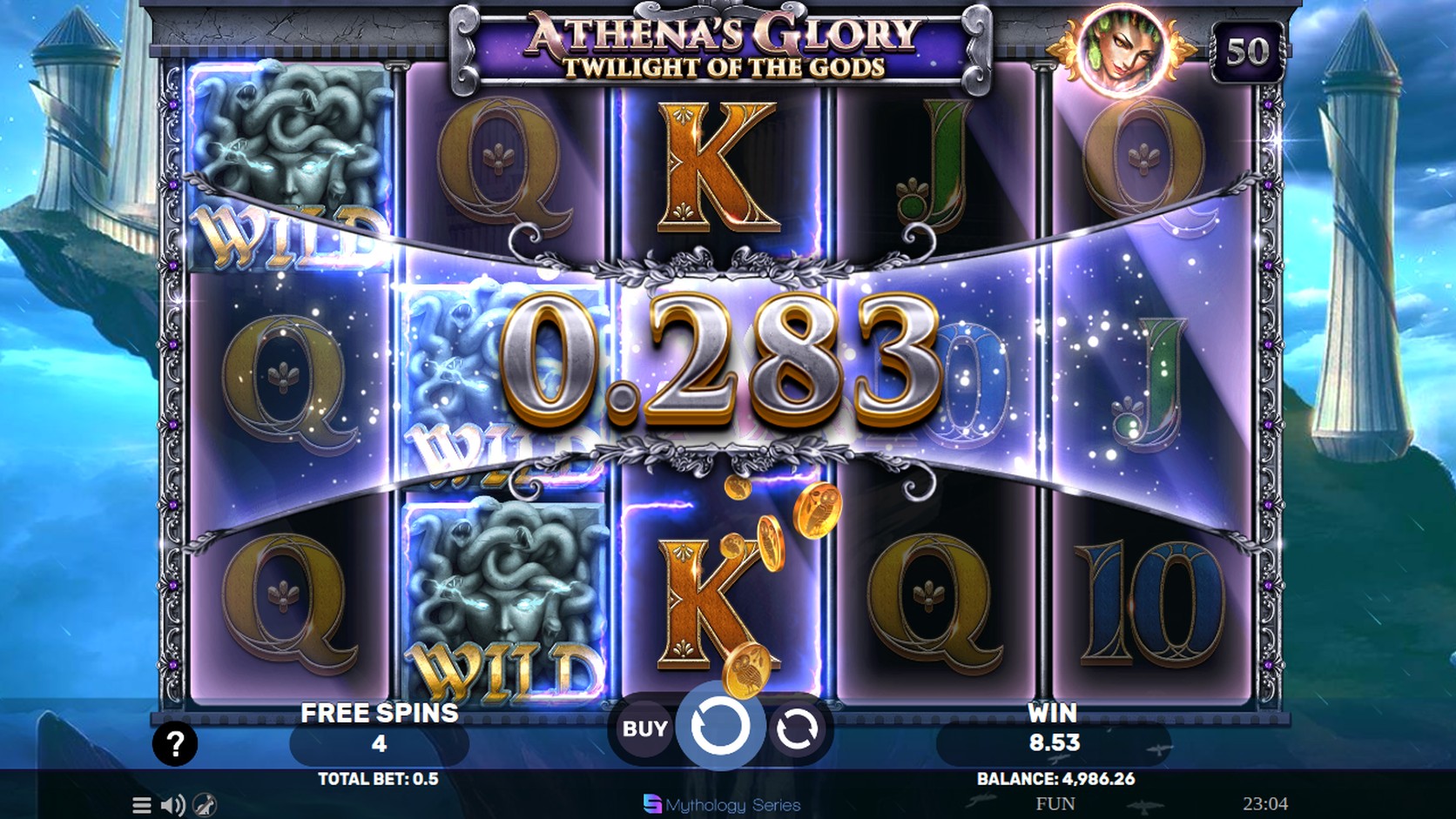
One late frame showed four spins remaining and 8.53 in the win field. Several Wilds were spread across the board among the lower ranks. The screen looked richer than the number because many potential paths shared the same substitutes, and only valid left-to-right matches paid. That state later grew to 18.54 by the end of the chapter.

I enjoyed reading these boards more than I expected. The smaller symbol pool made matching ranks easier to trace, while the Wild distribution changed on every spin. Yet the apparent density never erased the purchase line. At 18.54, the completed stage still fell 2.46 short of its 21.00 entry. A board may be busy, coherent, and enjoyable to follow without finishing ahead.

The Last Chapter Recovered 18.54

The fourth purchase returned 18.54, equal to 37.08 base bets at the 0.50 setting. It recovered most of the 42-bet entry but remained below it. The 8.53 state with four spins left shows that more than half of the final total arrived in the closing part of the feature.

That timing gave Extra Wilds a different shape from the other stages. Moving Reels built its most memorable increase through a visible respin chain. Moving Wild carried one known stack across five columns. Expanding Wilds never recovered from weak line connections. Extra Wilds accumulated value across changing Wild patterns and a reduced symbol pool, with no single board defining the whole total.

The result also shows why the lower-symbol restriction matters. Six Wilds may cover a large part of the grid, but their partners are modest ranks. Frequent-looking connections need not produce a large amount. I finished the fourth stage close to its cost, not far above it. The ending fit the cycle. The fifty-line map stayed busy, yet the final total still needed comparison with the 21.00 confirmation. The 0.50 base spin was the wrong yardstick.

Four Purchases Tell Four Different Stories

Across the complete Journey cycle, I spent 84.00 on four entries and received 80.27 back. The combined result was 3.73 below the total purchase cost. Moving Reels returned 34.07, Moving Wild 27.38, Expanding Wilds 0.28, and Extra Wilds 18.54. Two stages finished ahead of their individual price and two finished behind.

The ordering of those four numbers should not become a route ranking. Each stage was played once, and each uses a different reel rule. A second trip around the cycle could reverse every position. The useful comparison concerns texture. Moving Reels may extend a winning state through rightward respins. Moving Wild gives five boards a predictable travelling stack. Expanding Wilds turns a landed substitute into full-reel coverage. Extra Wilds injects several substitutes while restricting ordinary symbols to the lower group.

I judge the stages by visibility, not the largest total. Moving Reels made cause and effect easiest to follow because every win led to a new shifted board. Moving Wild was the cleanest short chapter. Extra Wilds kept me reading changing patterns. Expanding Wilds had the strongest single-symbol animation and the weakest result. The cycle worked because the four stages did not feel interchangeable.

The 450x Ceiling Is a Boundary, Not a Target

The listed maximum is 450 times the total stake. At my 0.50 setting, that corresponds to 225.00 before any operator-level limit is considered. None of my chapter totals came close. Moving Reels, the largest at 34.07, equalled 68.14 base bets, a little over fifteen percent of the 450x ceiling.

Maximum figures are useful for understanding scale, but they say nothing about frequency. A 450x cap does not mean a chapter is building toward that amount, and the four-stage cycle does not grant four separate chances that can simply be added into a 1,800x expectation. Each round settles under the game's own limit.

The help screen's five-Wild line value must also stay separate from the maximum. Five Wilds on one qualifying path are listed at 150 times the per-line stake. That is line arithmetic. The 450x figure uses the total-bet basis for the game ceiling. Mixing the two units can make a normal fixed-line award look fifty times larger than it is. I kept every observed result in total-stake multiples because that made the 42x purchase and 450x boundary directly comparable.

The Return Menu Spans 7.40 Percentage Points

Four return configurations exist for Athena's Glory - Twilight of the Gods: 88.89 percent, 91.59 percent, 93.47 percent, and 96.29 percent. The gap from the lowest to the highest is 7.40 percentage points, far too large to treat as a minor label difference. Two lobbies can show the same art and Journey, yet their theoretical return models may be far apart.

The percentage attached to the installed version matters more than my four totals. Return to player describes theoretical performance across a huge number of rounds under one configuration. It cannot explain why Moving Reels paid 34.07 this time or why Expanding Wilds stopped at 0.28. Those outcomes sit inside short-run variation.

For a Philippine reader, the practical check is simple: open the live help or information panel and find the actual return figure before comparing the game with any review. Do not assume the top 96.29 percent version from the title alone. If the number is missing or differs from the one expected, judge that loaded build on its own terms. The Journey mechanics may look identical while the mathematical starting point is not.

Medium Volatility Still Produced Uneven Results

The listed volatility is medium, but my four feature totals were anything but evenly spaced. One ten-spin chapter returned 34.07, the five-spin chapter returned 27.38, another ten-spin chapter returned 0.28, and the final ten-spin chapter returned 18.54. The label describes a broad distribution tendency, not a promise that every purchase will land near its cost.

Feature buying made the unevenness more obvious because each confirmation placed 42 base bets into one chapter. A small result therefore created a large immediate gap. The 0.28 Expanding Wilds finish erased most of one 21.00 entry, while Moving Reels recovered its own cost and added 13.07. Combining all four stages still left a modest 3.73 loss, but that tidy final difference hides the sharp swings inside the cycle.

This is where the medium label needs plain reading. It does not mean safe, steady, or low risk. It also does not guarantee the severe droughts commonly associated with a higher category. My play showed that the chapter structure can concentrate cost and result even under a middle rating. The chosen stake and the 42x purchase price determined how large those changes felt in the balance.

Turbo and Autoplay Change How Fast Cost Builds

Turbo shortened the reel animation, and autoplay could repeat ordinary spins without a fresh press each time. The same fifty fixed paths and stake figures remained in place under both controls. Only the time between one decision and the next result changed.

At 0.50 per ordinary spin, ten automatic rounds represent 5.00 in gross debits before wins are added. Turbo compresses the time needed to reach that amount. The Journey purchase is even more concentrated: one confirmation moves 21.00 at the same stake. A faster animation does not reduce that 42-bet multiple.

I used normal speed when learning a chapter and turbo only after the symbols and counters were familiar. Moving Reels in particular benefits from the slower view because the rightward shift explains why the same paid turn remains active. Extra Wilds is also easier to read when the three-to-six-symbol injection is visible before settlement. Speed becomes useful after comprehension, not before it. The stop control and win field remain more valuable than the extra seconds saved if the purpose is to track what each round actually cost.

My Philippine Player Verdict Follows the Journey

Progression gives Athena's Glory - Twilight of the Gods its identity. The base game is a conventional five-by-three, fifty-line slot with a 2x or 3x owl event. Three orbs then begin a four-stage route where the grid behaves differently each time. Rightward reel shifts, a marching stack, full-reel expansion, and several injected Wilds are distinct enough that reaching the next stop feels meaningful.

For an English-reading Filipino player, the controls and help text are direct, and the wide desktop layout keeps stake, win, balance, and spin count in view. On a smaller device, I would favour landscape because the fifty-line grid and side artwork need horizontal room. The more important local question is the installed return setting. A lobby running 88.89 percent is not equivalent to one running 96.29 percent, even when every symbol looks the same.

My favourite chapter was Moving Reels because the 34.07 result grew through a mechanic I could follow from one board to the next. Moving Wild was the cleanest short chapter. Extra Wilds looked busiest but finished below cost, and Expanding Wilds proved that a full Wild reel can still lead to almost nothing. Across four 21.00 purchases, the cycle ended 3.73 down. That is a small combined difference built from very uneven stages. I would return for the changing reel logic. My stake choice would begin with the full fifty-line cost. Every Journey purchase deserves to be read as forty-two base bets; the 450x ceiling is no shortcut.

By Fairy Editorial - 01 Sep 2026
Majestic Bison Review: The 39x Demo Door Behind Its Double Symbols
Majestic Bison
Majestic Bison Review: The 39x Demo Door Behind Its Double Symbols

The 39x Door Returned 15.6x

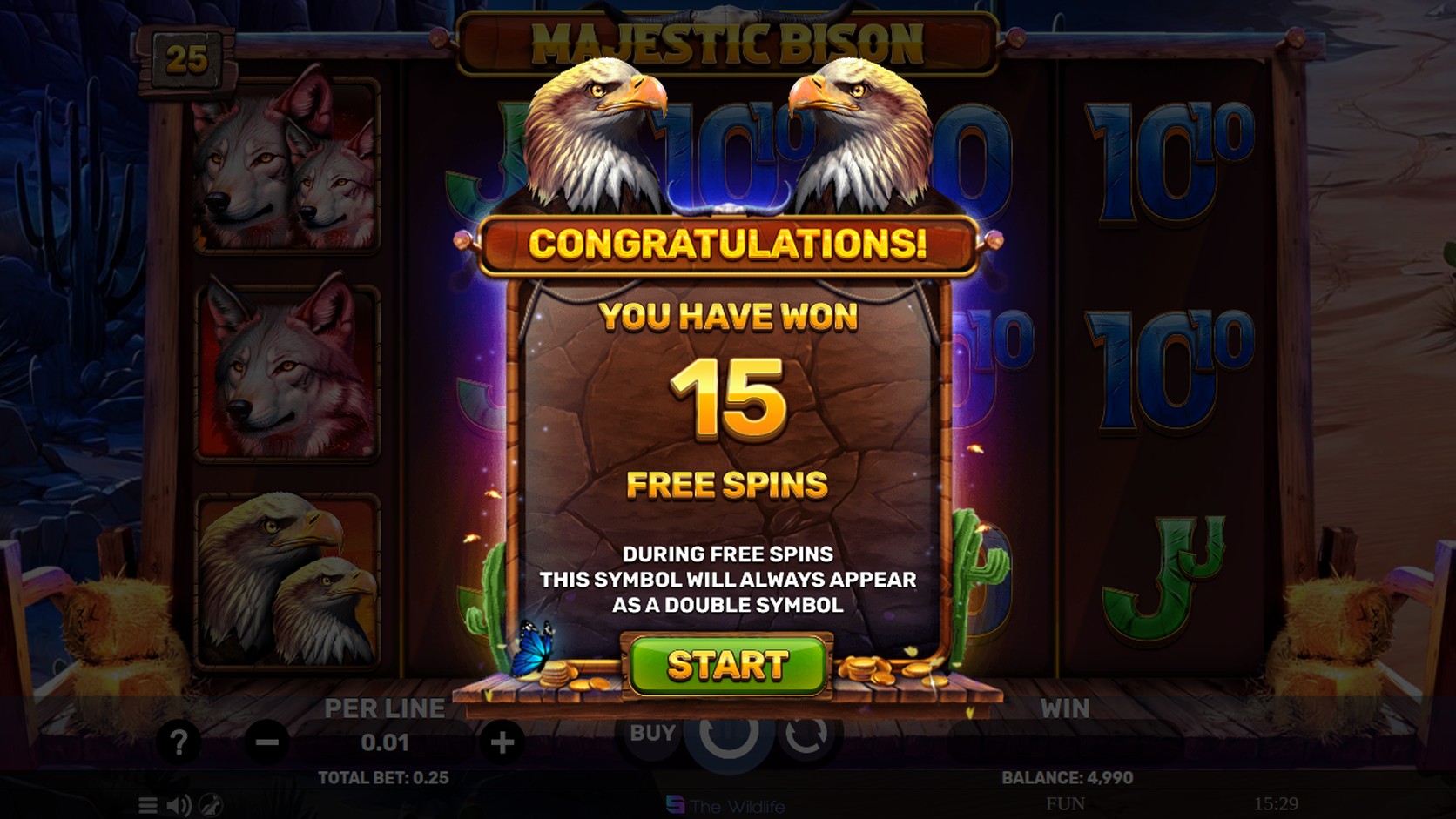
The buy panel put 9.75 beside a 0.25 total stake. I confirmed it in fun mode, watched the wheel stop at fifteen free spins, and finished the round at 3.90. In base-bet terms, the entry cost was 39x and the return was 15.6x, leaving this single purchased round 5.85 below its price. That is the cleanest place to begin because the feature animation made the result feel larger than the arithmetic.

The round was still useful. It selected the eagle as the medium animal that would remain double, then produced a Stacked Wilds intervention while twelve spins remained. Both mechanics were visible. No inference was needed. Neither placed a floor beneath the result. Fifteen spins, a persistent double identity, and a screen full of tall Wilds eventually settled at less than half the buy cost.

This is one fun-money result, not a forecast. It cannot predict future feature returns or trigger frequency. It does show the decision Majestic Bison asks a player to make: pay for immediate access, or let the two bonus routes arrive through ordinary random spins. The doorway changes timing. It does not remove uncertainty.

A Double Tile Changes the Count Without Changing the Grid

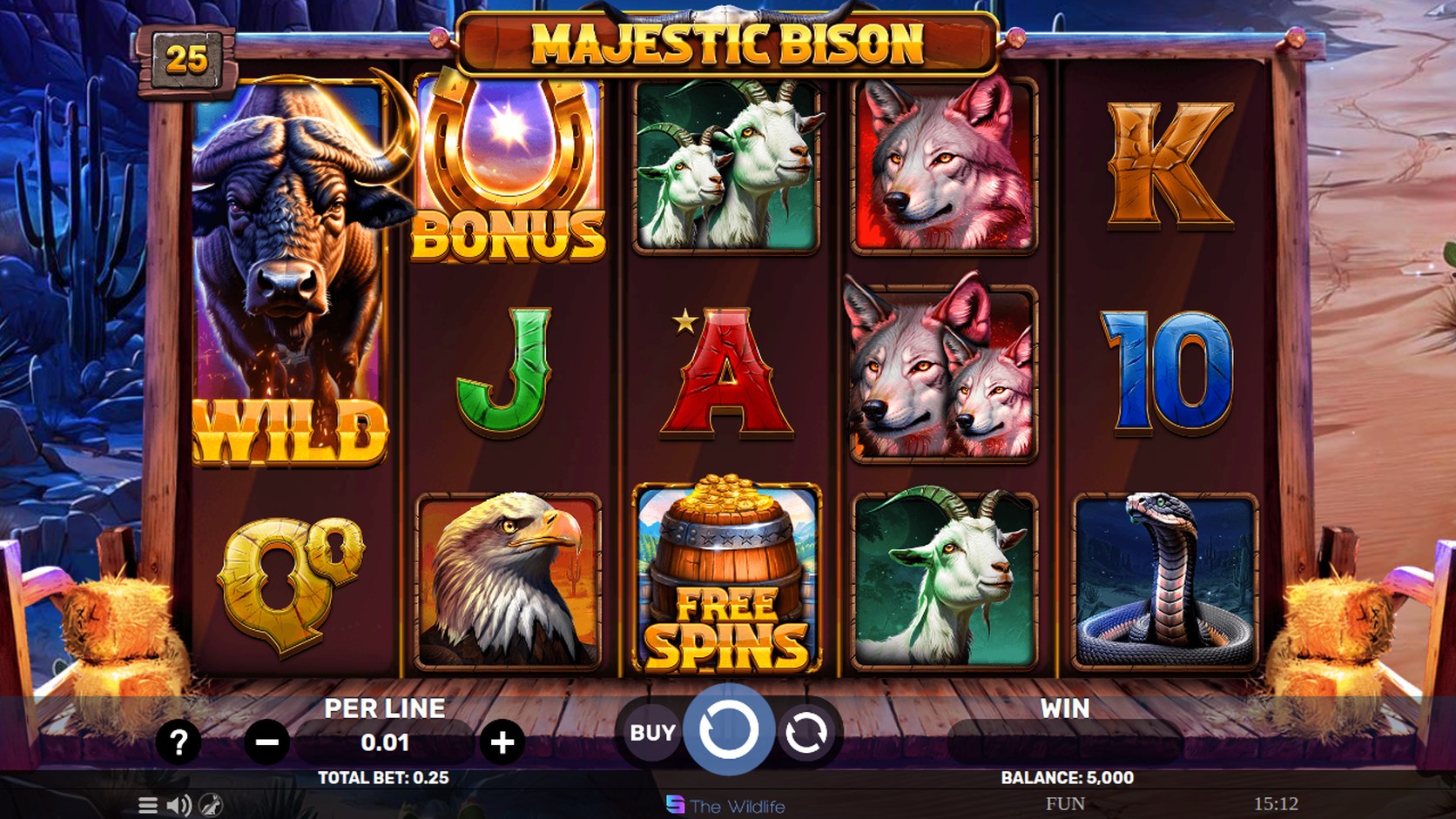
The Majestic Bison cabinet is five reels wide and three rows high, but some tiles display two copies of the same symbol. Each such tile counts as two single symbols when the game measures a line combination. A pair of wolves inside one cell is therefore more than artwork. It increases the symbol count attached to that exact position on a qualifying fixed line.

The grid does not become six reels when a double appears. Nor does the pair create two separate routes through the same cell. The line still crosses one position on each reel. What changes is the count used to read the matching run. A five-reel connection may be valued as six, seven, eight, nine, or ten matching symbols when enough occupied positions carry pairs.

That distinction is the whole design. Many slots expand a reel, add rows, or create more ways. Majestic Bison keeps the cabinet stable and changes what one occupied cell means. The effect stays legible because the paired animal is drawn inside a single frame. Once that rule is understood, the paytable's longer symbol counts stop looking impossible. The screen remains five columns wide; the line result can carry more than five matching units.

The Screen Keeps the Full Debit Visible

The tested control strip showed 0.01 per line and 0.25 as the total bet. The number 25 also remained visible on the cabinet, matching the fixed-line count. This presentation matters because a small line unit can be mistaken for the full cost if the lower bar is read too quickly. One normal spin removed 0.25 from the fun balance, not 0.01.

That same distinction follows every line award. A value stated against bet per line starts from 0.01 in my session. A total-stake multiple starts from 0.25. Mixing the units can enlarge a line payout by a factor of twenty-five on paper, even though the settled balance never makes that mistake.

The Buy button sat beside the central spin control, while balance and win had separate fields. I could compare the 9.75 confirmation against the 0.25 base debit before accepting. No conversion was hidden inside a second screen. For a player learning the cabinet, the essential arithmetic is visible in one row: line stake multiplied by twenty-five equals the amount at risk on an ordinary turn.

Twenty-Five Fixed Lines Govern Every Base Win

Every paid round evaluates the same twenty-five paths. There is no line selector and no changing ways count. A winning combination follows one predefined route through the five-column field, beginning on the far-left reel and moving one adjacent column at a time. Several routes may win on the same screen, and their separate awards are added after evaluation.

Under this framework, symbol location outranks a quick count across the whole board. Three wolves anywhere on screen do not automatically form a win. They must occupy consecutive reel positions on one active path. A double wolf can raise the count once that path exists, but it cannot connect two animals that sit on unrelated lines.

The fixed map also explains why a full stacked Wild reel has broad reach. Many paths cross each reel at different rows, so a three-cell substitute column can help several line shapes at once. Even then, useful matches still need to begin at reel one and progress without a missing column. Majestic Bison may look like a simple animal slot, yet reading the line path before reading the symbol quantity prevents most mistaken assumptions about a busy screen.

Reel One Must Start the Path

Wins are read from left to right, beginning at the first reel. A strong group on reels two, three, and four has no value as a standard line combination if reel one lacks the matching identity or a valid Wild. This directional rule gives early double symbols more practical reach than identical pairs appearing only at the far edge.

Suppose a double eagle occupies reel one and matching eagles cross reels two and three on one active path. The line already carries four eagle units across three occupied positions: two from the first cell, then one from each following cell. If reel four also holds a double eagle, the same path reaches six units. The line has not branched, and no extra payline has appeared. The count inside the connected route has grown.

Late positions work differently. A double on reel five may extend the value of an existing four-reel run, but it cannot rescue a broken start. This makes the feature-selected persistent double symbol easiest to judge by location as well as frequency. Seeing many paired eagles is not enough. Their value depends on early placement and compatible neighbours along one of the fixed paths.

One Line Keeps Only Its Highest Result

If one payline supports more than one possible reading, only the highest award on that path is retained. Separate winning lines still add together. The rule prevents the same route from being paid repeatedly for shorter and longer versions of one connected symbol run.

Double symbols make this boundary worth remembering. A line carrying several paired animals may qualify for a long count, but it does not also collect every shorter count nested inside that sequence. The final line evaluation uses the best eligible result. Another path crossing some of the same cells can still settle independently if it forms its own valid combination.

This is why the win field is more reliable than trying to total every visible animal pair by eye. One screen may contain several doubles, a Wild, and multiple apparent routes. The software first resolves the highest result per line, then adds the valid line awards. I found the line display useful at normal speed because it briefly traced the relevant path after settlement. Turbo reduces that reading time, which makes a crowded double-symbol result look less transparent even though the arithmetic is unchanged.

Ten Matching Symbols Fit Across Five Reels

The paytable extends matching counts beyond the physical reel total because every double tile contributes two. Five double tiles aligned on one qualifying path therefore represent ten matching symbols. Mixed lines land between the normal and maximum count: three doubles and two singles would read as eight units across five occupied cells.

This expanded count is not a multiplier applied after a normal five-symbol win. It is part of the paytable lookup itself. The game first identifies the connected symbol. It then totals the single and double units along that line before selecting the corresponding count. That matters when comparing a double animal to a Wild. A Wild may bridge the identity, but the help rules do not let it impersonate a double tile. It fills the ordinary symbol role needed by the path.

The result is a familiar fixed-line cabinet with an unfamiliar top end. A player does not need to memorise thousands of ways or follow a growing grid. The harder task is quieter: distinguish the five occupied positions from the number of matching units credited inside them. Once those quantities are kept separate, a ten-symbol paytable entry on five reels becomes internally consistent.

Double Symbols Do Not Become Extra Reels

The artwork can tempt the eye into treating paired animals as two adjacent cells. That reading causes three errors. It exaggerates the number of paths, suggests a pair can bridge a missing reel, and makes the paytable seem to count positions that do not exist. Each double remains one reel stop on one row.

Imagine a pair on reel two with no matching symbol on reel three. The two animals inside reel two do not jump across that gap. A standard left-to-right run ends because the next physical reel fails the identity test. Conversely, a pair on reel three can raise the count of a valid route arriving from reels one and two, even though both faces occupy the same frame.

The design is strongest when the player reads doubles as weighted cells. Ordinary animals have weight one; paired versions have weight two. Lines still determine adjacency. This mental model also helps during the free round, when one selected medium animal always appears in paired form. The selection raises that animal's weight whenever it lands, but it does not guarantee a useful route, an early position, or a matching neighbour.

Wilds Carry Three Important Exclusions

The bison Wild can stand in for ordinary single animals and card ranks when a fixed line needs that identity. Three categories sit outside that substitution rule: double symbols, the Free Spins barrel, and the horseshoe Bonus symbol. A Wild therefore cannot turn itself into two animals, complete a scattered barrel trigger, or complete a horseshoe entry.

Those exclusions keep the feature systems separate. Line substitution helps ordinary pay combinations. Double weighting changes the count within a valid line. Barrels lead to the wheel. Horseshoes lead to a three-spin collection game. One Wild face cannot perform all four jobs.

The distinction matters most on a screen containing two barrels and a bison. The bison may help an animal line crossing its cell, but the free-round count remains two. The same logic applies to horseshoes. A stacked bison column can affect many line routes without moving either bonus trigger closer. Majestic Bison uses a large, visually dominant Wild, yet its power is narrower than its size suggests. It is a line tool, not a universal replacement for every special symbol.

Five Wilds Use the Line Stake

Five bison Wilds aligned along a single active path pay 200 times the bet per line. At the tested 0.01 line unit, that specific line value would be 2.00 before any other winning paths are added. Multiplying 200 by the 0.25 total stake would produce 50.00, but that calculation uses the wrong unit.

The gap illustrates why the cabinet shows both numbers. Twenty-five lines transform the 0.01 unit into a 0.25 full debit, while a paytable entry tied to one line still starts from 0.01. A screen with several Wild-supported paths may add several line results, but each path is evaluated under the same per-line base.

This rule also limits what a stacked Wild visual means. A full column may place bison faces on three rows, yet a five-Wild award still requires one active route to cross Wilds on all five reels. A dramatic stack on reel three is only one physical column in that construction. The remaining four columns must also line up. The 200 figure is exact line arithmetic, not a general multiplier for any screen carrying five visible Wild tiles.

Only Double Symbols Rewrites the Whole Board

Only Double Symbols is a reel intervention that turns the visible symbol population into paired forms while the reels are resolving. Instead of selecting one animal identity for persistent double treatment, this event applies the double presentation across the board. Every occupied position still belongs to one reel and one row, but each eligible tile carries the two-unit logic.

The screen should be read from the line outward. First find a left-to-right route. Then check how many positions on that route are paired. A board full of doubles can still settle blank if the identities fail to connect through adjacent reels. The event increases the count available to compatible lines; it does not cancel the fixed map.

I did not knowingly catch this event across thirty-three base spins, so no result or frequency estimate belongs beside it. Its practical cadence remains unmeasured here. That boundary matters. A named feature may be fully explainable without pretending that a short session contained it. In Majestic Bison, Only Double Symbols is the broadest expression of the core counting rule, but its presence alone does not imply a win.

Stacked Wilds Intervene in a Different Way

Stacked Wilds changes vertical coverage and leaves symbol weight untouched. Tall bison substitutes can occupy many positions as the reels settle, supporting fixed paths that cross those rows. A paired animal adds an extra matching unit inside one cell. A stacked Wild places substitution power across several cells. The two mechanics may meet on one result, but they solve different line problems.

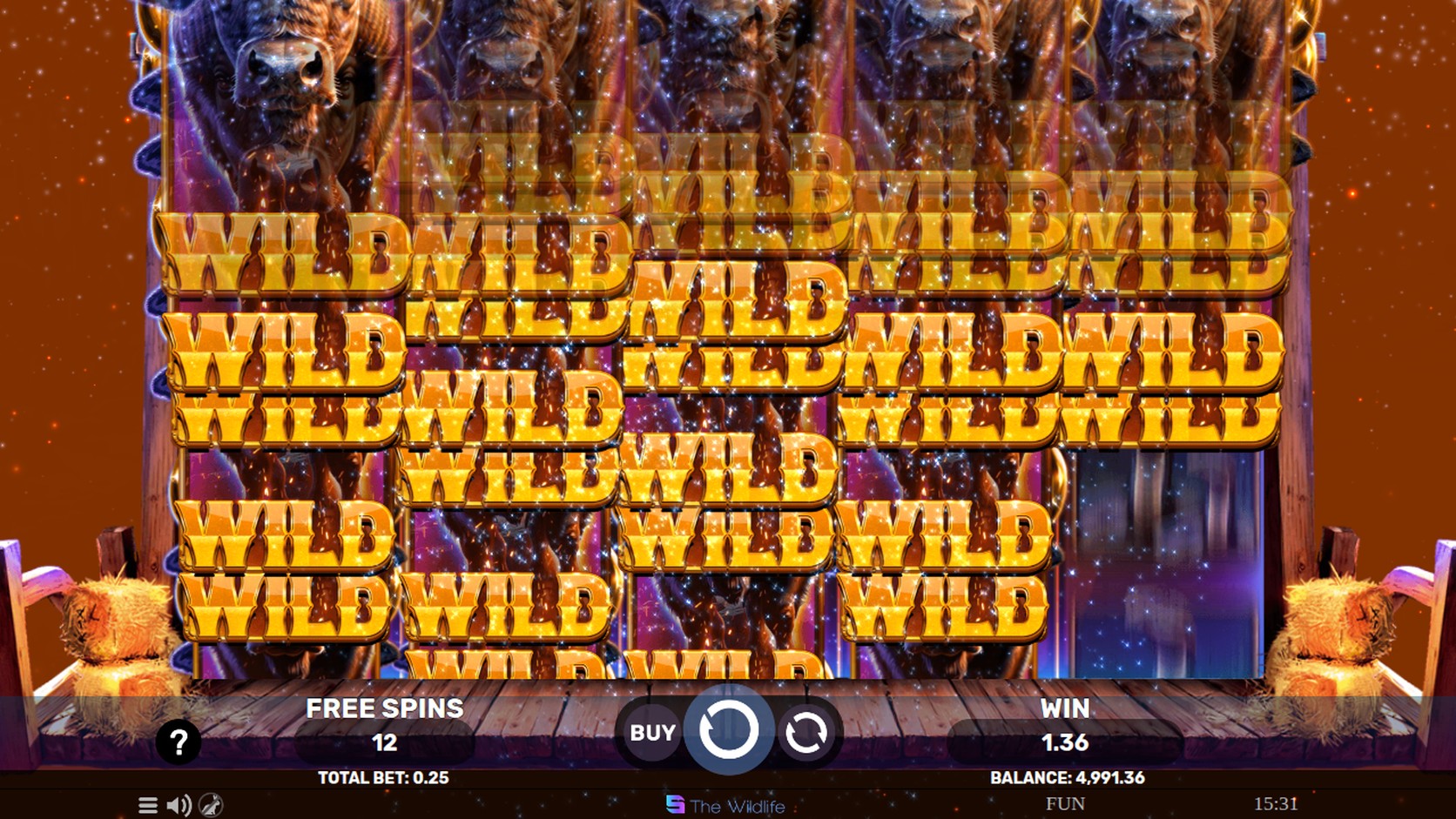
This contrast explains the largest visual moment in my purchased round. Multiple bison stacks covered much of the field while twelve free spins remained, producing a screen that looked almost solid gold. The win display stood at 1.36 during that state. The amount was meaningful inside a 0.25 stake, yet far below what the animation suggested at first glance.

The fixed-line map still had the last word. Each tall Wild had to intersect a route carrying compatible real symbols, and each line kept only its highest result. The stacks made many routes possible at once; they did not convert all visible bison faces into one giant combination. Stacked Wilds is visually louder than double weighting, but the same left-to-right discipline governs settlement.

Two Bonus Doors Need Separate Ledgers

Majestic Bison has two entry symbols with different jobs. Barrels marked Free Spins lead to a wheel, a spin count, and one persistently doubled medium animal. Horseshoes marked Bonus lead to a three-spin collection round with a meter. Treating both as a generic bonus hides the most useful difference between them.

The barrel route modifies ordinary reel play over a selected number of free turns. The horseshoe route changes the objective. Winning horseshoes are collected in scattered positions. Groups of five advance the meter, while plus-one icons can extend the remaining counter. One route asks how paired animals affect fixed lines. The other asks how far a collection state advances before time expires.

Only the first route was actually played in this session. I bought access and watched the wheel. All fifteen spins then ran before the total stopped at 3.90. The horseshoe round never appeared naturally. Its mechanics can be analysed, but no personal result belongs beside them. Keeping the results separate prevents a barrel outcome from lending false authority to a collection game I never entered.

Barrels Open the Wheel

Three or more Free Spins barrels appearing on a base-game screen open the wheel. Their positions do not need to trace one of the twenty-five lines. A Wild cannot stand in for a missing barrel, so the entry count must consist of the actual symbols. The selected bet per line carries into the awarded turns.

The wheel contains five visible spin counts: 10, 15, 20, 30, and 40. It also selects one of four medium animal symbols. That animal then appears only in double form for the complete free round. Entry therefore resolves two variables before the first free reel moves: how many spins are granted and which ordinary identity receives permanent two-unit weighting.

This is more informative than a plain fixed-spin award because the result panel tells the player what to watch. A selected eagle turns every later eagle landing into a paired tile, but other animals may still land as their ordinary or naturally doubled forms under the broader rules. The wheel does not add a multiplier to every win. It changes one symbol's representation and leaves the fixed-line evaluation in place.

My Wheel Chose Fifteen Spins and the Eagle

My wheel stopped on fifteen. Two eagle portraits then appeared above the result panel, followed by a clear note that this symbol would always appear as a double in the upcoming spins. The starting state was specific: fifteen turns, unchanged 0.01 line stake, 0.25 total stake, and eagle as the selected medium animal.

That result sat near the lower half of the visible count range. It exceeded ten but remained well below thirty or forty. Spin quantity did not imply a return level. It merely established how many free reel evaluations would occur unless another rule altered the counter. No retrigger appeared in this round, and the larger wheel segments do not justify inventing one.

The selection panel was one of the clearest screens in the client. It joined count and symbol identity in one place before the Start button became active. I knew what had changed before the first reel motion. That is clearer than remembering a later cluster of eagles and guessing that a special state was active. The client named the selected animal and the exact turn count directly.

The Eagle Stayed Double for the Full Round

Every eagle I needed to track carried the paired presentation through the feature. That persistence narrowed the visual task. Instead of scanning every animal for a temporary modifier, I could recognise the two-headed eagle tile as the selected identity and then ask where it sat on a valid line.

Persistent does not mean sticky. Eagle tiles did not remain locked for the next spin. Their positions changed with each fresh reel result. What persisted was the rule attached to the symbol identity: when an eagle appeared, it appeared double. This distinction prevents the feature from being confused with a hold mechanic or a collection meter.

It also explains why fifteen turns may still settle modestly. A double eagle matters only when the fixed path contains neighbouring eagles or a valid Wild. Many selected-symbol landings can be isolated, begin too late, or sit on incompatible rows. The feature improves the credited count of a successful eagle line; it does not schedule those lines. My 3.90 finish is consistent with that structure. The persistent rule was active and visible, while the random reel positions limited how much value it found.

A Stacked-Wild Event Covered the Screen

With twelve free spins still displayed, tall bison Wilds spread across much of the grid. The moment was impossible to miss. Gold Wild labels occupied several reels as spark effects covered the cabinet. The win field showed 1.36. It was the strongest visual state I saw in the whole session.

The event demonstrated how substitution coverage and double weighting may coexist. Stacked bison faces could bridge ordinary animals on several paths, while the selected eagle remained a two-unit identity whenever it appeared. Yet the two systems were not multiplied together as a blanket screen factor. Each line was still read separately, and only its highest eligible result counted.

This is also a useful check against animation-led judgment. A nearly covered board can look like a maximum state while settling at a small fraction of the 9.75 entry. The 1.36 shown at that point equalled 5.44 base bets at the tested 0.25 stake. Respectable for one feature state, yes, but not a recovery of a 39-bet purchase. The balance field and settled total kept the spectacle anchored to cost.

The Feature Closed at 3.90

After all fifteen awarded spins had settled, the summary returned 3.90. Dividing by the 0.25 base debit gives 15.6 base bets. Comparing the same amount with the 9.75 purchase leaves a 5.85 gap. Both calculations are useful, but they answer different questions. The first measures the feature against one normal spin; the second measures it against the actual entry decision.

The ending also puts the earlier 1.36 stacked-Wild state in context. Later turns added another 2.54 before the round closed. No single final screen transformed the feature. Value accumulated in pieces across the selected eagle rule, ordinary fixed-line results, and the visible Wild intervention.

I prefer the purchase-cost comparison because the button compressed the cost of thirty-nine ordinary spins behind one tap. Calling 3.90 a 15.6x result sounds substantial until its 39x price is restored. The round returned forty percent of the entry cost. That does not make the game defective or prove that the feature usually underperforms. It is simply the complete arithmetic for one fun-mode purchase.

One Round Cannot Predict the Next

Fifteen free spins are far too few to estimate a selected symbol's useful landing rate, the frequency of Stacked Wilds, or the distribution of feature totals. The thirty-three base spins recorded under Auto Play are equally unfit for RTP analysis. Random variation dominates samples of that size, and the information panel did not display the active return configuration.

The sample has a narrower job. It records working controls, a 9.75 buy price at a 0.25 total stake, a fifteen-spin eagle selection, a Stacked Wilds state, and a final feature return of 3.90. It also shows that several named mechanics can appear without recovering the access price in one round.

Any stronger claim would invent probability from a short run. A second purchase might finish higher or lower. A naturally entered round might behave differently only because its random outcomes differ, not because the route carries special luck. This sample maps cause, screen state, and settled cost. It cannot estimate the long-run math.

Horseshoes Open a Three-Spin Collection Game

Three or more Bonus horseshoes appearing in the base game open a separate round with three starting spins. The symbols are scattered and have no fixed-line requirement, while the feature replaces ordinary line reading with a collection objective. Each qualifying horseshoe carries a win amount that contributes to the round as it lands.

New winning horseshoes are collected while the counter runs. The collection state matters more than a left-to-right animal path, and the meter records progress in groups of five. This makes the second door structurally different from the wheel route. Barrels set up a longer series of ordinary reel evaluations with one persistent double identity. Horseshoes create a short timed state whose value depends on collected symbols and the last meter cell reached.

I did not reach this screen during my demo play. The round starts with three spins. Winning horseshoes enter the collection. Groups of five move the meter, and plus-one icons extend the counter. No personal return amount, trigger cadence, or visual-performance claim belongs beside it. The absence is worth stating because the collection game is central enough to shape player fit, yet it would be false to narrate it as my own event.

Every Five Collected Symbols Advances the Meter

The collection meter advances one cell for every five winning horseshoe symbols gathered. That grouping creates clear checkpoints. Four collected symbols leave the current cell incomplete; the fifth moves the marker. The final reward depends on the last filled cell when the feature ends, so complete groups matter more than the raw number alone.

This design makes late collection especially important. A horseshoe that completes a group of five changes the final meter position, while one that leaves the count at four may add its own displayed value without unlocking the next cell. The exact prize levels belong on the live feature screen, where the active build can state them. I will not invent amounts that were not visible in my session.

The meter also creates a different kind of suspense from double symbols. A paired animal changes a line immediately and then disappears with that reel result. Collected horseshoes build a state across several spins. The player watches a threshold, not only a path. That persistence is the strongest reason to keep the two bonus routes separate when comparing session texture.

Plus-One Symbols Buy Time, Not Value

A plus-one symbol adds one spin to the remaining Bonus Game counter. It does not itself guarantee another collected horseshoe, a meter advance, or a particular prize. Its direct effect is time: one additional chance for the collection state to change.

The distinction resembles the wheel's spin-count segments. More turns increase the number of random evaluations, but they do not place a minimum under the feature total. In the horseshoe round, an extra turn becomes valuable only through what lands during that turn. It may complete a five-symbol group, add a smaller amount, or finish without moving the meter.

Because I did not enter the collection game, I cannot judge how clearly the counter and meter share space on a phone or how often plus-one symbols appear. The icon changes only the counter: plus one means one extra spin. Converting that simple extension into a claim about expected value would be misleading. The feature still ends according to its counter, and the last completed meter cell determines the final reward tier.

The 500x Number Is a Multiplier Boundary

Majestic Bison caps its maximum multiplier at 500x. That label should remain exact. It does not automatically mean that every operator describes a whole-round maximum win on the same basis, and it does not reveal how rarely the boundary is reached. The figure marks scale, not a destination toward which normal sessions move.

At the tested 0.25 total stake, a simple 500-times calculation equals 125.00. This translation helps compare that boundary with the 9.75 buy and 3.90 return, but it is not a forecast. My feature reached 15.6x the base stake, just over three percent of 500x. That comparison shows distance, not probability.

Do not merge the 200-times five-Wild amount with this figure; it uses bet per line. At 0.01 per line, that listed line result begins at 2.00. The 500x limit and the five-Wild paytable entry use different labels and may use different bet bases. Keeping those units explicit prevents an impressive-looking number from being multiplied by the wrong stake.

Four RTP Builds Change the Starting Edge

Majestic Bison may run at 88.69, 92.16, 94.04, or 96.31 percent. The lowest-to-highest spread is 7.62 percentage points. That is a material difference hidden behind identical artwork, symbol rules, and feature names.

Expressed as theoretical house edge, the four settings correspond to 11.31, 7.84, 5.96, and 3.69 percent. This math applies across enormous volumes of play, not as an expected result for one phone session. The 3.90 return from my purchased round cannot identify which version was loaded. The information panel did not display an active RTP figure.

This is the weakest disclosure point in the tested client. Locate the installed percentage inside the live client before comparing the title with any review. If a Philippine lobby exposes 88.69 percent, it is not mathematically equivalent to a 96.31 percent lobby even when every reel and wheel segment looks the same. If the live value is missing, the honest response is uncertainty, not an assumption that the highest build applies.

Medium Volatility Still Allows Sharp Outcomes

The volatility category is medium. That broad label does not mean each short session will finish near its starting balance or that a bought feature will return close to its price. Concentrating 39 base bets into one feature confirmation can create a sharp balance change even when the game's long-run variance sits in a middle category.

My play illustrates concentration without proving a distribution. One 9.75 purchase returned 3.90. Thirty-three separate 0.25 base spins returned 6.41 against 8.25 in gross debits. Those two samples felt different because one placed a large decision at the front while the other spread cost across repeated small turns. Neither sample is long enough to validate the medium label or estimate any outcome rate.

Practical volatility also depends on stake relative to the session limit. A 0.25 spin and a 9.75 feature entry are not comparable decisions merely because both use the same line unit. The first risks one base debit. The second advances thirty-nine of them at once. Medium is a property of the game model; purchase concentration is a property of the chosen interaction.

The Buy Button Compresses Thirty-Nine Bets

At the tested setting, the buy price was exactly 39 times the total stake. Pressing the button skipped the wait for three qualifying barrels and moved 9.75 fun credits in one decision. The selected line stake remained 0.01, so the awarded free turns settled under the same per-line value as an ordinary trigger would have used.

The price belongs to this demo build and session. Another operator, jurisdiction, or client configuration may disable the button or use a different multiple. Its presence should never be assumed from the title alone. A live lobby needs its own confirmation before any real-money comparison is made.

The main behavioural difference is speed of exposure. Thirty-nine manual base spins require thirty-nine separate reel starts. The buy panel gathers that gross cost behind one tap and then immediately runs the feature state. A hard session loss ceiling can be crossed faster if the button is treated like an ordinary 0.25 spin. Reading 9.75 as thirty-nine base bets restores the scale. It also makes the 3.90 summary easier to judge without being led by the wheel or Wild animation.

Turbo and Auto Play Compress the Debit Rhythm

Turbo shortened reel motion in the demo, and Auto Play repeated base spins until I stopped it. The stake, line map, and random evaluation did not change. Only the time between decisions and settlements became shorter. Thirty-three completed automatic spins represented 8.25 in gross debits at 0.25 each before 6.41 in returns was applied.

That log should not be mistaken for a strategy test. The results included many blanks, several small line wins, and a final 2.08 hit. Their order cannot signal that a larger result was due, and stopping after the 2.08 return does not improve the mathematics. The run merely confirms that both controls functioned and that cost accumulated quickly enough to deserve attention.

Normal speed was better for learning double counts and watching the winning-line trace. Turbo made paired animals and Wild stacks pass too quickly for careful reading. Auto Play was useful only after the 0.25 total debit was fixed in mind. On a phone, where the control strip already occupies less visual space, speed can hide the balance rhythm even more. A time limit and a loss limit matter more than shaving seconds from the animation.

Portrait and Landscape Behave Very Differently

At a 390 by 844 portrait viewport, the full landscape cabinet shrank into a small band near the centre. Large areas of background remained around it, while the line stake, balance, and help controls became tiny. The game was visible, but careful reading required more effort than the screen size should demand.

At 844 by 390 landscape, the same cabinet filled the viewport. Symbol pairs were easier to separate, the 0.01 line unit and 0.25 total remained legible, and the central spin target was large enough for a clean touch. I completed one real spin interaction in that orientation. The balance moved from 4992.06 to 4991.81 after a zero-return 0.25 turn, confirming that the scaled control worked exactly as it looked.

On a phone used in the Philippines, orientation is not a cosmetic preference here. Landscape preserves the information needed to distinguish per-line and total cost. Portrait preserves the whole cabinet but sacrifices practical scale. A phone browser may also add its own address bar or gesture area, reducing room further. My clear choice is landscape before opening the paytable, adjusting stake, or using the buy panel.

A Philippine Lobby Needs Four Local Checks

The exact demo proves the game client works in English, not that every Philippine-facing casino carries the same build. Before real-money play, four items need local confirmation: legal availability at the chosen operator, the active RTP percentage, the currency and complete stake range, and the presence or absence of the Buy Feature. None can be inferred safely from the Spinomenal title screen.

The RTP check is the most important because four builds span 7.62 percentage points. The stake check comes next because the demo used generic fun credits instead of pesos. A 0.01 line unit in the demo does not establish a PHP minimum. Buy availability may also depend on market rules or operator configuration.

Device fit belongs on the same list. An English-reading player using a Philippine mobile connection may find landscape comfortable once the client loads, yet network performance was not benchmarked across local carriers. No payment method, account flow, withdrawal process, PAGCOR status, or local catalogue position was tested. Those belong to an operator review. This game review stays at the reel client. Its scope ends at the disclosed math menu and the controls I actually used.

Verdict: Strong Symbol Logic, Weak RTP Visibility

Majestic Bison earns its identity through one coherent rule: a paired tile counts as two matching symbols while the five-reel, twenty-five-line map stays fixed. The wheel applies that rule persistently to one medium animal. Only Double Symbols spreads it across a board. Stacked Wilds takes the separate job of widening line coverage. The horseshoe game adds a collection rhythm without blurring the two entry symbols.

My feature was easy to follow and poor against its tested price. Fifteen spins, an always-double eagle, and a stacked-Wild screen returned 3.90 after a 9.75 buy. That result does not condemn the feature; it demonstrates why access cost must remain visible beside animation. The 39x doorway is a concentrated wager, not a shortcut to the 500x multiplier boundary.

My main reservation is disclosure. Four RTP builds range from 88.69 to 96.31 percent, yet the active demo value was not visible in the help I read. My practical Philippine verdict is therefore conditional. Use landscape, confirm the full total stake, find the installed RTP, and check local buy availability before play. The slot fits readers who like fixed-line arithmetic and visible mechanic interaction. It fits poorly when the lobby hides the mathematical version or when portrait phone play is the only comfortable option.

By Fairy Editorial - 01 Sep 2026
Wolf Fang – Crystal Caves Review: What Changed Between 20 and 10 Free Spins
Wolf Fang - Crystal Caves
Wolf Fang – Crystal Caves Review: What Changed Between 20 and 10 Free Spins

The Choice Screen Became the Real Test

The reels made their clearest argument when they stopped asking me to spin and asked me to choose. One route held twenty free spins and shorter 1x2 stacks. The other cut the counter to ten while stretching eligible medium-value symbols into 1x3 stacks. Both routes charged the same amount in the official fun-mode build I opened. That made the decision more useful than a routine bonus announcement. It placed duration and symbol height against each other without pretending that either side came with a guaranteed result.

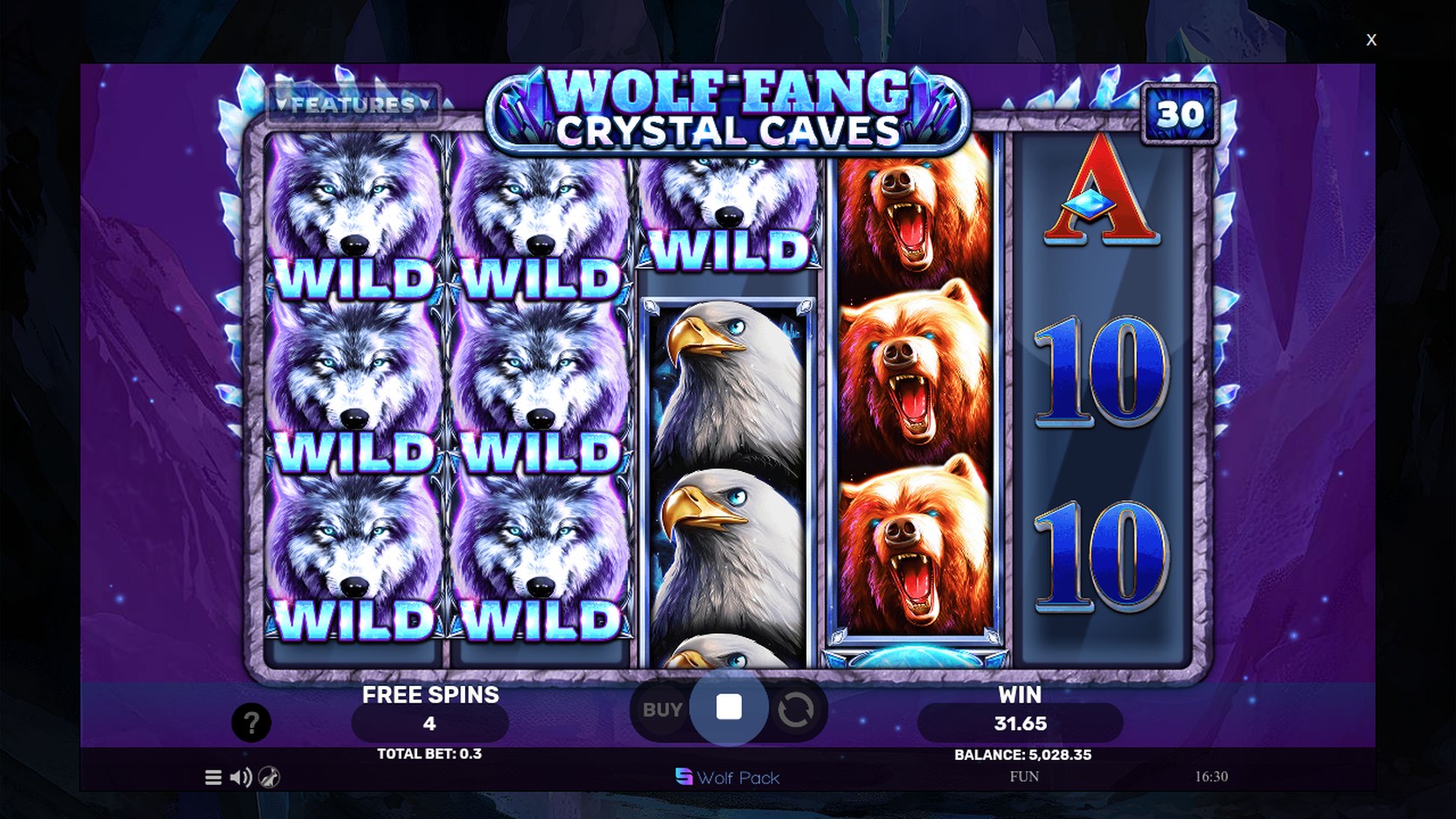
I bought both routes at the same 0.30 total stake and retained the completed event logs. The twenty-spin round finished at 17.70 fun credits. The ten-spin round finished at 31.65. Those figures made the shorter route look stronger in this tiny comparison, but they did not prove that it has a better return model. A single tall-Wild screen shaped the second total. This review therefore treats the two rounds as field notes about pace, screen geometry, and interface clarity. They are not an odds study dressed up as personal experience.

What I Tested and What I Did Not

The retained session contains thirty-seven completed rounds: seven base spins and thirty purchased free spins split across the two selectable routes. One later base spin started before the recovered browser session disappeared, but its completion event was not retained, so I left it out. The distinction may look fussy. It is exactly the sort of boundary that stops a short test from becoming a false statistic.

Everything happened in Spinomenal's official fun mode. I did not use a casino account, deposit money, test a withdrawal, or place a peso wager. I also did not verify a named Philippine operator carrying this exact build. First-person statements refer only to actions visible in the demo and preserved in its logs: changing the line stake, running spins, opening the help pages, buying each route, rotating mobile viewports, and reading the results. Seven base spins cannot establish hit rate, free-spin frequency, RTP, or practical volatility. The feature rounds show how the two modes behaved on two particular draws. That narrow claim is enough to support a useful mechanical review.

The Current Five-by-Three Build Is the Target

The client I tested uses five reels, three visible rows, and thirty fixed paylines. Its runtime identifies the title directly. The current Spinomenal portfolio entry names the same five-by-three, thirty-line arrangement. The upper-right counter displays 30 at all times, while the help pages explain line evaluation and symbol roles. That agreement between the live screen, runtime configuration, and current catalogue makes this the review target.

This boundary matters because an older official product sheet describes something materially different: a 3x5 layout, fifty lines, moving reels and Wilds, a 450x maximum, and another set of return percentages. The wording variations are substantial. They describe another rule package. I found no such moving-reel system in the live build, and its line counter never changed from thirty. I use the current portfolio page and the playable client for present-build facts, leaving the two documents separate. The old sheet remains useful only as a warning that title art cannot tell us which rules were installed.

Thirty Fixed Lines Govern Every Ordinary Win

Each paid result is read along thirty predefined paths. Every regular combination must start in column one and extend across neighbouring columns toward the right. A matching animal on reels two, three, and four does not form a line by itself when reel one lacks the correct start. A gap also breaks the chain. The rules pay only the highest eligible combination on each line, then add wins from separate lines into the credited total.

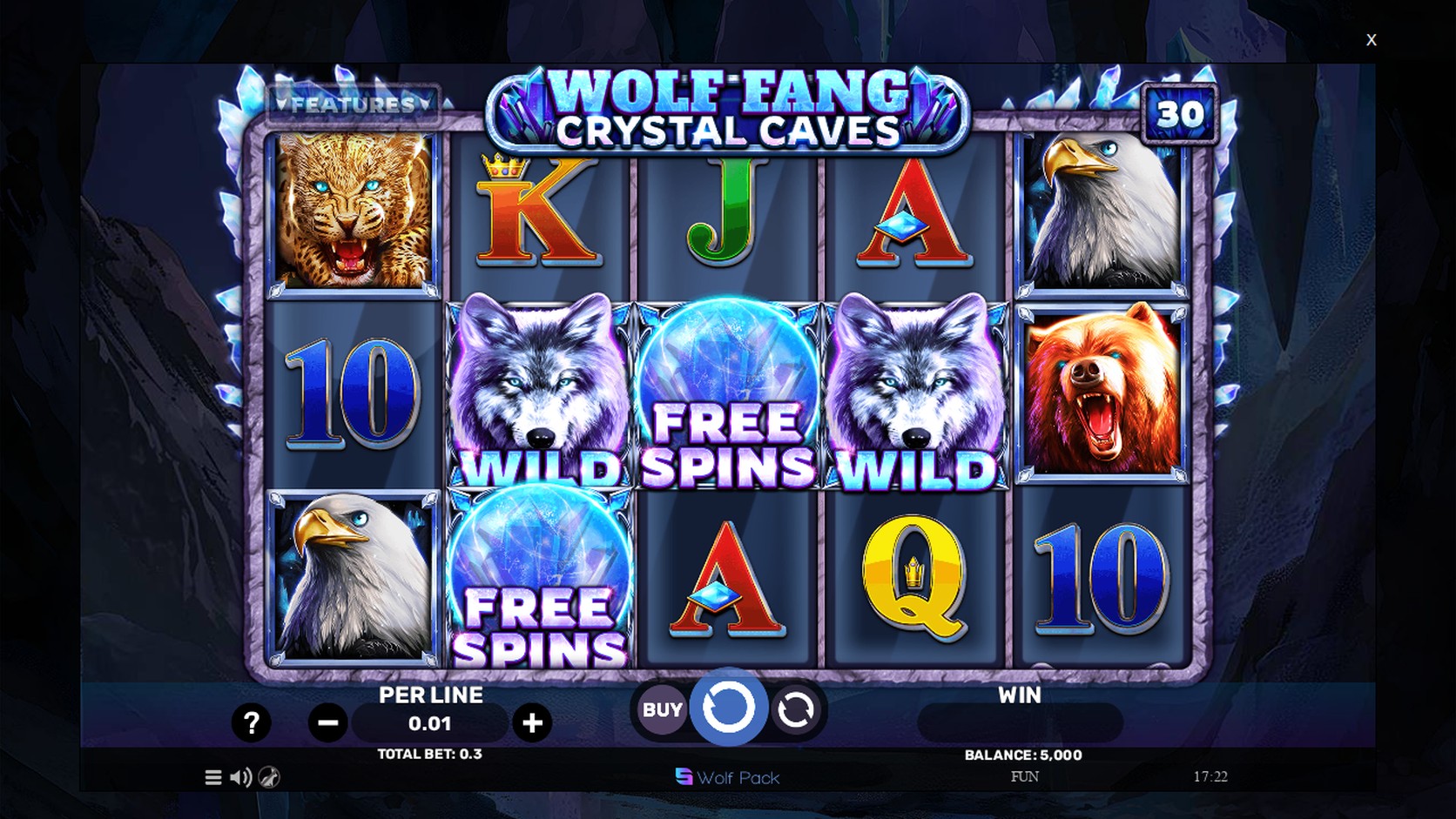
That system rewards path reading, not raw symbol counting. The base screenshot used here contains two free-spin orbs and several Wolves, yet the eye still needs the line map before deciding what pays. Several matching icons scattered across the fifteen cells may produce nothing if they miss the fixed paths. Conversely, one Wild placed between matching symbols can repair multiple routes crossing that cell. I kept the line count visible and used the help panel instead of assuming an all-ways calculation from the busy animal artwork. On a small screen, that habit is especially important because a dense grid may look far stronger than the settled line total.

A Line Stake Is Not the Full Cost

The bottom control labels the adjustable unit as Per Line. In my test, 0.01 per line produced a total bet of 0.30, exactly thirty times the selected unit. The runtime ladder ranged from 0.01 to 10 per line, making the demonstration totals 0.30 through 300 in generic fun credits. Those numbers are useful for understanding the selector. They do not establish a casino's peso limits.

The interface deserves credit for showing both layers at once. I could change the line value and watch the total beneath it update before starting a round. Still, the smaller 0.01 figure is visually more prominent than 0.30. Anyone accustomed to games that display only a total stake could underestimate the debit by reading the wrong label. My practical check was simple. I tapped the plus control once and confirmed that the total moved by thirty line units. After that, I returned to the intended setting. The same total becomes the basis for the Buy Feature price and all stake-relative calculations later in the review.

The Medium Tier Carries the Bonus Identity

Leopard, eagle, bear, and card-rank imagery fill the ordinary reels, while the Wolf carries the Wild label and a glowing crystal orb marks free spins. The choice screen refers specifically to medium symbols, excluding part of the regular set from its stack rule. In the selected bonus route, eligible medium icons may arrive as two-cell or three-cell vertical stacks. The rules add an important limit: a stacked medium symbol keeps the same pay value as its ordinary 1x1 form. Height changes coverage, not the price of one symbol unit.

That distinction prevents a tempting but wrong interpretation. A three-cell bear stack does not turn one bear into three separate premium multipliers. Its value comes from occupying three connected reel positions at once, which may place the same symbol on several of the thirty paths. Tall coverage creates more line geometry around a single draw. The actual return still depends on neighboring reels, the paytable, and Wild placement. The full paytable inside any casino copy deserves a check before a paid spin because the public current page does not list every ordinary symbol award. The live information panel settles those values. Animal size and animation do not.

The Wolf Wild Has a Precise Boundary

Any ordinary paying icon may be represented by the Wolf. The free-spins orb is excluded. That boundary keeps bonus entry tied to actual trigger symbols. It also means a row packed with Wolves cannot fabricate the third orb needed for the choice screen or a retrigger. On ordinary lines, the Wild fills gaps between matching symbols and may form its own Wild combination when the paytable conditions are met.

The help page lists five Wilds on one line at 1000 times the per-line stake. This is a line-pay value, so it must not be confused with one thousand times the total thirty-line wager. At my 0.01 line setting, a literal five-Wild line calculation would use the line unit defined by the rules. Multiple eligible lines could be involved in a dense Wild screen, but the client remains responsible for applying its cap and settlement order. The tall-Wild screenshot from the ten-spin route shows why the distinction matters: six visible Wolf tiles cover two full reels, yet the final amount belongs to all evaluated paths and the active stake basis, not to a casual count of Wolf faces.

Three Orbs Open Choose Your Play

Three or more free-spins symbols scattered anywhere on the base grid open the route picker. They do not need to follow one of the thirty line paths. That separation becomes clear once the rules are open. The shared screen can still mislead. Ordinary animal wins use lines, while the crystal-orb condition uses scattered positions. The Wolf cannot act as an orb, and two orbs plus several Wilds remain short of entry.

The opening cover image captures that exact near-trigger state. Two orbs sit on the second reel while Wolves occupy adjacent cells. It looks feature-heavy, yet no picker appears because the required third orb is absent. This is a better teaching frame than a polished trigger overlay. It shows that visual drama cannot override symbol category. I saw the same principle inside both purchased rounds. Free-spin orbs could still appear; their job had changed from initial entry to extension. The game preserves the selected stack mode and the current stake when an eligible bonus scatter event adds more spins.

Seven Base Spins Stay a Comprehension Sample

The base round is visually direct. Five reels stop, line wins are counted, and no cascade or persistent meter changes the settled grid. Autoplay and turbo can shorten the interval between decisions, but the mathematical unit remains one paid thirty-line result. In the four completed recovery spins, the logged win totals were 0.35, 0.45, 0, and 0 at a 0.30 stake. Three earlier completed base spins bring the retained base count to seven.

I will not turn that sequence into a hit-rate claim. Two positive outcomes among a handful of spins say almost nothing about the full model, and the later blank results do not establish a streak pattern. The sample did show that the balance, total stake, win field, and line unit updated coherently. It also gave enough settled screens to confirm that the game does not require a tumble explanation or a hidden collection state in ordinary play. Mechanically, base mode is the waiting room for a route choice, with standard fixed-line wins doing the accounting in between. How often natural entry arrives remains unresolved by this test.

The Buy Button Charges Thirty-Five Base Bets

At a 0.30 total stake, the confirmation panel charged 10.50 fun credits for access to Choose Your Play. That is thirty-five times the base wager. Runtime configuration also recorded a Buy Feature cost of 35, matching the displayed arithmetic. Both selectable bonus routes carried the same price in the tested client. Changing the line stake would scale that price because the feature cost is tied to the total bet.

This compression changes session exposure more sharply than the modest 0.01 line label suggests. One confirmation placed the equivalent of thirty-five base wagers at risk, then resolved the amount through either ten or twenty free spins. The purchase did not impose a minimum return. Both of my rounds happened to finish above 10.50, but that is an observation about two demo outcomes, not a rule. A future round could settle below its entry cost. Jurisdictions and operators may remove paid feature access. The current provider demo proves the control exists in that build. A Philippine casino is under no obligation to display it. Any live confirmation should state the complete amount before acceptance.

The Picker Creates a Real Trade Between Time and Coverage

The route choice is more than a cosmetic counter. Twenty spins create twice as many starting grids, but their eligible stacks occupy two cells. Ten spins halve the starting count and stretch those same categories to three cells. Both modes keep the ordinary symbol values and fixed-line evaluation. The trade therefore sits in how often a fresh free-spin grid begins and how much vertical coverage one eligible stack may occupy when it appears.

No displayed probability table tells me how frequently stacks land in either route, how symbol strips differ, or how the two choices divide the same theoretical return. Without those details, a claim that one side is safer or stronger would be invented. The honest decision is about session texture. The twenty-spin side spreads the feature across more individual reel stops and leaves more room for mixed-height arrangements. The ten-spin side concentrates its action into fewer stops where a full-height stack can dominate an entire reel. I chose each once because comparing those visible consequences was the point of the test, not because the first result predicted the second.

Twenty Spins Use One-by-Two Stacks

Route A begins with twenty free spins. Eligible medium symbols may appear in vertical 1x2 blocks, covering two positions on a reel while retaining the pay assigned to their ordinary form. On a three-row reel, that leaves one cell for another symbol. The screen therefore tends to preserve more mixed compositions than the 1x3 route. A stack may occupy the top and middle or middle and bottom positions, and its usefulness changes according to the symbols appearing on neighboring reels.

Two-cell height can place the same animal on several line paths without filling the entire reel. It creates broad access but does not guarantee a matching start on reel one or an adjacent match farther right. Settlement remains confined to the drawn pay paths. Wilds remain especially important because one Wolf can connect a stacked animal to a partial chain across several routes. In my round, this mode had more separate chances to assemble such screens simply because the counter began at twenty. That statement concerns round count only. It says nothing about the unknown distribution behind each spin or the expected value of the route.

The Twenty-Spin Ledger Closed at 17.70

The twenty-spin purchase cost 10.50 at a 0.30 total stake. Its completed feature total was 17.70 fun credits, equal to 59 times the base wager. Subtracting the purchase cost leaves 7.20 fun credits above entry for this single demonstration round. I retained the start and finish events, so the arithmetic does not depend on reading a celebratory overlay at the wrong moment.

One spin inside the round produced a Mega Win screen at 6.85. That label is a presentation band, not a separate mathematical category. The 6.85 amount equalled roughly 22.83 base bets at the selected stake and formed part of the final 17.70 total. The screenshot shows several Wolves across the grid, yet the completed feature record matters more than the animation. No retrigger appeared, so the round ended after its original twenty-spin package. This result demonstrates that the 1x2 route can create dense Wild states and a return above its purchase cost. It cannot estimate how common such states are or what another twenty-spin package is likely to pay.

The Longer Route Felt Easier to Audit

Twenty starting spins gave me enough time to distinguish the free-spin counter from the current win field and the running feature total. Individual layouts had less visual concentration than the strongest 1x3 screen, so I could follow which reels carried stacks and where Wolves completed paths. For a reviewer trying to understand the rule, the longer counter was the clearer classroom.

That does not turn clarity into mathematical value. More screens also mean more animation time and more chances for ordinary low-impact outcomes to separate the memorable moments. The round's final 59x base-bet result came from the sum of all settled wins, not from the counter itself. A person who dislikes extended features may prefer the shorter route even before comparing potential returns. On mobile, the extra duration also matters: twenty spins keep the landscape client active longer, and a portrait layout makes every symbol smaller. My practical preference for this route is therefore about auditability and pacing. It is not a recommendation based on an undisclosed return split.

Ten Spins Replace Duration With Full-Reel Height

Route B starts with ten free spins, and eligible medium-value symbols may appear as 1x3 stacks. A three-cell stack fills the complete visible height of one reel. Any one of the thirty paylines crossing that reel encounters the stacked symbol at its row position, though a win still needs the correct matching path across adjacent columns. Full height removes vertical scarcity on that reel. It does not remove the left-to-right rule.

This route creates more abrupt screen changes. A single stacked animal can occupy a whole column, while a full-height Wolf state can turn several paths at once. The reduced counter means each starting grid carries more visual weight in the final memory of the feature. If no useful connection forms, one tenth of the original package has passed. If two early reels fill with compatible high-coverage symbols, many lines may become eligible together. That concentration is the route's identity. The rules do not state that the taller format comes with a higher chance of winning, a larger return percentage, or a better top prize. Height is the verified change; probability remains undisclosed.

31.65 Came From the Shorter Package

The ten-spin route also cost 10.50 fun credits at the same 0.30 total stake. Its completed total reached 31.65, equal to 105.5 base bets. Against the purchase price, this one demonstration result ended 21.15 fun credits above entry. No additional five-spin award appeared, so all value came from the original ten-spin package.

The decisive screenshot arrived with four spins still displayed. Six visible Wolf tiles filled the first two reels. A tall eagle arrangement occupied the middle reel, with a bear stack taking up much of reel four. The win field read 31.65. That image captures the route's central effect better than a final summary modal: full-height coverage can turn a compact fifteen-cell grid into a dense network of eligible line paths. It still does not reveal the probability of drawing that state. The result exceeded my twenty-spin total. The experiment contains only one completed purchase per route, so it records what happened and leaves typical performance unknown.

One Result Cannot Rank the Two Routes

Putting 17.70 beside 31.65 tempts a simple verdict: choose ten spins. That verdict would misuse the evidence. Each total came from one random feature round. The two routes may have different symbol distributions, stack frequencies, or return allocations that the public rules do not expose. Even if both share one theoretical return, two samples could land far apart. A 105.5x result after a 35x purchase does not become a forecast for the next click.

The valid comparison is qualitative. Route A doubles the starting-spin count and uses partial-height stacks. Route B halves the count and uses full-height stacks. My Route A session spread its value across a longer sequence and produced a 59x total. My Route B session concentrated more value into a striking tall-Wild state and reached 105.5x. No retrigger complicated either package. Readers may choose based on pace and screen density, but an evidence-led review should leave expected-value ranking unresolved until Spinomenal or a certified build discloses route-specific mathematics.

The Full-Reel Wolf Screen Explains the Appeal

The third image is not a generic supplier render. It is a retained state from the exact official demo round described above. Two complete reels show Wolves across all three positions, while stacked animals occupy much of the next columns. Because each Wolf may replace an ordinary symbol, those first reels create starting support for many line paths at once. The middle and late reels then decide which symbol identities can use that support.

This is where the fixed-line system and tall-stack system meet. Full reels look like an all-ways event, yet settlement still follows thirty paths. The client counts each eligible route and applies the highest combination on that line. A viewer cannot multiply six Wolf faces by an imagined symbol price and recover the total. Line basis, paytable values, overlapping paths, and the active maximum all matter. The screenshot is strong evidence of interface state and mechanic interaction. It is weak evidence of frequency. Its value in this review is explanatory: the 1x3 route changes vertical coverage so sharply that one draw can dominate the feature's visual and financial story.

Retriggers Add Five Spins Without Changing the Route

Inside either free-spin package, three or more scattered crystal orbs add five more spins. The added rounds retain the selected 1x2 or 1x3 stack treatment and use the same wager setting. This keeps the choice meaningful after entry. A Route A retrigger does not transform later symbols into 1x3 stacks, and Route B does not gain the twenty-spin package's shorter stack rule.

Neither of my completed rounds retriggered. That absence cannot estimate the retrigger rate because thirty free spins form a small sample and the required event is random. It does establish a clean accounting boundary for the observed totals: 17.70 came from twenty spins, and 31.65 came from ten. If a future round adds five, the proper session record should separate starting quantity from added quantity. Describing the larger final count as the original award would be inaccurate. The help screen states the extension rule clearly. What remains undisclosed is its probability and any maximum number of successive extensions in a certified deployment. The active client should govern if an operator-specific rule panel adds a limit.

The Current Runtime Caps the Build at One Thousand Times Bet

Runtime configuration for the playable build sets the maximum-win multiplier to 1000. A current secondary catalogue also lists 1000x, while the older official sheet prints 450x for its different configuration. The current demo's number is therefore the relevant ceiling for this review. It is not a typical outcome, and the session did not approach it. The larger feature result reached 105.5x the total stake, a little over one tenth of the stated cap.

The help page also gives a five-Wild line award of 1000 times the per-line stake. Those two uses of 1000 must stay separate. One is a line-pay entry based on the line unit; the other is the runtime ceiling expressed against the build's configured bet basis. The client performs the final settlement and cap handling. Public material viewed for this review does not explain exactly how remaining spins are presented if the maximum is reached. The cap is a hard model boundary; any unshown animation sequence or cash equivalent remains speculative. Operator cash limits may add another boundary above the game rules.

The RTP Menu Matters More Than a Single Advertised Number

Spinomenal's current portfolio page lists several return configurations: 88.36%; a band from 91.42% to 91.54%; another from 93.31% to 93.34%; and a top band from 95.79% to 95.83%. That spread is too wide to compress into one universal percentage. Matching artwork can hide return models separated by several percentage points.

The official demo runtime exposed a variant identifier but returned 0 in the RTP field, so I could not map the tested client to one of those percentages. A numeric identifier is not a return rate without an official key. I therefore will not label my two feature results as evidence for any particular configuration. RTP describes long-run mathematical return under a defined model, not the direction of a short session. In a Philippines-market copy, the exact percentage needs to appear in the live help page before a paid spin. If the installed figure sits in the lowest band or remains hidden, that fact should carry more weight than the crystal art or one selected demo win.

The Older Product Sheet Belongs to Another Rule Package

An official PDF published in 2024 lists fifty lines, moving reels, moving and expanding Wild behavior, a 450x maximum, medium volatility, and return figures ending at 96.29%. The current page and live client show thirty lines, a Choose Your Play stack decision, a Buy Feature priced at 35x in the demo, and a 1000x runtime maximum. These cannot all describe one deployed build.

The sensible reading is version separation. The older sheet may document an earlier design, a retired integration, or a file attached to the wrong current listing. I do not need to choose among those explanations to reject the hybrid. In this review, the tested build has no verified moving-reel mechanic, no fifty-line counter, and no 450x ceiling. Its exact installed RTP remains unresolved despite the current public range. Anyone comparing an operator lobby should use the live help panel, grid, line count, feature picker, and maximum rule as identifiers. A thumbnail and title are insufficient when official material has changed so materially across time.

Volatility Is Unresolved for the Tested Configuration

The old PDF calls its fifty-line version medium volatility, and some secondary catalogues repeat that label beside mixed current and old specifications. The current Spinomenal page does not display a volatility category for the five-by-three build. Since the mechanics, line count, maximum, and RTP family changed, carrying the old label forward would be an unsupported shortcut.

My two feature rounds also cannot diagnose volatility. Both purchases finished above cost, one at 59x and one at 105.5x, while the tiny base sample included positive and blank results. That sequence says only that short-session outcomes varied. It cannot measure the distribution across thousands or millions of rounds. Mechanically, the paid feature and tall-stack route concentrate a large debit and can concentrate value into a few screens, which makes session exposure feel uneven. That is an interface and wager observation, not a certified volatility rating. Until the current provider material or an active rule panel names the category, the correct label for this exact build is unresolved.

Autoplay and Turbo Change Pace, Not the Rule Set

The tested client included autoplay, a faster spin control, help, sound, and fullscreen access. Autoplay began a sequence of ordinary paid rounds and replaced the central spin icon with a stop control. Turbo shortened reel movement. Neither altered the thirty-line stake unit, symbol rules, or route-picker terms visible in the client.

Pace still changes practical exposure. At 0.30 per round, ten automatic spins represent up to 3.00 fun credits in base debits before wins are considered. Raising the line unit multiplies that flow across all thirty paths. Faster animation also leaves less time to notice the balance or reconsider a Buy Feature purchase between rounds. The stop control and transaction history work best as accounting tools, not as evidence of a different odds mode. Local regulation may hide autoplay or paid entry, so their appearance in the provider demo does not guarantee access elsewhere. The core title remains playable manually without either speed control.

Landscape Is the Practical Phone Orientation

At a desktop viewport of 1280x720, the grid, title, counter, stake controls, and balance fit comfortably across the screen. I also tested a 390x844 portrait viewport. The internal game retained its landscape proportions and contracted into a narrow horizontal band, leaving substantial cave artwork above and below. Symbols, line-unit text, and buttons remained present but became much smaller than the surrounding page.

At 844x390 in landscape, the client used most of the available width. The five reels became easier to read, and the total stake, free-spin counter, win field, and central controls sat on one practical plane. In a Philippines-facing phone review, this matters more than decorative responsiveness. A mobile connection may already make rules and balance checks slower; a compressed portrait grid adds visual friction. Rotating the phone before changing stake or confirming a feature purchase makes those controls easier to verify. This test did not measure startup speed across local mobile networks, data use, battery drain, or reconnection after a signal drop. The demo left all four points unanswered.

Crystal Art Helps Separate Functional Symbols

The visual design begins with a dark cave frame and blue-violet crystals. Large animal portraits fill the premium positions; jewel-trimmed card ranks occupy the lower tier. The Wolf is the easiest functional icon to identify because the word Wild appears across the portrait. The free-spins orb carries equally direct text. Those labels reduce ambiguity on a grid where the leopard, bear, and eagle otherwise compete for attention.

Large-win overlays are less restrained. The Mega Win screen fills much of the central area with glowing type, a crystal sphere, and coins, temporarily hiding the line result beneath it. The amount remains visible, and the underlying feature total can be checked once the overlay clears. Sound and motion reinforce the same hierarchy, but neither is necessary for settlement. I could mute the client and still follow the counter and balance. The presentation works best when the feature is running because stacked animals and full-reel Wolves make the chosen mode visible. In base play, the cave theme is polished but mechanically conventional; the picker and stack height give the art a reason to exist.

English Support Is Clear but Filipino Is Not Listed

The official client loaded in English, and Spinomenal's current language list includes English alongside several European languages. Filipino does not appear in that list. For an en-PH reader who uses English interfaces, labels such as Per Line, Total Bet, Buy, Free Spins, and Win are direct enough. The help pages also explain fixed paylines, Wild exclusion, the two stack modes, and retriggers in English.

English availability should not be mistaken for a fully localised Philippine client. The demo used generic fun credits, not pesos. It did not establish local date formatting or customer-support language. The locally required safer-play text and operator-specific terms also remain untested. A casino wrapper might translate its lobby while the embedded client stays in English. The money controls still need unambiguous labels in the loaded version. Before real play, verify account currency, total debit, feature price, active RTP, and game-history access in the exact operator client. Theme text can remain decorative; financial text cannot.

Local Carrying Status Needs Fresh Proof

No accepted source linked this tested version to a locally licensed operator in the Philippines. I also found no public record sufficient to claim PAGCOR approval for the exact title. Provider distribution, website accessibility, and local game authorisation are separate facts. The public Spinomenal demo proves that the supplier hosts a playable fun-mode build. It does not prove that a reader may lawfully stake through any site that lists the name.

That boundary rules out naming a casino, payment rail, peso range, or purchase-button status as universal. A local operator may select another RTP setting, remove Buy Feature, change stake denominations, or omit the title entirely. The right check happens inside the operator's current rules and legal information, not through an overseas catalogue or a search snippet. If the operator screen shows fifty lines, moving reels, or a 450x cap, it is not the same configuration reviewed here. Record the line count, feature-picker wording, maximum, and return percentage before comparing it with this article.

My Verdict Favors Clarity Over the Larger Demo Win

My verdict rests on one sound design decision: the feature choice becomes visible in the geometry. Twenty spins use partial-height stacks and create a longer, easier-to-audit sequence. Ten spins use full-height stacks and turn fewer grids into more concentrated events. The same thirty-line rules remain underneath both. My demo totals, 17.70 and 31.65 from equal 10.50 purchases, illustrate those contrasting textures without settling which route has better mathematics.

I prefer the twenty-spin route for learning the game and the ten-spin route for a shorter session where each tall stack has more visual weight. That is a pacing judgment, not an expected-return claim. The active RTP could not be identified in the demo. Current volatility is undisclosed as well, and Philippine availability needs operator-level proof. Any copy that hides its return setting or mixes the old fifty-line rules with the current artwork deserves rejection. In a clearly documented thirty-line build, the A/B choice gives this otherwise conventional animal slot a precise identity. My choice starts with the desired counter length and screen density. Every purchased round can still return less than its displayed cost.

By Fairy Editorial - 31 Aug 2026
Celestial Conquest Review: Four RTP Builds Change the Whole Decision
Celestial Conquest
Celestial Conquest Review: Four RTP Builds Change the Whole Decision

The first number I checked was not the advertised 3000x ceiling. It was the row of four return settings in Spinomenal's own material: 89.53%, 92.60%, 94.19%, and 95.78%. That spread changes how I read everything else in Celestial Conquest. Two copies may carry the same gods, the same twenty lines, and the same expanding wild animation, yet sit more than six percentage points apart on paper.

That is why this review begins at the rules screen instead of Mount Olympus. I inspected Spinomenal's material and a documented operator rule set. I then compared official images with several independent descriptions. I do not have a retained Philippine account session for this title, so I will not turn promotional screenshots into a story about my own wins. My judgment stays within a useful boundary. I explain the mechanic, identify version differences, flag what remains unverified locally, and state what I would check before risking a peso.

My Verdict Starts With the RTP Menu

Celestial Conquest has a sound central idea. In free spins, a wild can occupy an entire reel. It remains there for one respin and changes the geometry of the next result. The base round also has an Extra Wilds event that inserts three to six wild symbols. Those two interventions give a conventional twenty-line slot a clear mechanical identity. I can follow why a strong screen formed. A pile of effects never has to replace readable cause.

The reservation is just as clear. Spinomenal lists four RTP configurations, and the weakest one sits at 89.53%. I would not treat that as a cosmetic operator setting. The highest figure, 95.78%, is the version I would seek, while the two middle builds require a more cautious value judgment. A casino displaying only the title thumbnail has told me almost nothing about the mathematical version underneath it. Before the first paid spin, I would open the information panel and match the number shown there against the provider's range. If the number is hidden, that missing fact becomes part of my verdict.

The Screen Is Clearer Than the Theme Sounds

Greek-myth imagery can become visual noise, but the official base-round image keeps the important objects separate. Five tall reels sit inside a stone temple frame. Letter symbols use distinct red, gold, and green treatments, while the harp, wheel, temple, and crown-like mirror occupy their own framed tiles. A bearded god marks the wild. The purple space behind the columns stays outside the grid, so it does not compete with the symbols.

I also like that the control strip states the wager in two layers. The official display shows a per-line value and a total bet beneath it, beside minus and plus controls. That matters in a twenty-line game because a number on the line control is not the full amount leaving the balance. The same image is marked as fun mode and uses unlabelled numerical units, so I do not read its total as a peso stake or a live casino limit. It is an interface example, not proof of a Philippine denomination.

A Five-by-Four Grid With Twenty Fixed Lines

The layout uses five reels and four visible rows, producing twenty symbol positions on every settled screen. Wins follow twenty fixed lines. This is different from an all-ways system, and it changes the reading task. A matching symbol on every reel does not automatically create a pay unless those symbols follow one of the defined line paths. Four rows create more crossing routes than a three-row classic slot, but the line map still controls which route counts.

I find this footprint manageable on a wide phone because the grid remains rectangular and the line count stays modest. There are no changing reel heights or hundreds of ways to recalculate after each stop. At the same time, a busy screen can look stronger than it pays. Several copies of the same symbol may be scattered across the twenty positions without forming an eligible chain. I would keep the win-line display active until the route logic becomes familiar. The third official image selected for this review is useful precisely because it shows the line highlight and lets the artwork remain in the background.

What One Paid Spin Is Actually Buying

A documented operator rule sheet states that line wins run from the leftmost reel across adjacent reels and that only the highest combination on an active line is paid. In practical terms, a symbol chain that starts on reel two is not rescued by having more copies on reels three through five. A gap also breaks the route. The position of a wild therefore matters as much as the number of wilds visible.

The twenty-line structure links the per-line control to the full wager. In the official display example, a per-line value of ten corresponds to a total bet of two hundred. I treat that as arithmetic inside a demonstration screen, not as a currency statement. For a Philippine player opening a casino copy, the relevant number is the actual total in the bottom bar after the site has applied its denomination. I would adjust the control once. Then I would confirm the expected change in the total before choosing repeated spins. That small check prevents a line value from being mistaken for the entire cost.

The Paytable Puts Two Symbols Far Ahead

The operator rules I examined place the temple at the top of the ordinary paytable, followed by the wheel. On that documented line-bet scale, five temples return one thousand units and five wheels return six hundred. The crown-like mirror and harp sit below them at one hundred and twenty for five, while the letter ranks are lower again. A and K reach forty for five, and Q and J reach twenty.

Those gaps tell me where the screen's value is concentrated. A full line of letters may cover the reel path and still be far below a line of temples. It also explains why a large cluster of low symbols can produce a modest total even when the animation highlights several routes. I would read the paytable inside the exact casino copy because symbol values can belong to a particular rule configuration. The order is still useful for interpreting the official art: temple and wheel connections carry much more weight than the number of low-card tiles alone suggests.

Why Left-to-Right Adjacency Matters

The rule is simple to say but easy to ignore when full-reel wilds arrive. A valid ordinary line needs matching symbols on consecutive reels, beginning at the left. Suitable wild replacements may fill positions along that route. Imagine an expanding wild on reel four while the first three reels show unrelated low symbols. The wild dominates the artwork, yet it may have little line value because no chain reaches it. Move that same wild to reel two and many symbols on reel one gain a bridge toward reels three, four, and five.

This is the first major reason I rate location above spectacle. Full height does not mean universal payment. It means that every line crossing that reel receives access to the wild at that point. Early reels intersect the start of all qualifying routes, so an early expanded wild usually has more connective importance than a late one. The precise return still depends on the symbols around it and the game's rule treatment. I would watch the highlighted routes after a respin, not judge the result from the size of the portrait alone.

Extra Wilds Are the Base-Round Intervention

Outside free spins, the named Extra Wilds event adds between three and six wild symbols to the grid. That is a direct interruption of the ordinary reel result. Instead of waiting for naturally placed wilds, the round gains several additional connection points before the win is assessed. It gives the base mode a route to a materially altered screen even when no scatter award appears.

The number range sounds generous, but count is only half the story. Three well-positioned wilds across early and middle reels can repair several lines. Six symbols bunched on a late reel or placed around incompatible starting symbols may do much less. Since the grid uses defined lines, the additions do not convert every nearby symbol into a pay. I would therefore assess this event by the final line highlights: which reels received wilds, which high symbol they joined, and how many routes actually crossed those positions. The mechanic has real structural value, yet its outcome remains dependent on placement.

Three to Six Wilds Can Still Miss the Right Reels

Consider two hypothetical screens. On the first, three inserted wilds occupy reels two, three, and four along paths that begin with a temple on reel one. They may extend a high-symbol chain deep into the grid. On the second, six wilds occupy several cells on reels four and five while reel one carries mixed letters. The second screen has twice the wild count, but its line starts may be weaker. This is an illustration of line geometry, not a prediction of frequency or return.

That distinction keeps me from treating the event banner as the result. I want the game to show each paid path and the total after all lines have been counted. The official material identifies the three-to-six range, but it does not publish a hit-rate table for this event. I found no accepted source that tells me how often each count appears. Any claim that five or six wilds are common would therefore be guesswork. The honest conclusion is that the event can reshape the base grid, while its frequency and count distribution remain undisclosed in the material I verified.

Free Spins Arrive in Three Different Packages

The documented award ladder is unusually wide. Three scatter symbols give ten free spins, four give twenty-five, and five give fifty. Moving from three to four scatters adds fifteen rounds, while the jump from four to five doubles the package. That makes the fifth scatter far more consequential than a routine extra spin.

I would still resist translating spin count directly into likely profit. A fifty-spin package creates more chances for expanding wilds to appear, but each settled grid still depends on symbol placement and line connections. Ten rounds may contain a strong expanded-wild sequence; fifty may spend long stretches on low-value lines. Spin count controls the amount of feature exposure, not the result of that exposure. The published information also does not give separate RTP figures for the three packages. I read the ladder as a duration choice built into the scatter outcome, not as three products with disclosed return profiles.

Session texture changes when the award count changes. Ten spins compress the feature into a brief run. A single expanded wild and its respin can dominate the whole sequence. Fifty spins spread the result across many more initial grids and possible respins, so one blank patch has less visual control over the final total. That is a difference in sample length, not a claim that the long package pays better per wager.

For me, the practical issue is attention. A phone session that enters fifty free spins may last far longer than the same stake entering ten, particularly because expanding wilds insert extra respins. The counter therefore matters. I would check how it treats the added respin. The rule description indicates that an expanding wild adds a new resolution ahead of the next awarded spin. Since I did not run a retained live session, I would verify that counter behaviour in the actual client before describing it as universal.

The Expanding Wild Creates a Two-Step Win Cycle

Free spins change the wild from a single-cell helper into a reel-wide event. When the relevant wild appears, it expands over the full reel and initiates one respin. The expanded symbol then remains in place for that respin. I see a two-step cycle. The first grid selects and expands the wild. The next grid resolves around a locked column.

That order is more important than the animation. On the first result, the wild can participate across every line crossing its reel. On the added spin, the other reels move while that column stays available as a bridge. A second set of surrounding symbols therefore gets a chance to connect through the same reel position. This is where the title earns its mechanical identity. It is not merely a full-height replacement on a single finished screen. It persists long enough to alter the next reel stop, creating a readable before-and-after relationship that I can trace in the payline display.

The Held Wild Changes the Respin Geometry

A locked full reel removes one column of uncertainty from the added spin, but it does not remove the rest. If reel two is held wild, every valid start on reel one has a route through the second reel, then still needs matching material from reel three onward. If reel five is held, the first four reels must already build a chain that reaches it. The same feature therefore has different connective force depending on the column selected.

Two expanded wild reels create a much stronger bridge, as the official free-spin artwork demonstrates with full portraits on reels one and four. Yet that picture is a chosen display state. It confirms what the interface can look like; it does not state how often two wild reels appear together. I use the image to explain geometry, not probability. What I want to know after any such result is which columns were locked, which lines crossed both, and what symbols occupied the spaces between them. Those facts explain the total more reliably than the number of portraits alone.

Wild Reel Count Has Its Own Award

Independent rule descriptions list a separate return tied to the number of scattered expanding wild reels: one at 2x, two at 5x, three at 10x, and four at 20x. I treat those figures as rule-set details that should be checked inside the loaded version, because the provider summary names the expanding-wild respin but does not spell out that ladder on its public page.

If the local information panel matches those values, the award adds a second accounting layer. The line wins measure symbol routes through the grid, while the wild-reel amount recognises how many full columns appeared. That distinction matters when reconstructing a total. A screen can gain value from the wild count even before considering the lines those reels repair. I would look for separate entries in the win breakdown and avoid assuming that every credited unit came from paylines. If the casino client omits the ladder or shows different values, the in-client rule page controls that session and the external description should be discarded.

Official Art Shows the Feature, Not a Typical Session

All three images in this review come from Spinomenal's own Celestial Conquest page and were resized without changing the scene. That gives me confidence about game identity and interface relevance. It does not turn the pictured balances, symbol layouts, or win totals into statistical evidence. Promotional assets are selected because they explain the product clearly; a random session is not selected that way.

The distinction is especially important in a high-volatility slot. A screenshot with two expanded wild reels proves the client has an art state for two expanded wild reels. It cannot establish the chance of reaching that state. The all-J image proves how line highlights and total-win accounting appear when the grid is filled with one symbol. It does not show the normal frequency of a full-screen symbol. I would rather state that boundary plainly than write a false personal scene around an official image. The pictures teach the interface; the rule sheets carry the factual claims.

Bonus Buy Shortens the Wait and Concentrates the Risk

Spinomenal's product sheet marks a Buy Feature as present. The visible Buy button in the official interface supports that listing. Availability may still depend on the operator and jurisdiction, so a Philippine casino copy may hide or disable it. I have not verified a current peso price for this title, and I would not convert a third-party euro or generic-unit example into local currency.

Mechanically, a purchase removes the unknown wait for a natural scatter result and charges a larger amount at once. It does not change a feature round into guaranteed profit. A third-party review lists three selectable packages priced at forty, one hundred, and two hundred times the stake for ten, twenty-five, and fifty spins, but I would confirm those figures in the client before acting. A purchase at two hundred times stake concentrates the cost of two hundred base wagers into one decision. That compression is the reason I would treat the button as a separate risk mode, not as a convenient menu shortcut.

High Volatility Is the Practical Label

Spinomenal classifies Celestial Conquest as high volatility. For me, that label describes concentration. It makes no promise about the size or timing of a win. Much of the design's mechanical force sits in inserted wilds, expanding wild reels, locked respins, and a broad free-spin ladder. Ordinary line results may therefore feel secondary to relatively rare grid interventions, even though the public material does not disclose their exact frequency.

The feature-buy option sharpens that concentration by letting one click carry many times the base stake. A natural fifty-spin award can also extend a session far beyond the time implied by one trigger because respins may be added along the way. Those are mechanical reasons to decide the total wager and stopping point before pressing spin. I am not assuming a particular bankroll size or experience level. I am saying that the slot contains decisions where the amount at risk changes abruptly, and the interface deserves a pause at those points.

The 3000x Ceiling Needs Context

The provider sheet lists a maximum multiplier of 3000x. That figure is a cap, not an average, a target, or a likely outcome. It tells me the rules allow a total as high as three thousand times the relevant stake definition. It does not tell me the probability of reaching that level, and the public sheet does not attach an odds table to it.

I also want the client to make the stake basis clear. Some interfaces discuss line bet, total bet, and feature cost on the same screen. A maximum quoted against total stake is read differently from a symbol pay quoted in line-bet units. The safest interpretation comes from the exact rule panel loaded by the operator. Until that panel defines the multiplier basis, I would keep 3000x as a provider ceiling and no more. Marketing attention naturally moves toward the largest number, but my decision still begins with the RTP build and the cost per full spin. The ceiling cannot repair a weak configuration.

Four RTP Builds Need Four Different Verdicts

The four published values are 89.53%, 92.60%, 94.19%, and 95.78%. RTP is a long-run mathematical setting, not a forecast for tonight's balance. Even so, the selected setting changes the theoretical amount retained by the game across a very large volume of stakes. I cannot review those four builds as if they were interchangeable.

At 95.78%, the title reaches the top of its own range and lets the wild-respin system carry the judgment. At 94.19%, the same mechanic comes with a reduction of 1.59 percentage points. At 92.60%, the gap from the top is 3.18 points. At 89.53%, it becomes 6.25 points. Those differences are calculated directly from the provider's figures. They cannot predict a single session. They are still large enough to change my willingness to play. A review that prints only 95.78% describes the best build and fails to describe Celestial Conquest as distributed.

The Lowest Build Is Not a Minor Downgrade

An 89.53% setting implies a theoretical house share of 10.47% before any other local consideration. The 95.78% setting implies 4.22%. The difference between those theoretical house shares is the same 6.25 percentage points seen from the RTP side. Over short play, variance can overwhelm that distinction. Over repeated exposure, the setting remains mathematically relevant.

This is the point where my Philippine-player lens becomes practical. A familiar provider name or polished mobile lobby does not identify the installed RTP. I would open the help or paytable, search for the exact percentage, and capture it for my own reference if the interface permits. If the title shows 89.53%, I would leave. The feature design cannot compensate for the setting. Expanding wilds alter how wins form; they do not cancel the published return model. If no percentage appears anywhere, I lack the information needed to compare that copy with the provider's four documented versions.

Operator Bet Ranges Do Not Travel Cleanly

The operator documents disagree on the available ceiling, which is precisely why I will not publish a universal stake range. One named rule sheet lists a minimum of €0.20 and a maximum of €100. A separate casino review page lists a €0.20 minimum and €200 maximum. Both may be accurate for their own integrations. Neither establishes the Philippine peso limits at a different site.

The interface itself also uses a per-line control and a total figure. Currency conversion, denomination mapping, and operator limits can change what those numbers mean in a local lobby. I would record only what the loaded client states: currency, line value, total stake, and any feature-buy price. If a casino account is denominated in pesos, the final total should display PHP or an unmistakable peso symbol before money is committed. A generic demonstration balance marked as fun does not meet that standard. Operator-specific limits belong to the operator, not permanently to the game title.

English Support Helps, Filipino Support Is Not Listed

Spinomenal's product sheet includes English among the supported languages. It does not list Filipino or Tagalog. For an en-PH reader comfortable with an English casino interface, the core controls and rule labels should therefore have a supported language route. That is relevant because terms such as per line, total bet, free spins, buy, and RTP need to remain precise.

I would not stretch English support into a claim of full Philippine localisation. The absence of Filipino from the provider list means translated rules, customer support language, date format, currency display, and local responsible-gaming notices must be checked at operator level. A casino wrapper may translate its lobby while leaving the embedded game in English. The reverse can also happen. My standard is functional clarity: the wager total, feature price, remaining free spins, win amount, and mathematical information must be readable before play. A mythological theme needs no translation; a money control does.

How the Layout Reads on a Philippine Phone

The official 16:9 images show a layout designed around landscape width. Five reels remain large, and the wager controls form a single strip beneath them. On a phone, I would rotate to landscape so the grid stays wide. That preserves symbol separation and keeps the per-line and total-bet labels on the same visual plane. It also makes the highlighted pay paths easier to follow after a busy wild result.

There are still practical checks the artwork cannot answer. I have not measured loading time on a Philippine mobile network, touch accuracy on a specific handset, heat, battery use, or reconnection behaviour after a signal drop. Those are device and operator questions, not safe inferences from a desktop-sized image. Before paid play, I would use any permitted fun mode to test the help panel, sound toggle, spin button, wager adjustment, and return from background. If the total stake or win amount is clipped at the phone's native scale, that client is not ready for a money decision on that device.

Local Availability Must Be Checked, Not Assumed

I did not find accepted evidence that Celestial Conquest is currently carried by a specific authorised Philippine operator. I also did not verify its presence in every locally accessible Spinomenal catalogue. Casino libraries change, and a provider relationship does not prove that each title is enabled in each market.

For that reason, this article does not name a Philippine casino, payment rail, or licence as a route to the game. A reader should verify the operator's current legal status, the title's visible rule panel, account currency, and any local restrictions directly in the service being considered. A search-engine page or an overseas casino rule sheet cannot settle those local questions. The same boundary applies to the Buy Feature: the provider supports it, but a particular jurisdiction or operator may remove the button. If the casino copy differs from the screenshots here, the live client's documented rules take priority and the difference should be treated as a version issue, not a hidden bonus.

One External Test Shows Why Anecdotes Stay Anecdotes

A named third-party reviewer reported that a base-mode trial did not reach free spins naturally. That reviewer then used demonstration activation for the three packages and recorded returns of 24x, 74x, and 176x against listed costs of 40x, 100x, and 200x. I include those figures for one reason: they show how easily a personal sequence can be mistaken for a general verdict.

All three reported rounds finished below their stated entry cost, but three trials cannot estimate the feature return or prove that the purchase is poor in every version. The natural-trigger miss also says nothing reliable about trigger frequency without a disclosed spin count and repeated sampling. I would not retell that session as my own, and I would not use it to predict another reader's result. Its proper place is context. It demonstrates that paid access does not guarantee recovery and that a reviewer's short run remains an anecdote beneath the published mathematics.

The Line Display Deserves More Attention Than the Win Banner

The all-J official image is the clearest teaching frame in the asset set. Every position contains the same low symbol, while the top panel identifies a particular line and its win before showing a larger total. Glowing boxes trace the current route across the five reels. The screen separates one line result from the sum of all qualifying lines.

That visual distinction is essential when wilds are involved. A total may combine many routes, a separate wild-reel award, or both, depending on the rule set. I would let the client cycle through each highlighted line and compare the per-line amount with the final figure. Doing so reveals why a grid that looks full can still pay according to a defined unit scale. It also catches misunderstandings about the twenty-line multiplier. The win banner is the answer; the line display is the working. For a deep review, the working carries more information.

The Best-Fit Player Is Mechanic-Led

I would point Celestial Conquest toward someone who enjoys reading a visible state change: added base wilds, a full-reel expansion, then a held respin whose value depends on column position. The mechanic has a clear sequence, and the twenty-line grid lets a curious reader reconstruct most results from the highlighted paths. Greek-god artwork is a secondary preference; the decision should rest on the rules.

The strongest match is also configuration-sensitive. I could justify time with the 95.78% build far more readily than with the 89.53% build. A person who dislikes feature concentration, paid bonus access, or long free-spin packages may find the session rhythm uneven. Someone who wants cluster pays, reel cascades, or a jackpot ladder will not find those systems in the verified description. This is a fixed-line slot built around wild placement and respin persistence. Knowing that boundary prevents the theme from promising a different kind of game.

Reasons I Would Leave This Slot

I would leave immediately if the information panel showed 89.53% or concealed the RTP. I would also stop if the displayed currency, per-line value, total bet, or buy price could not be reconciled. Those are not minor interface complaints. They determine the mathematical version and the amount exposed on each action.

A second reason is mechanical mismatch. If repeated ordinary spins become a wait for the wild event, the high-volatility structure is asking for patience I may not want to spend. A third is feature-buy pressure. The button sits beside the main spin control in the official layout, making the shortcut constantly visible. If that placement turns an intended base session into repeated high-multiple purchases, leaving is the rational interface response. No theme, maximum multiplier, or long free-spin package changes those boundaries. Responsible play here begins with accurate information and a decision that remains intact after a dry sequence.

Final Decision for a Philippine Player

Celestial Conquest earns credit for a mechanic I can explain from one screen to the next. Three to six extra wilds disturb the base grid. Free spins can expand a wild across a reel, hold it, and rerun the surrounding columns. Twenty fixed lines keep the accounting visible, and the official interface distinguishes line value from total stake. The result is a slot with a coherent rule chain. Its theme does not have to carry unrelated bonuses.

My recommendation is conditional. I would first confirm that the operator is appropriate for my location, then check the in-client RTP, currency, full-spin total, and feature-buy terms. The 95.78% build is the version that gives this design its fairest hearing. The 89.53% build changes the judgment enough for me to walk away, while the two middle configurations sit between those decisions. English interface support helps an en-PH reader, but Filipino localisation and current Philippine availability remain unverified. If the strongest configuration is present and the expanding-wild respin is the mechanic I came to play, the title has a clear case. If either condition fails, the gods on the reels do not rescue it.

By Fairy Editorial - 31 Aug 2026
Gold Magnate Review: Why 9,990x and 10,490x Are Both Correct
Gold Magnate
Gold Magnate Review: Why 9,990x and 10,490x Are Both Correct

Gold Magnate looks like a compact steampunk slot, yet its most important detail sits outside the artwork. BGaming publishes two maximum figures that appear to disagree: 9,990 times the bet for the bonus and 10,490 times for the entire game. That gap is the key to reading the design properly. This is not a free-spins slot with a long ladder of upgrades. It is a ten-line game whose base round and one-shot bonus have separate ceilings.

For this review, I use a professional-reviewer lens for Filipino readers. I did not retain a live demo session during this research pass, so I do not present spin counts, personal wins, phone performance or loading times as firsthand results. Interface observations come from BGaming's official gallery, while mechanics come from the provider's June 2024 English rules and product page. Philippine regulatory comments come from the exact game entry in PAGCOR's published electronic-game list. That evidence boundary matters because a provider screenshot in euros cannot prove the currency, stake limits or return setting inside a particular Philippine operator account.

The short judgment is clear. Gold Magnate has a readable core, a mathematically transparent bonus and far less state to track than its club-room presentation suggests. Its weakness is concentration. A high card can settle a large part of the game's theoretical value in one die result, and there is no expanding free-spin sequence to soften that dependence. Readers who prefer one decisive event may understand the appeal. Anyone expecting frequent feature layers should inspect the rules before attaching meaning to the brass, clocks and heavy win effects.

The 500x Gap Explains the Headline Number

BGaming's rules split the limits into three statements. The main game has a maximum win of 500 times the bet. The bonus has a maximum of 9,990 times. The entire game has a mathematical ceiling of 10,490 times. Adding the first two figures gives the third. That arithmetic strongly indicates that the largest complete-round result can combine the maximum ordinary line settlement with the maximum bonus award, although the rules do not narrate a worked example of that exact outcome.

This distinction prevents a common review error. Calling 9,990x the game's maximum understates the published whole-round ceiling. Calling 10,490x the bonus maximum overstates what the die-and-card sequence alone can settle. Both numbers belong in a careful review, but each needs its denominator and scope. A displayed cash figure on a promotional page also depends on the stake used in that example; it is not a universal prize amount for every account or currency.

What the Official Product Record Actually Fixes

BGaming dates Gold Magnate to 16 July 2024. The product record identifies a five-reel, three-row field and ten lines. It also lists a 96.1 percent return setting alongside very-high volatility and a 10,490x maximum multiplier. A hit-rate field of 11.55 appears there as well. Those are provider-level facts for the showcased version, not proof that every operator deploys the same return configuration or control set.

The rules document is version 1.0 and dated June 2024. Its return section contains template fields for the main game and the bought bonus. No filled return number appears. That makes the public product page useful, but it also creates a sensible verification step: open the information panel in the actual client and read the deployed RTP there. If the in-game value differs from 96.1 percent, the local help screen describes the build in front of the player.

A Small Reel Window Inside a Busy Club

The official base-game image places the 5-by-3 reel window at the centre of a private Victorian club. Brass pipes, gauges, leather upholstery and a large clock fill much of the frame. The important controls remain along the bottom, while ten payline markers sit at the sides. This visual hierarchy makes the active grid easy to locate even though the surrounding room is dense.

The contrast also tells us what Gold Magnate is not. There are no changing reel heights, cluster fields or symbol collections filling a side meter. Three rows and ten fixed lines keep the reading task narrow. A player mainly watches left-to-right symbol alignment and the appearance of Big Ben bonus icons. The room sells scale; the actual decision surface stays small.

Ten Lines Require a Line-by-Line Reading

Wins begin on the leftmost reel and run through consecutive reels along one of the listed paylines. For any single line, concurrent awards do not stack; settlement keeps the top qualifying amount. Several different paylines can settle in the same accepted round, so the total may combine more than one line result. The paytable evaluates ordinary line awards from the bet per line, apart from the Bonus symbol.

That last point deserves attention when a client shows only a total-bet selector. Ten lines divide the stake into line exposure under the rules, even if the interface hides the arithmetic behind one total figure. The safest reading is to compare the displayed total stake with the paytable's unit language before judging any symbol amount. A win banner can look large while still returning less than the complete paid-round cost.

The Symbol Ladder Is Conventional, Not Decorative Noise

The gallery shows card ranks at the lower end and club characters at the premium end. A gentleman, a woman in period dress and a mechanical bird fit the steampunk room, while the low symbols use familiar playing-card letters. This separation helps the eye distinguish likely lower and higher paytable tiers without requiring a new icon vocabulary on every reel.

Exact symbol values should still come from the help panel, not from costume or screen size. Premium art does not prove a particular multiplier, and a large character image is not automatically a special symbol. The June 2024 rules explain the line system and Bonus icon but do not turn the character symbols into persistent objects, collectors or modifiers. They remain ordinary pay symbols unless the deployed paytable says otherwise.

No Wild Changes More Than It First Appears

The official rules do not define a Wild, and the provider gallery does not show a separate substitute icon. Exact-title reference databases also describe the game without one. That absence removes the usual rescue mechanism on the middle reels. Two matching premiums separated by an unrelated symbol stay separated; there is no substitute waiting to complete the line.

This makes line reading unusually literal for a modern themed slot. The same limitation also keeps settlement clean. There are no Wild multipliers, sticky Wild states or reel-specific exclusions to remember. Players arriving from slots built around substitute symbols may initially overestimate the value of near-complete lines. Gold Magnate asks for exact consecutive matches and reserves its special logic for Big Ben.

Big Ben Is a Trigger, Not a Payline Shortcut

The clock symbol can appear on any reel. Three or more Big Ben symbols start the bonus round, according to both the rules and the product description. The trigger is counted across the visible field, so a standard left-to-right line is unnecessary. Its purpose is entry into the multiplier selection, not substitution in an ordinary character combination.

The official trigger image is useful because it shows three clocks spread across separate reels while the History panel records an earlier multiplier. Still, one marketing frame cannot establish the frequency of that event. BGaming labels the title very highly volatile and lists a hit-rate field of 11.55, but neither number tells us the isolated probability of landing three clocks. The provider does not publish that trigger probability on the public rules page.

Three Clocks Open One Decisionless Event

Three Big Bens lead to a screen with six facedown multiplier cards and a die. The cards show numbered positions after being mixed. A die result from one through six selects the corresponding card. The resulting multiplier is then applied to the triggering bet. There is no player choice that changes the probability after the cards are hidden.

The sequence looks interactive because a die travels across the screen and a single card becomes the focal point. Mechanically, it is an automated random selection. Pressing at a different moment is not described as a skill input, and the history of earlier multipliers does not alter the next roll. Treating timing or card position as a strategy would add a rule that BGaming has not published.

Four and Five Clocks Modify the Same Round

Extra trigger symbols do not create more rolls. Four Big Bens add a 3x multiplier, while five add 10x, to the selected bonus result. The wording and the official product explanation frame these as added multiplication around the same card-and-die event. Five clocks therefore represent the route needed for the largest 999-by-10 bonus figure.

This design concentrates value in the trigger itself. A three-clock entry can reveal one of six card values with no added trigger multiplier. Four clocks raise the selected card by three times. Five clocks raise it by ten. The event does not need a retrigger rule because it does not become a package of repeated spins. Entry count, card set and die selection settle the whole bonus path.

The second official image captures three Big Ben symbols on the reels and a congratulatory transition toward the bonus. It verifies how the icon reads against character symbols, how the line markers remain visible and where the History panel sits. It cannot tell us how often the screen appears, how many paid rounds preceded it or what stake produced the stored history value.

That limitation is easy to miss in game imagery. A publisher naturally selects an informative event, so feature screens appear far more often in galleries than they do in a random session. For a Filipino reader comparing titles, the correct use of this frame is interface recognition. It is not a sample from which to estimate return, trigger rate or likely session length.

Six Cards Create a Wide Result Spread

BGaming states that the six concealed cards carry multipliers from 5x up to 999x. The public description does not publish one permanent six-value distribution for every bonus. An official result image shows a particular set that includes low, middle and high values, but that one layout should not be promoted into a fixed table for all rounds.

The lower bound and upper bound explain the tension. Entering the bonus guarantees access to the selection process, yet the picked card can sit much closer to the stake than to the headline maximum. The die makes each displayed position relevant, while the concealed shuffle stops the eye from tracking a preferred card. After settlement, note all six revealed values. Record the selected position and trigger count as well. Do not infer the next set from the previous one.

The Die Does Not Create a Player Edge

Dice imagery often invites ideas about hot numbers, repeated faces or stopping patterns. None of those ideas appears in the rules. BGaming states that outcomes are produced by a random number generator. The numbered card positions turn that random selection into a visible sequence, but the sequence does not expose a controllable choice.

Past rolls also carry no published memory. A run of low numbered faces does not make a six due, and a high multiplier in the History panel does not make another high card less likely. The panel documents what happened; it does not announce a changing pool. This is a useful dividing line between interface feedback and game state. Only written persistence rules should influence a state-based reading.

History Records the Past Without Upgrading the Future

The History panel is one of the more practical interface decisions. It keeps recent bonus multipliers visible beside the reels, so a player does not need to rely on memory after the animation ends. That can help when comparing the selected card with the credited amount or reviewing how concentrated a short sample became.

Its name is also exact. History is not a meter. It does not fill, reset toward an award or unlock a stronger card set. A previous 150x result remains a record and creates no stored progress. Screens that retain old numbers can create a false sense of accumulation, especially during a long session. Here the safe test is to ask what changes the next accepted round. The published rules describe no change caused by the list.

The Main Game Stops at 500x

The ordinary reel game has its own 500x ceiling. That is substantial relative to many small line hits, but it sits far below the combined 10,490x headline. Most of the visible maximum therefore cannot come from repeating base-game modifiers because no such modifier chain exists. The line grid supplies one capped component; the bonus supplies the much larger component.

This split affects how maximum-win language should be read. A player can land ordinary line awards without seeing Big Ben, and those awards follow their own paytable. Yet the published whole-game limit requires the bonus side to approach its own extreme. Marketing that presents only 10,490x can hide that dependency. A rule-focused review should show the route, not just repeat the largest number.

Why 999 Times Ten Produces 9,990x

The top card named by BGaming is 999x. Five Big Ben symbols attach the 10x trigger multiplier. Multiplying those values gives the stated bonus cap of 9,990x. This is the cleanest part of the mathematics because each factor appears in the official description and rules. No escalating trail, retrigger or collector is needed to reach the formula.

Reaching the formula in theory is different from expecting it in a session. Five visible trigger symbols must occur, the six-card set must contain the top value under the applicable game logic, and the die must select its position. BGaming does not publish the joint probability in the public documents reviewed here. Any claim that the maximum occurs once in a stated number of spins would need a certified math sheet or game-specific probability record that is not in the public material.

How 10,490x Can Describe the Complete Round

The whole-game ceiling exceeds the bonus ceiling by exactly 500x, which matches the stated base maximum. The reasonable reading is that line settlement and bonus settlement can coexist in the same complete round and reach their separate caps together. I label that combination as an inference from the official limits because the rules state the three caps but do not print the addition as a worked equation.

This wording matters for accuracy, not just caution. A maximum can refer to a feature, a paid round, a session cap or a cash cap. Gold Magnate's public rules use separate scopes for main game, bonus and entire game. A local client may also impose a currency-denominated maximum under operator terms. The help screen and final transaction record decide the cash amount; the multiplier ceiling only sets the mathematical ratio to the relevant bet.

The 11.55 Field Is Not a Profit Rate

BGaming's product page displays 11.55 in its hit-rate field, and exact-title reference sites render that figure as 11.55 percent. The public rules page does not define the calculation in detail. Even when read as hit frequency, it refers to results counted as hits under the game's math, not necessarily rounds that return more than the full stake.

A small line payment can still leave the balance lower after the paid round. That is why counting win animations gives a poor picture of profit. A review log should separate returns below 1x, exactly 1x and above 1x, then record bonus entries on their own. Such a sample describes only the observed session; it cannot validate the theoretical hit figure or predict the next result.

Very-High Volatility Appears as Concentration

The provider's very-high volatility label fits the architecture. Ordinary paylines have a 500x cap, while the feature can reach 9,990x through a single selected card multiplied by the trigger count. A large share of the upper range is concentrated behind a rare-looking combination and one random selection. There is no free-spin runway that spreads the feature result across ten or twenty rounds.

In practical terms, the balance can move through many ordinary outcomes before the event that dominates the memory of a session. That statement does not convert volatility into a schedule. Very high does not mean that a large result becomes due after a dry sequence, and it does not mean every feature pays well. It means the distribution is shaped around much wider distance between common settlements and the remote upper tail.

The third official image reveals the chosen card alongside the other five multipliers. That is a useful moment because it shows both the settled value and the values not selected. The display can make a low pick feel like a near miss when a much larger number is visible beside it, but those unchosen cards are not partial wins. Only the die-selected position settles.

For review work, this screen is better evidence than a cropped win banner. It identifies the mechanism, keeps the six-card context and shows the relationship between position and multiplier. It still lacks a session ledger, local currency proof and operator configuration. The small Mocks label in the official gallery further confirms that the asset is a product presentation frame. It is not a captured Philippine cash-account transaction.

A Listed 96.1 Percent Still Needs a Local Check

The provider product page lists RTP at 96.1 percent. RTP is a long-run mathematical setting over extensive turnover, not a forecast for one person, one phone or one evening. A short session can finish far above or below that figure without contradicting the model. It also says nothing about the timing of a Big Ben trigger in the next few rounds.

The rules template contains separate placeholders for main-game and bought-bonus return values. That is a warning against assuming all modes share one number. Operators may deploy approved configurations, and some jurisdictions may remove the purchase control entirely. Before real-money play, the in-client information panel should show the exact RTP tied to that build. If it does not, the missing disclosure is more important than the 96.1 shown on a marketing page.

Buying the Bonus Changes Cost, Not the Random Logic

The Buy Bonus control forces the next spin to land three, four or five Bonus symbols, according to the rules. Its price adjusts with the bet and appears in a confirmation popup. BGaming's public gallery shows one sample where the displayed purchase price equals 100 times the displayed total bet, and exact-title reference sites report 100x. That example is useful context, but the live confirmation is the authority for an actual build.

Purchasing entry does not let the customer choose the die face or winning card. It changes the path and immediate exposure by replacing ordinary waiting with a priced trigger. The rules also state that this control may be unavailable because of licensing. A missing button is therefore not proof of a broken client. It may reflect the operator, jurisdiction or approved version.

Stake Limits and Currency Belong to the Deployed Client

Secondary databases disagree on the public minimum, while several list the same upper stake. That conflict is enough reason not to print one universal range. BGaming's gallery uses euros, and the provider product page shows a euro-denominated maximum-win example. Neither detail establishes that a Philippine operator uses euros, pesos or the same limits.

Read total bet, denomination and any line-unit explanation together. A wallet may show Philippine pesos, converted credits or another account currency. Check the amount again in the Buy Bonus popup because purchase cost scales with the selected stake. If the client uses credits, convert the stake and potential cash cap before accepting the round. Interface labels, not a third-party review, govern the transaction on that account.

Quick Spin and Autoplay Change Pace, Not Odds

The rules list speed controls, Quick Spin and autoplay, while noting that some functions may be unavailable under licensing conditions. Quick Spin shortens presentation time. It does not carry a published change to reel mathematics. Its practical effect is turnover speed: more accepted paid rounds can fit into the same period when animations are shortened.

Autoplay can stop on any win or on a single win above a chosen amount. Separate thresholds cover specified balance increases and decreases. Those controls are useful only when their units are understood. A blank or misunderstood threshold can leave the sequence running beyond the intended point. Remaining present also matters because a network interruption, confirmation screen or account control may pause the run. Automation is a pace tool, not a prediction system.

Gold Magnate uses the language of a mechanical club: clock faces, steam fittings, polished metal and formal character portraits. The bonus naturally shifts attention from reel sound to die movement and card reveal. That presentation makes the selected value legible, but it can also make a single automated result feel like a sequence of decisions.

The settings described in the rules split music and effects and include speed choices. Muting music while keeping settlement effects can help a reviewer identify accepted wins without letting the soundtrack define their importance. Spacebar control is also documented for desktop use. These are interface aids, with no mathematical function. Changing them should not be confused with changing hit frequency or card distribution.

Mobile Readability Depends on More Than Scaling

BGaming states that the title is optimized for mobile and desktop. The official landscape frames support a cautious visual assessment: the reel symbols have strong silhouettes, the side line markers are small, and the History panel takes space beside the main cabinet. No retained phone session means I cannot certify portrait behaviour, touch accuracy, battery use or load time for a specific device.

For a Filipino reader using a phone, the sensible test is concrete. Rotate the device if the payline markers or history values become cramped. Open the paytable without enlarging the stake by mistake. The total-bet figure should remain visible before every confirmation. If mobile data is unstable, verify the account history after reconnection instead of assuming an interrupted animation cancelled the accepted round. Settlement follows the server record. The animation is secondary.

PAGCOR Lists the Exact Game, Not Every Website Carrying It

PAGCOR's official list of approved electronic games labelled as of 19 May 2026 contains Gold Magnate by BGaming. The row names the internal identifier bgm_gold_magnate - 1 and classifies it as a slot. This is strong evidence that the exact game identity appears in that regulator's published catalogue. It does not automatically license every domain, app, mirror or social-media link displaying the same title.

Operator verification remains separate. PAGCOR directs the public to its verification channel for licensed online gaming providers. Match the domain being used, not just the logo or game name. Availability can also change after a list date, so check the current regulator record and the operator's own licence details at the time of play. Philippine access should never be inferred from a euro screenshot or from the existence of a Buy Bonus button in another market.

Four Misreadings Can Distort the Entire Review

First, 9,990x is the bonus cap, while 10,490x is the whole-game ceiling. Second, the History panel records past multipliers but does not build progress. Third, the six facedown cards do not create a skill choice; the die result selects the position. Fourth, the Big Ben round is not a free-spins package. It is a one-event multiplier settlement with added 3x or 10x logic for four or five triggers.

Correcting those points changes the evaluation. The mechanism is smaller than its stage suggests and depends heavily on one selection. Settlement is also easier to audit than it would be in a retriggering slot. Chasing becomes harder to rationalize. No published meter is approaching completion, no card is due, and a long wait does not improve the next accepted spin. The clean rules leave little room for a strategy myth.

The Best Fit Is a Preference, Not a Skill Level

Gold Magnate makes sense for readers who like fixed paylines, a compact field and a bonus that resolves in one visible calculation. The card reveal communicates the entire multiplier spread at once, and the History panel makes recent feature results easy to revisit. Those traits can suit a short rules-led inspection on desktop or a carefully checked phone layout.

The same structure may feel thin to someone who wants cascades, free-spin decisions, persistent collections or several bonus stages. Very-high volatility adds a second filter because ordinary settlements and rare upper-tail results sit far apart. Neither preference maps neatly to beginner or expert. Knowledge cannot change the random result. Its value is limited to a clearer reading of cost and scope before accepting exposure.

Final Assessment: Clean Arithmetic, Severe Concentration

Gold Magnate earns its identity through restraint. Ten fixed lines handle the base game. Big Ben handles entry, while six hidden cards define the range. One die identifies the result. Four and five clocks add their clear 3x and 10x multipliers. The 500x main cap, 9,990x bonus cap and 10,490x whole-game ceiling fit together without requiring an invented jackpot or undocumented retrigger.

My verdict for Philippine readers is conditional. The rules are unusually direct once the two maximum figures are separated, and PAGCOR's published list contains the exact game identity. The concentrated math, absent Wild and decisionless one-shot bonus leave little depth beyond the draw itself. Before money is involved, verify the operator domain, in-client RTP, total stake, currency, feature-purchase status and transaction history. Gold Magnate is strongest as a transparent high-variance draw, not as a slot that rewards tactical input or persistent progress.

By Fairy Editorial - 31 Aug 2026
A Philippine Review of OOF The Goldmine Planet and Its Sticky Wins
Oof
A Philippine Review of OOF The Goldmine Planet and Its Sticky Wins

The Sticky-Win Question Comes First

OOF The Goldmine Planet is easy to misread from a single base-game image. Its five reels look conventional, its ten lines are modest, and the space-mining theme uses familiar card ranks beside gold bars, blasters, fuel tanks, asteroids, and alien creatures. The important design choice sits elsewhere. During free spins, a paying combination can stay fixed and pay again on every remaining spin. That persistence turns an ordinary line win into a position that shapes the rest of the feature. My first judgment comes from the official rules and BGaming media; I did not run a personal gambling session. OOF has a strong bonus concept wrapped in a deliberately plain base game. For a Filipino reader, the mechanical idea is only half the decision. The exact title does not appear in PAGCOR's May 2026 BGaming approved-games list, so operator legitimacy and exact-game approval must be checked before any real-money use.

A Philippine Lens Without a Made-Up Persona

This review examines OOF through questions that matter to an adult reader in the Philippines: is the game readable on a phone, does an official EUR image prove a PHP version, is the listed return tied to the deployed build, and does provider recognition equal local approval? It does not pretend that I am a Filipino resident, an account holder, or someone who deposited and played this title for cash. I also could not retain a working official-demo session in the present environment. Interface comments therefore come from BGaming's own screenshots and rules, not from invented spins. That boundary matters because a promotional capture can show a control or a possible state, but it cannot establish bonus frequency, typical returns, local currency support, or current availability at a Philippine operator. The useful viewpoint here is editorial: start with the rule, trace its consequence, then apply a Philippine verification gate before treating the title as locally playable.

What the Official Record Confirms

BGaming identifies the release as OOF The Goldmine Planet, game ID Oof, dated 2 May 2024. The current product page lists a five-by-three layout, ten win lines, medium-low volatility, a 97 percent theoretical return, and a maximum multiplier of 5,000 times the stake. It also displays a monetary maximum of EUR 250,000, a Hit Rate label of 5.39, and an FS Rate label of 96.35. The separate official rules page is version 1.0, dated 11 November 2023. Those rules confirm line wins, Wild and Scatter behavior, ten free spins, sticky combinations, ten-spin retriggers, a purchasable feature where permitted, and the 5,000-times ceiling. They do not resolve a universal minimum or maximum stake because the public document leaves those values as deployment variables. That is a useful warning: the exact in-game information panel outranks a generic product page when money, currency, or regional settings differ.

Five Reels, Three Rows, No Geometry Puzzle

The grid uses fifteen visible positions. There are no changing reel heights, cluster zones, tumbling columns, or expanding matrices to decode. Every result can be read as a fixed five-by-three arrangement. That simplicity helps on a smaller screen because the player is not asked to track a changing shape while symbols move. It also makes the free-spin transformation easier to understand. The grid stays the same size. Particular positions change status when a paying line becomes sticky. In the official captures, symbol silhouettes are large and widely spaced against a dark blue and black field. The contrast is strongest for the orange Scatter planet, orange fuel tanks, and gold bars, while the purple card ranks can recede into the background. A Filipino mobile reader should see the main special symbols without much effort, though this assessment comes from desktop-format official images. It is not a measured test on a budget Android handset or a weak data connection.

Ten Lines Make Position Matter

OOF evaluates ten active paylines. It does not award every adjacent symbol path. Under the official rule, an ordinary symbol sequence must begin at the leftmost reel and run through neighbouring reels along one enabled line. Several line wins in the same result are added, but only the highest award is counted on each individual line. Each line award is scaled by the stake assigned to that line, while Scatter uses its own rule. This structure makes exact placement more important than it would be in a ways or cluster system. Three matching symbols spread across the first three reels are not automatically enough; their row pattern must belong to an active line. During the sticky feature, that positional discipline becomes central because held symbols remain where they landed. A retained symbol can be valuable, yet it does not become a free-floating helper. It still needs the right left-to-right sequence on a listed line. Anyone used to modern ways games should pause at the payline screen before assuming that nearby matches qualify.

How a Normal Win Is Read

Start at reel one and follow an active line across consecutive reels. A valid run can end after reel three, four, or five according to the paytable for that symbol. A gap breaks the ordinary sequence. When two possible symbol counts occupy the same line, the rules pay the highest applicable result. Lower tiers on that line are not stacked. Separate active lines can still pay together. The animation and Total Win field show the settled amount after evaluation. This is not a strategy layer; it is simply the accounting logic the interface follows. The distinction matters when a feature screen becomes crowded with held symbols. A bright path between icons may help explain a paid line. It reports a completed evaluation. It offers no forecast of the next symbol. The safest reading order is line pattern first, symbol count second, paytable value third, then any sticky persistence created by that win.

The Symbol Ladder Stays Legible

BGaming's published images show J, Q, K, and A card ranks at the low end of the visual hierarchy. Themed icons include an alien creature, fuel canisters, a space blaster, an asteroid, gold bars, and a small spacecraft. The official public text does not print a complete static paytable, so this review will not invent an exact value order among every premium icon. A reader should open the deployed Payments panel to see values scaled to the selected stake. Visually, size, colour, and object detail create the hierarchy. Tiny labels are not needed. Gold bars and machinery read as premium objects; the card ranks act as quieter filler. The main drawback is that several purple objects share a dark palette. On a dim phone or under glare, the A, K, Q, and some rock-like icons may take an extra glance. Settlement remains unchanged. The extra glance affects how quickly a result can be checked without relying only on animation.

Wilds Solve Gaps, Not Scatter Duties

The Wild is a circular orange mechanical emblem carrying the word WILD. According to BGaming's rules, it may appear on any reel and can stand in for any ordinary paying symbol, but not for Scatter. Its value is therefore local to a line. It can complete or lengthen a left-to-right combination when its position matches an active pattern. It does not count toward the three-Scatter threshold and cannot turn an almost-trigger into free spins. The official documents do not state that Wilds expand, multiply, move, or remain sticky merely because they are Wild. During the bonus, a Wild can become part of a sticky paying combination under the same persistence rule that applies to other winning symbols. That is different from a special sticky-Wild mechanic. The distinction prevents a common overreading. The feature holds winning positions. It does not retain every useful-looking special icon. A Wild landing away from a paid line has no stated right to remain.

Scatters Carry Two Jobs

The Saturn-like Scatter can appear on reels one through five. Three or more in one base-game spin pay an award and start ten free spins. Its payout is not governed by the ordinary left-to-right line requirement, which means the qualifying planets do not need to occupy a single active line. Scatter is also excluded from the sticky-combination rule. That exclusion keeps the feature from freezing trigger symbols across the grid and turning every later spin into an automatic retrigger. The visual design supports the rule. Scatter is much larger and warmer than the card ranks. Its label runs across the ring. Even in a dark capture it dominates the grid. The dual job is clean but must be separated mentally. A Scatter award belongs to the current result; the free-spin trigger changes the next state. Neither fact tells us how often three Scatters appear. BGaming's published page gives labels called Hit Rate and FS Rate, yet it does not define either as a simple per-spin trigger probability.

The Base Game Is Mostly a Waiting Room

Outside free spins, OOF behaves like a restrained ten-line slot. There is no stated cascade, collector, growing meter, roaming object, or progressive state between paid spins. A base result is evaluated, paid if valid, and cleared before the next round. The main persistent decision is the selected stake, plus any autoplay settings allowed by the deployment. That makes the base game easy to scan but mechanically thin. A small line hit has no stated path into a larger chain unless the same spin also contains the trigger. The design stakes its identity on reaching the sticky round. Paid turns receive few extra layers. This can be a strength for someone who wants a clear separation between ordinary spins and the feature. It can also feel repetitive during a long wait. Medium-low volatility on the provider page should not be mistaken for a promise of regular bonus entries. Volatility describes a mathematical distribution, while the base-game experience in one short session can still vary sharply.

Three Scatters Change the State

The official trigger sequence is direct: at least three Scatters land anywhere across reels one to five, the Scatter award is settled, and ten free spins begin. A normal line win in the same triggering result receives special treatment. BGaming says that a paying combination present beside the triggering Scatters already becomes sticky and remains in place for the feature. This is a meaningful rule because the bonus may begin with occupied positions instead of an empty persistence board. The starting value therefore depends on the three planets plus any ordinary paid line sharing that result. No trigger-frequency estimate can be inferred from the promotional image showing three Scatters. It is an authored illustration of a valid state, not a random sample. For a careful reader, the useful check is visual and procedural: confirm the Scatter count, confirm the awarded ten spins, then note which non-Scatter paying symbols remain as the feature starts.

Ten Spins Start the Feature Clock

The initial round contains ten free spins played at the same stake and line configuration that activated it. The rule fixes the starting clock but not necessarily the ending length, because another set of three or more Scatters adds ten spins. During those ten turns, held wins can occupy more of the board. This creates two simultaneous progress measures: spins remaining and sticky coverage. The first always moves downward unless a retrigger arrives. The second can stay flat or rise when a new paid combination qualifies. That tension is more informative than a generic bonus label. Early sticky positions have more remaining turns on which to pay again, while a line formed on the final spin has little time to repeat unless extra spins are awarded. Timing changes realised value without changing the printed paytable. A late premium combination can still pay well, but it lacks the repeated exposure of an equally valued line fixed near the start.

A Win That Refuses to Leave

The bonus rule holds every symbol belonging to a winning combination, except Scatters, in its exact position until the round ends. That combination pays again after every later spin. The wording is stronger than a simple respin lock: the held win is not waiting to be re-evaluated from scratch as a fresh coincidence. It remains a paid structure and repeats through the remaining feature. The result is an accumulating floor. Once a line has stuck, later empty-looking drops are not truly blank because the retained combination still contributes. This can make the feature feel progressively denser even when new symbols add little. It also explains why the same visible grid can represent more value late in the round than it would in the base game. The important limit is time. All sticky positions vanish when the feature ends. They do not carry into the next paid spin, and the rules describe no saved progress between sessions.

Sticky Positions Change Every Later Spin

A held line removes some positions from ordinary turnover. New symbols arrive only in the remaining open spaces, so the practical search area shrinks as sticky coverage grows. That can help an existing pattern because fewer gaps remain to be filled, but it can also leave awkward islands that do not connect through an active line. The game is not a cluster system where any touching mass grows freely. Every new contribution still needs a valid payline relationship. This is the feature's main analytical point: persistence has geometric value, not just monetary value. A sticky symbol on reel one can anchor future left-to-right runs. A held symbol on reel five may complete long combinations but cannot start an ordinary line by itself. Central reels can connect several line shapes, though their usefulness depends on the ten-line map. The player should read the grid as occupied coordinates and active routes, not as a bag of repeated icons.

New Symbols Can Join an Existing Line

BGaming adds a second layer to persistence. When later symbols extend a held paying pattern, the fresh positions lock in as well and create a newly evaluated win. Imagine a retained three-symbol run across reels one to three. A matching icon later arrives on reel four along the same active line. The four-symbol award is evaluated, and the new reel-four position joins the fixed structure. A further matching icon on reel five can extend it again if the paytable recognises that count. This growth is why early anchors matter. The feature is not limited to replaying the first award at its original length; it can build outward when later positions align. Yet growth is conditional. A matching symbol on the wrong row pattern does not join merely because its artwork matches. A different symbol also cannot attach to the line unless Wild completes the relevant combination. The official rule supports extension, not indiscriminate collection.

A Worked Example Without Fake Results

Consider an abstract line with spacecraft symbols on reels one, two, and three. The deployed paytable assigns some amount to that three-symbol run; this review deliberately leaves the number unspecified. The three positions become sticky. On the next free spin, the same combination pays again even if every open cell misses. If a spacecraft then lands on reel four along the same line, the game checks the longer run and fixes the new position after it forms a win. From that point, the enlarged combination repeats for the spins still available. A Wild on reel five may complete the line if it occupies the correct route, while a Scatter there cannot act as a spacecraft. This example explains cause and effect without claiming that such a sequence is common. It also shows why a screenshot of a large sticky board cannot be converted into a probability claim. The image records a possible state, not the odds of reaching it.

Retriggers Can Stretch the State

Three or more Scatters during free spins grant ten additional spins. The public rule does not publish a retrigger ceiling, so this review will not invent one. It also does not say that Scatters stay fixed; they are specifically outside sticky wins. A retrigger is therefore a fresh qualifying event inside the feature. Its value is contextual. Extra spins arriving after several paid lines have stuck create more repeat payments from an already developed board. The same ten-spin addition on a sparse grid has less built-in value, though it still creates time for growth. This asymmetry can make a retrigger look more powerful late in the sequence, but no outcome is guaranteed. The feature clock, not the Scatter artwork alone, is the key. Check that the displayed remaining-spin count rises by ten after a qualifying result. A flashy transition without the counter change would need support review because the official rule ties the award to that addition.

Sticky Wins Are Not Multipliers

OOF repeats a paid combination; it does not state that a rising multiplier is applied to that combination each turn. This distinction matters when reading promotional captures. If a line worth one stake unit remains for five later spins, its repeated contribution comes from five more payments. The final turn does not automatically make that line five times larger. New symbols may extend a combination and thereby change its paytable tier. That is line growth, separate from a multiplier ladder. Several sticky combinations may also coexist, causing the total to rise because more paid structures are active. None of those paths means every win on the screen receives a universal multiplier. The provider's 5,000-times maximum is a round ceiling, not a visible multiplier that climbs one step per sticky event. The feature earns its impact through accumulated repetition and geometric extension. The rules describe no automatic multiplier ladder.

The Five-Thousand-Times Ceiling

The official product page and rules both state a maximum of 5,000 times the stake. The product page also prints EUR 250,000 as a maximum monetary win. Those two limits describe different units. The multiplier travels more cleanly across currencies; the EUR amount belongs to the displayed product configuration and should not be converted into a promised peso ceiling. Deployed operator rules, currency limits, and platform caps may affect the cash figure. The 5,000-times label also says nothing about how often the ceiling is reached. It is a hard boundary, not an expected target. Sticky combinations create a plausible route toward accumulated value because the same line can pay repeatedly and grow, but the provider does not publish a step-by-step probability for reaching the cap. A review should therefore treat 5,000 times as the maximum settlement rule and avoid building a sales pitch around an outcome whose frequency is not disclosed.

Reading the Ninety-Seven-Percent RTP

BGaming's current product page lists 97 percent as OOF's theoretical return. That figure describes a long-run mathematical setting, not a refund rate for a single session and not a promise that a hundred pesos produces ninety-seven pesos back. The public standalone rules page contains a variable placeholder in place of a filled number, which reinforces the need to read the deployed in-game panel. An operator may carry a different approved configuration, and optional feature modes can have separate mathematics. The provider page is still strong evidence for the showcased build, so 97 percent belongs in the review, but the showcased-build scope must stay attached. A Filipino reader should look for the RTP inside the exact operator launch, note the currency and version, and leave if the value is hidden or inconsistent. No short demo, screenshot series, or handful of outcomes can verify a theoretical return by observation.

The Two Labels That Need Caution

The BGaming listing prints the labels Hit Rate 5.39 and FS Rate 96.35. It does not place a percent sign beside the first label in the extracted details, nor does it define FS Rate in plain language on that page. The rules template mentions a separate theoretical return for a purchased free-spin feature, so 96.35 may correspond to that mode, but the public presentation does not justify silently relabelling it. It would be even riskier to interpret 5.39 as the chance of a win or 96.35 as the chance of free spins. This review therefore records the labels and stops short of turning them into probabilities. The exact in-game help screen should explain the deployed configuration. If it does not, the unresolved meaning is a product-documentation weakness. Clear mathematics should not depend on a reader guessing what an abbreviation represents, especially when the bonus purchase changes exposure in a single decision.

What the Medium-Low Label Means for Session Texture

BGaming classifies OOF as medium-low volatility. In practical language, that label suggests the mathematical model is less concentrated in rare extreme results than the provider's high-volatility category. It does not mean every short session will feel calm, nor does it prove that bonuses arrive at short intervals. OOF can still create uneven session texture because much of its identity sits in a feature that may start with very different sticky coverage. A base-game line and an early expanding sticky line have different paths even under the same volatility label. The 5,000-times cap is also large enough that the top end remains far from ordinary small hits. For a Philippine mobile reader, the useful takeaway is not a personality label such as safe or gentle. It is that the provider places the title below its harsher categories, while actual stake selection, feature access, and a brief run still require independent caution.

The Missing Universal Bet Range

The official public rules leave minimum and maximum bet as variables. BGaming's images show sample EUR stakes, including a low base-game capture, but those screenshots are not a global betting schedule. Currency conversion, line denomination, operator limits, and regulatory settings can all change the displayed range. The ten-line system adds another reason to check carefully. Total Bet is the combined amount for the spin. Awards on ordinary lines are based on bet per line. A reader who looks only at one denomination field may misunderstand the real exposure. Before any paid round, inspect the exact minimum, maximum, increment steps, number of active lines, and total stake shown beside the spin control. If the deployment uses PHP, confirm that the symbols and decimal treatment are clear. A missing universal range is not automatically a fault. An EUR screenshot still cannot define Philippine stakes.

Bonus Buy Changes Exposure, Not Mathematics

Where local licensing and operator settings permit it, the Buy Bonus control purchases entry to free spins. The purchased round begins on the following spin; its purchase control then stays unavailable until the feature ends. BGaming says the price adjusts when the selected stake changes. The official screenshot shows a sample ratio in EUR, but that authored state should not be treated as a permanent price across builds. Buying entry removes the wait for a natural trigger; it does not turn the sticky mechanism into a guaranteed profit. It also concentrates more stake into one decision, which makes the distinction between feature RTP, price, and possible return important. In the Philippines, the first question is more basic: is the exact title and purchase mode permitted on the chosen licensed platform? If the control is absent, a license setting may explain it. The game is not necessarily broken. A review should not encourage workarounds or offshore access to restore it.

Autoplay and Quick Spin Need Local Checking

The official rules describe autoplay settings for a chosen number of rounds and several stop conditions, including a win, a bonus trigger, a single award above a selected amount, or a specified balance change. They also describe quick spin, sound controls, and a spacebar shortcut on compatible desktop layouts. The same document warns that autoplay, quick spin, and purchase functions may be unavailable because of license requirements. Those controls alter pace and interaction, not the random result. Faster animation can compress decision time, while autoplay can make repeated base spins feel detached from individual total-bet checks. On a phone, a prominent spin button and compact balance area make manual use straightforward in the official images, but the exact operator wrapper may add menus or resize the game. Check the deployed control panel. Do not assume that every switch from the rules page is present in the Philippine build.

Phone Readability Is Good but Untested Here

BGaming states that OOF works on mobile and desktop. Its visual composition supports that claim at a basic level: fifteen large symbol positions, a centred logo, a clear bottom control strip, and oversized special icons fit a landscape screen without dense text. The sticky feature may actually become easier to follow than a cascade because held positions remain visually stable. There are limits to this assessment. I did not run a retained session on a Philippine handset, measure loading weight, test portrait rotation, check a low-memory Android device, or simulate unstable mobile data. Official captures are landscape and use EUR. An operator's iframe, consent layer, login bar, or promotional header may reduce usable space. A Filipino reader who relies on a phone should first use a lawful demo, rotate the device, open the paytable, verify that the total-bet field remains visible, and confirm that sticky highlights can be distinguished without zooming.

Sound, Colour, and Feedback Know Their Roles

The art uses dark space as a quiet base and reserves orange, magenta, and electric blue for symbols and state changes. Gold bars keep the mining premise visible, while the alien, blaster, fuel, and spacecraft icons prevent the theme from becoming another generic treasure screen. The official feature image marks sticky positions with a bright burst and a visible STICK label. That direct feedback is valuable because persistence is the mechanic that must never be ambiguous. Scatter planets are also immediately recognisable. The weaker side is tonal compression: several ordinary symbols sit in similar purple shadows, and large win overlays can cover much of the grid in promotional states. The rules include separate music and effects controls, plus full muting. No retained audio test was made here, so claims about soundtrack repetition or sound quality would be speculative. Visually, OOF communicates special events better than ordinary symbol value.

The Philippine Approval Gap Is Material

PAGCOR's electronic-gaming page links a BGaming list dated 19 May 2026. That document contains 95 approved BGaming game entries. OOF The Goldmine Planet is not among them. BGaming's presence in the regulator's supplier catalogue therefore cannot be used as proof that this exact title is approved for Philippine deployment. The list is a dated snapshot, so a later approval may exist. A newer official record must establish it. PAGCOR also maintains the PAGCOR Guarantee route for checking licensed internet gaming platforms. These are separate checks: a legitimate platform does not automatically establish that every provider title or optional feature is approved there, and an official provider demo does not make a real-money site legitimate. Until a current exact-title record and licensed operator placement are confirmed, OOF is best treated as a provider demo or an international product under review. It is not yet a verified Philippine real-money choice.

EUR Screens Do Not Promise PHP Play

Every selected official capture displays EUR amounts. That makes the images useful for interface and mechanic evidence but unsuitable as proof of peso support. A Philippine deployment may show PHP, another currency, or a credit denomination, and each choice affects how the Total Bet and monetary cap are read. The provider's EUR 250,000 maximum should not be translated at a daily exchange rate and presented as a Philippine jackpot. The more stable ceiling is 5,000 times the stake, still subject to the exact rules shown in the deployed build. Currency also intersects with feature price. A buy amount that looks modest in an EUR promotional image may represent a very different peso exposure after conversion and operator minimums. Confirm the currency code, total stake, bet-per-line basis, feature price, displayed RTP, and cash cap in the same in-game information panel before treating any number as actionable.

The Strongest Idea and the Main Weakness

OOF's best design decision is the way a simple ten-line grid becomes a stateful puzzle after the trigger. A paid line lasts beyond its first flash. Its coordinates matter for every spin left. Later symbols can extend the held structure. The rule is easy to state yet creates real cause and effect. The main weakness is everything that must happen before that idea matters. The base game has little stated progression, the most important round depends on a Scatter event or a licensed purchase control, and public documentation leaves some labels and bet variables unexplained. Philippine readers face an additional external weakness: the exact title is missing from the regulator's May 2026 BGaming list. Strong feature logic cannot substitute for a clear local approval trail. This leaves OOF as a mechanically interesting demo subject and a conditional real-money product. It is not an uncomplicated recommendation.

Verdict for a Filipino Reader

OOF The Goldmine Planet earns attention for one precise reason: sticky paying combinations make position, timing, and remaining spins interact in a way the plain base grid does not reveal. The official 97 percent setting and medium-low volatility label give the showcased build a comparatively approachable mathematical profile, but neither protects a short session. The 5,000-times cap is substantial, yet its probability is unpublished. From a Philippine perspective, the decision stops at verification. Check PAGCOR's newest exact-game catalogue and PAGCOR Guarantee, confirm the operator domain, open the deployed rules, and verify PHP or credit treatment before any cash use. The May 2026 approved list does not contain OOF, and this review has no first-hand Philippine session evidence. As an official free demo, it is a clear study in sticky paylines. As a real-money option for a Filipino adult, it remains a no until current exact-title approval and local configuration are independently visible.

By Fairy Editorial - 30 Aug 2026
Times Of Egypt Review: The Pick Screen Matters More Than the Pyramid Backdrop
Times Of Egypt
Times Of Egypt Review: The Pick Screen Matters More Than the Pyramid Backdrop

Times Of Egypt is easier to judge when its visible state is separated from its theme. Its one-page sheet lists four RTP bands from 88.36 percent up to a range of 95.79 to 95.83 percent. This review follows debit, rule change and settlement rather than treating animation as proof of value. Spinomenal documents a five-reel game with thirty paylines, stacked symbols, stacked Wild, Free Spins Pick, a regional Buy Feature and a 1,000-times maximum. Exact regional terms remain a client-level fact. The three landscape pictures are original editorial reconstructions. They show a base game, an unlabeled three-object Free Spins Pick screen and a stacked-Wild bonus state; they are not Spinomenal screenshots or paid results. The evidence order used here is deployed help screen, studio rule sheet, regulated operator description and independent catalogue. Artwork proves identity or theme only; it cannot prove hidden probability, trigger frequency, reel strips or an operator return setting. No paid wager was placed and no age-confirmation screen was bypassed. Public material supplied the documented rules, while the unavailable or unreliable demo state is represented only by clearly labeled editorial reconstructions. A reproducible test should record selected stake, starting balance, round identifier, each line, way or cluster component, feature entry, counter movement and final credit. That log cannot predict later rounds, but it can expose a mistaken denominator or reset rule. Closely related games must remain separate. Similar fire, forest, Norse or Egyptian art does not guarantee the same return, purchase price, retrigger term or maximum. The exact title and active help file define the product. The three landscape images use different game states rather than crops of one picture. Values, positions and balances inside them are editorial props and must not be reused as proof of a trigger or win. For a first-session audit, twenty or thirty rounds are too few for probability claims but enough to inspect the interface. Check the debit point, result itemization, counter persistence, reconnect behavior and location of the rules. These observations prevent display mistakes from being confused with game mathematics. A second pass should separate entertainment pace from financial pace. Time ten ordinary rounds at the lowest practical stake, then repeat at the intended stake without changing speed. Record total money placed, returned credit, longest blank stretch and interruptions caused by feature animation. Cash figures need context. A multiplier normally refers to the base amount, line bet or total round stake defined by the help file, while a jackpot or feature prize may use another denominator. Save the local rules beside the session log because those screens are the defensible reference when listings disagree.

Mobile testing also needs a display check. Run the game once in landscape at ordinary brightness, open the paytable, return to the board and confirm that the selected stake has not moved. Note any control hidden behind a menu, any line marker that becomes too small to follow, and any animation that covers the settled result. Then repeat after rotating the phone or restoring the app from the background. A responsive screen may rearrange controls without changing the mathematics, but a tester still needs to know where the authoritative numbers appear. Screenshots should be taken only after the result is settled and should include the title, bet unit, round identifier and final credit when the client permits it. Network behavior deserves its own short record. Begin a legal demo round, interrupt the connection only through normal device controls, restore it and compare the recovered screen with the history entry. The recovered animation may restart or skip, yet the server result and credited amount should remain consistent. If a collection meter or remaining-action counter changes after reconnect, save both states and stop the test until the operator explains the discrepancy. This process is not a method for finding favorable rounds. It is a basic integrity check that separates presentation recovery from settlement data. Finally, keep promotional language outside the accounting notes. A large banner, coin shower or character reaction can appear for a return that is still below the original stake. Write down the ratio of settled credit to total bet before assigning a label such as small, medium or large. The same discipline applies to accumulated features: visible progress can make a session feel productive even when no withdrawable value has been created. The result history, not the emotional weight of the animation, decides what happened.

At the Temple Threshold

Times Of Egypt opens with Temple dossier. The stacked pharaoh Wild and Free Spins Pick chamber and pharaohs, queens, scarabs, ankhs, hourglasses, lotus flowers and card ranks are not background ornaments; they form a visual hierarchy that tells the eye where to look before any rule has been read. The reel area sits inside that hierarchy, so symbols remain distinct from the scenery instead of dissolving into it.

That first reading matters on a phone. A slot may spend heavily on illustration and still fail if the stake, spin control or settled result is hard to locate. Here the strongest idea is not mere decoration. It is the way lapis blue, old gold, sandstone and torch orange separates the game board, framing art and controls into layers.

The Spinomenal Fact Sheet

Spinomenal documents a five-reel game with thirty paylines, stacked symbols, stacked Wild, Free Spins Pick, a regional Buy Feature and a 1,000-times maximum. Its one-page sheet lists four RTP bands from 88.36 percent up to a range of 95.79 to 95.83 percent.

These facts set the review boundary. Operator help text still controls the local return version, stake units, regional options and cash cap.

Four RTP Bands, Not One Number

The official sheet prints four return bands: 88.36, 91.42 to 91.54, 93.31 to 93.34, and 95.79 to 95.83 percent. The small ranges indicate version or mode variation.

It does not print volatility on the original one-page sheet. A rating from a related sequel should not be transferred to this title.

The Pick Screen Defines the Bonus

The word Times is the headline hook. It raises an obvious question: does it describe a multiplier, a progression, a visual motif or simply the scale of the story? Only the help screen can answer that. A number or power word in a logo is not automatically the highest cash ratio for a paid round.

Before treating the title as a promise, locate the line that defines it. Check the triggering symbols, the stage at which the value applies, any stake multiplier, the cap on simultaneous wins and any separate cash ceiling. If those conditions are absent, the name should remain a marketing label rather than a calculation.

Five Reels and Thirty Lines

The artwork uses the five-by-three screen shown across public materials, while the official one-page sheet confirms five reels and thirty lines. The active help screen should settle deployed rows, exact pick choices, free-spin counts and retrigger rules.

Board shape alone cannot settle a result. Direction, match length, pay method, substitution exclusions and simultaneous awards must be read together.

Pharaohs, Ankhs and Hourglasses

The theme naturally divides the reel set into character or object symbols, special icons and card ranks and small emblems. pharaohs, queens, scarabs, ankhs, hourglasses, lotus flowers and card ranks carry more visual weight than the letters and numbers. That weight usually signals premium status, but the paytable may rank two similar objects very differently. Size and shine are clues, never final values.

Read every payout in the unit used by the game. Some tables show bet-per-line units; others use total stake. A five-of-a-kind figure can appear ten or twenty times larger if the unit is misunderstood. The cash meter after a test spin is useful, but the written help panel should settle the conversion.

Small Ranks Under the Gold Frames

card ranks and small emblems occupy a large share of ordinary reel time in the editorial layout. They create visual breathing room around the premium art and make small combinations quick to recognize. Their role in the mathematical model may be larger than their small paytable values suggest because frequency and value are separate parts of return.

A low-symbol hit can light the grid while returning less than the amount staked. That is a paid result, not necessarily a profitable round. The correct comparison is final credit divided by the full spin cost. Animation length, coin count and sound volume do not change that ratio.

Tracing a Fixed Line Through the Temple

Large portraits and objects such as pharaohs, queens, scarabs, ankhs, hourglasses, lotus flowers and card ranks can dominate the frame. The practical test is to follow one settled combination from its first symbol to its last without relying on flashing borders. Clear spacing between reels, consistent icon silhouettes and a visible route make the result easier to audit.

If several awards arrive together, open the win breakdown or history panel. One total may contain multiple lines, an anywhere payment and a modifier. Treating the largest symbol on screen as the sole cause can produce a false reading of the rule, especially when a substitute or multiplier is also present.

The Stacked Wild Column

Stacked Wild is listed as a core mechanic. A tall Wild column can cover several of the thirty lines at once when it lands in a useful position.

The paytable must state substitution exclusions. Egyptian portraits and Wild art can look similar, so rely on the actual label rather than gold framing.

What Free Spins Pick Confirms

Free Spins Pick is confirmed by the studio. The public sheet does not spell out the choices, counts or odds attached to each selection.

This review therefore describes the transition without inventing three mathematical packages. The active pick screen and help page are needed for exact terms.

What the Public Sheet Does Not Confirm

The studio gallery labels free-spin and stacked-Wild states, but gallery captions do not settle starting count, retrigger rule or changed reel strips.

Record the selected object, the counter before the first action and any persistent modifier. Those fields turn a theatrical pick into an auditable rule state.

Paid Spins Before the Chamber Opens

Many reviews rush past the paid reels and treat the bonus as the only meaningful part. That misses the money path. Base spins create nearly all turnover, settle small and medium awards, and decide how long a balance remains available. A rare feature cannot repair a stake level that is too high for the intended session.

Times Of Egypt needs ordinary results that are readable at a glance. A clean board lets the user distinguish a no-win, a partial return and a profit without waiting for a long count-up. That clarity is especially important when the surrounding sandstone temple around a five-reel Egyptian cabinet is busy and the screen uses strong motion.

The Regional Buy Feature

A Buy Feature is listed, but purchase buttons can be disabled by region or operator. Availability and price must be checked in the current client.

Buying entry does not alter the certified nature of the later results. It changes the entry cost and usually the RTP calculation shown for that mode.

Separating Choice From Random Outcome

The pick gives the player an input, but an input is not necessarily a strategy edge. If the concealed outcomes are assigned before selection, the objects may be presentation choices.

Only the rules can establish when outcomes are determined. Without that statement, describe the choice and avoid claims about the best urn.

The 1,000x Ceiling and Local Cash Limits

The maximum is listed at 1,000 times total bet. The same operator may also enforce a currency ceiling that overrides the multiplier at larger stakes.

A moderate published cap does not state how often free spins occur. Maximum, volatility and trigger frequency are separate mathematical properties.

Picture One: Sunset Base Screen

Picture one shows a complete thirty-line base screen at sunset, separating ordinary symbols from later bonus states.

The illustration supports visual analysis only. It cannot certify probability, a balance change or an actual result.

Picture Two: Three Sealed Picks

Picture two removes the foreground reels and presents three sealed selection urns under Free Spins Pick. No invented counts or outcome labels are attached to them.

The different state is used to teach one mechanism. Settlement history remains the authority for credited components.

Picture Three: Night Bonus State

Picture three moves to a blue night temple with a stacked pharaoh Wild and a 72x editorial settlement. It is not an observed balance event.

The third image completes the three-state sequence without claiming that the pictured event occurred in a lawful demo session.

Temple dossier 19: Sound Design and Perceived Pace

Temple dossier can be strengthened through layered music, reel-stop cues and short feature stingers. Sound is useful when it marks a trigger or completed calculation. It becomes less useful when every partial return receives the same fanfare as a clear profit.

Try several rounds with audio lowered. If the board still communicates outcome, the interface is doing its job. If the result becomes ambiguous without a voice line or long count-up, the visual feedback needs more attention. Audio should confirm settlement, not replace the numbers.

Temple dossier 20: Landscape Play and Thumb Reach

A horizontal phone gives the sandstone temple around a five-reel Egyptian cabinet room on both sides of the reels. The central board remains large while settings, stake controls and spin can occupy the lower band. This arrangement works best when the largest button sits away from the minus and plus controls.

Before rapid play, rotate the device, enter full screen and check the total-stake field after one adjustment. Browser bars and system gestures can cover edge controls. A test spin at the minimum setting confirms that the hit boxes match the visible buttons and that no accidental Max Bet control sits beneath the thumb.

Temple dossier 21: Portrait Mode Is a Compromise

Portrait layout may scale the entire game down or reorganize controls beneath the grid. Tiny payline markers and condensed help text are the first casualties. The screen can remain playable, yet accurate rule reading becomes harder when the table requires repeated zooming or horizontal swipes.

Use portrait mode for quick navigation, not for the first rules check. Landscape is the better place to compare total stake, balance and win because all three can remain visible together. The relationship between those numbers matters more than keeping the device in one hand.

Temple dossier 22: Performance on Mid-Range Phones

The artwork uses multiple layers, large character cutouts and particle effects. On a mid-range handset, watch for delayed button response after a count-up, audio falling out of step with the reels or a stake change taking effect one round late. Those are interface problems, not signs of altered probability.

Close other heavy apps and use a stable connection during the first session. If the client reconnects, verify balance and the last completed round in history before spinning again. A frozen animation can recover after the server has already settled the result, so the account record takes priority over the last visible frame.

Temple dossier 23: Stake Controls Deserve More Attention Than the Mascot

A choice screen can create a sense of control, but the help file must state what is selectable and what remains random. The most useful habit is to read total stake after every change and before the first rapid sequence. Bet per line, coin value and total bet may occupy separate fields, and altering one can multiply the final debit.

A planned session should be written in money, spins and time. Divide the session amount by the intended number of paid rounds to find a workable average stake. Free actions do not add a new debit unless the client states a purchase. This arithmetic is dull, but it controls exposure more reliably than any theme-based hunch.

Temple dossier 24: RTP Belongs to Turnover, Not a Short Run

Once the deployed RTP is known, interpret it as a long-run model ratio. If the help page lists 96 percent, theoretical cost is four units per hundred units of turnover. That sentence is an example of the calculation, not a claim that this version uses 96 percent.

Turnover equals total paid stake across accepted rounds. A hundred spins at one unit create one hundred units of turnover even if several free actions appear between them. A short session may finish far above or below the model ratio because random outcomes do not settle into a neat percentage on demand.

Temple dossier 25: Volatility Is About Distribution

Volatility describes how payout value is spread across outcomes. A higher band usually places more weight in less common large results; a lower band usually returns more of its value through smaller payments. The label does not state when a feature will arrive or how long a losing sequence can last.

Without an official band, infer nothing from Temple dossier. A calm fruit village can use severe math, and a battlefield can use a mild distribution. After the label is found, use it to size stake and session length, not to forecast the next reel stop.

Temple dossier 26: Maximum Win Needs a Denominator

A maximum written as 1000x or 5000x must say what x means. It may refer to total bet, coin value, feature stake or a base amount before an ante. Some clients also apply a fixed cash ceiling. The lower of the mathematical award and cash cap may be the amount actually credited.

Check if the cap ends the feature immediately or allows remaining actions to play without added credit. Also check if simultaneous line, Scatter and jackpot awards share one cap. A headline number without these conditions is incomplete and should never be used to set a spending target.

Temple dossier 27: A Clean Demo Test in Thirty Paid Rounds

Use the minimum fixed stake and create one row for each paid round. Record starting balance, debit, base credit, feature credit, ending balance and any meter change. Keep free actions inside the row of the spin that triggered them. This format exposes the money flow without treating a tiny sample as statistical proof.

Thirty rounds are enough to learn button behavior, symbol settlement and feature messages. They are not enough to estimate RTP or trigger frequency. The purpose is mechanical literacy. Stop the test once each major control has been checked; more spins do not turn an informal sample into certification.

Temple dossier 28: How to Audit a Bonus From Start to Finish

Capture the trigger screen, starting counter, carried stake and opening multiplier. Then note each retrigger, held symbol, expanding reel or meter reset. At the end, compare the feature total with the history record and final balance. Every free action should trace back to one paid round.

If a purchase button exists, treat it as a separate bet mode. Record its price as the full stake for that round and read its RTP entry independently if the client lists one. A purchased feature may use the same animation while carrying a different cost structure.

Temple dossier 29: Common Misreads Around Times Of Egypt

The first misread is assuming that Times states the unconditional top award. The second is assigning premium status solely from symbol size. The third is treating a filling thirty fixed line markers and free-spin state counter as proof that a feature is due. The fourth is calling every substitute a multiplier Wild without checking the rules.

The fifth is copying an RTP from an unrelated review. The sixth is counting free actions as fresh paid spins. The seventh is judging profit from the win banner instead of balance movement. Each mistake disappears when the player keeps the stake field, history panel and help page in the same audit.

Temple dossier 30: What Philippine Players Should Verify

A Philippine listing may use peso values, wallet credits or a converted coin display. Confirm the minimum and maximum total stake, not merely coin size. Check that the operator names Spinomenal as the studio, and compare the logo with the official key art before assuming that a similarly named title is the same product.

Also read local rules for feature purchases, autoplay, session reminders and cash limits. These controls belong to the operator build and jurisdiction. A screenshot from another market can explain layout, but it cannot establish the available stake range or certified return in a Philippine account.

Temple dossier 31: Who Gets the Most From This Theme

Readers who like fixed paylines and want a pre-bonus selection step rather than a single automatic free-spin package will find the presentation immediately legible. The theme also suits short review sessions because the visual hierarchy can be judged quickly. That does not make the mathematical profile suitable for every budget; the actual volatility and minimum total stake still control that decision.

Anyone who dislikes dense side art or loud event effects should test the sound and fast-play controls first. A strong theme can be a reason to open a demo, but it is not a reason to ignore the paytable. Interest in the artwork and comfort with the stake are separate choices.

Temple dossier 32: A Practical Decision Checklist

Before real play, confirm the exact title, studio, RTP, volatility, win method, Wild exceptions, Scatter route, feature trigger, multiplier scope, maximum-win denominator and cash cap. Then set a total session amount and a stopping time. If any critical rule remains hidden, keep the title in demo mode.

During play, watch balance rather than animation. After play, compare opening balance, deposits, withdrawals and ending balance with the history log. This checklist does not change random results. It changes how clearly the cost and settlement can be seen.

Temple dossier 33: Final Reading: Theme First, Math Before Money

Times Of Egypt is best read as a thirty-line stacked-symbol game whose bonus identity comes from the Free Spins Pick transition, not from its familiar ancient-Egypt art

Times Of Egypt earns attention through Temple dossier and a tightly coordinated lapis blue, old gold, sandstone and torch orange palette. The next step is not a larger stake; it is the local information screen. Confirm the deployed math, test the controls at minimum value and treat every visual promise as a question that the rules must answer.

Temple dossier 34: Separating Hit Rate From Profit Rate

A hit is any result the rules count as a payment. Profit requires the credited amount to exceed the full stake for that paid round. A title can register frequent small hits while the balance declines. Without an official hit-frequency figure, the only safe statement is that the two rates are not interchangeable.

For a demo log, mark return ratios below 1x, exactly 1x and above 1x in separate columns. This reveals how many recorded wins were partial returns. It still does not predict future play, but it gives a much clearer account of the sample than a simple count of flashing win messages.

Temple dossier 35: Near Misses Are Animation, Not Progress

A bonus icon stopping just outside a payline or a premium symbol passing during reel motion can feel meaningful. Unless the written rule stores that event, it has no carry-over value. The next accepted round is not improved because the previous animation looked close.

The same caution applies to two trigger symbols when three are required. They may create suspense, yet their payment and stored effect depend entirely on the table. Record what was credited, then clear the image from the decision about the next stake.

Temple dossier 36: Fast Play Changes Exposure Speed

Fast play shortens animation; it does not normally change the random model. Its financial effect comes from time. More paid rounds can fit into the same minute, so the balance may move faster even though the stake per round stays fixed.

Measure pace before enabling it. Ten ordinary rounds on standard speed and ten on fast speed reveal the difference in turnover per minute. If the faster rate breaks the planned session limit, lower the stake or return to standard timing rather than relying on attention alone.

Temple dossier 37: Autoplay Needs Stop Conditions

Where autoplay is available, set a round count and use any loss, win or single-award limits shown by the client. Read those fields carefully because some are cash values while others are stake multipliers. An empty field may mean no automatic stop for that condition.

Remain present during automated rounds. Network reconnection, a feature choice or a changed balance can pause the sequence. Autoplay is a convenience control, not a budget system, and it does not make a long sample more likely to follow the theoretical return.

Temple dossier 38: Responsible Play in Plain Numbers

Set a sum that can be lost without affecting bills, savings or debt payments. Do not borrow to play, do not chase a prior loss and do not treat a rare large result as income. Time reminders and deposit limits are useful because strong game art can blur the length of a session.

If play stops feeling optional, close the client and use the operator exclusion or limit tools. The clearest review of any slot ends with the same fact: outcomes are random, the house keeps a mathematical margin over long turnover and no visual pattern creates a reliable edge.

By Fairy Editorial - 29 Aug 2026
Wildfire Fruits Review: A 3-4-4-4-3 Reel Shape Changes the Classic Fruit Read
Wildfire Fruits
Wildfire Fruits Review: A 3-4-4-4-3 Reel Shape Changes the Classic Fruit Read

Wildfire Fruits is easier to judge when its visible state is separated from its theme. The studio sheet lists medium volatility and four return configurations from 88.26 to 95.72 percent. This review follows debit, rule change and settlement rather than treating animation as proof of value. Spinomenal documents five staggered reels with heights 3-4-4-4-3, thirty paylines, stacked symbols, Wild, Scatter, free spins and a 1,000-times maximum. Exact regional terms remain a client-level fact. All three wide images are original editorial reconstructions. They show three different states: the staggered base board, a two-reel stacked-Wild study and a free-spin settlement. They are not Spinomenal screenshots or evidence of a 180-times hit. The evidence order used here is deployed help screen, studio rule sheet, regulated operator description and independent catalogue. Artwork proves identity or theme only; it cannot prove hidden probability, trigger frequency, reel strips or an operator return setting. No paid wager was placed and no age-confirmation screen was bypassed. Public material supplied the documented rules, while the unavailable or unreliable demo state is represented only by clearly labeled editorial reconstructions. A reproducible test should record selected stake, starting balance, round identifier, each line, way or cluster component, feature entry, counter movement and final credit. That log cannot predict later rounds, but it can expose a mistaken denominator or reset rule. Closely related games must remain separate. Similar fire, forest, Norse or Egyptian art does not guarantee the same return, purchase price, retrigger term or maximum. The exact title and active help file define the product. The three landscape images use different game states rather than crops of one picture. Values, positions and balances inside them are editorial props and must not be reused as proof of a trigger or win. For a first-session audit, twenty or thirty rounds are too few for probability claims but enough to inspect the interface. Check the debit point, result itemization, counter persistence, reconnect behavior and location of the rules. These observations prevent display mistakes from being confused with game mathematics. A second pass should separate entertainment pace from financial pace. Time ten ordinary rounds at the lowest practical stake, then repeat at the intended stake without changing speed. Record total money placed, returned credit, longest blank stretch and interruptions caused by feature animation. Cash figures need context. A multiplier normally refers to the base amount, line bet or total round stake defined by the help file, while a jackpot or feature prize may use another denominator. Save the local rules beside the session log because those screens are the defensible reference when listings disagree.

Mobile testing also needs a display check. Run the game once in landscape at ordinary brightness, open the paytable, return to the board and confirm that the selected stake has not moved. Note any control hidden behind a menu, any line marker that becomes too small to follow, and any animation that covers the settled result. Then repeat after rotating the phone or restoring the app from the background. A responsive screen may rearrange controls without changing the mathematics, but a tester still needs to know where the authoritative numbers appear. Screenshots should be taken only after the result is settled and should include the title, bet unit, round identifier and final credit when the client permits it. Network behavior deserves its own short record. Begin a legal demo round, interrupt the connection only through normal device controls, restore it and compare the recovered screen with the history entry. The recovered animation may restart or skip, yet the server result and credited amount should remain consistent. If a collection meter or remaining-action counter changes after reconnect, save both states and stop the test until the operator explains the discrepancy. This process is not a method for finding favorable rounds. It is a basic integrity check that separates presentation recovery from settlement data. Finally, keep promotional language outside the accounting notes. A large banner, coin shower or character reaction can appear for a return that is still below the original stake. Write down the ratio of settled credit to total bet before assigning a label such as small, medium or large. The same discipline applies to accumulated features: visible progress can make a session feel productive even when no withdrawable value has been created. The result history, not the emotional weight of the animation, decides what happened.

First Look at the Burning Cabinet

Wildfire Fruits opens with Heat check. The tall stacked flame Wild and cherries, lemons, plums, grapes, oranges, watermelons, bells and red sevens are not background ornaments; they form a visual hierarchy that tells the eye where to look before any rule has been read. The reel area sits inside that hierarchy, so symbols remain distinct from the scenery instead of dissolving into it.

That first reading matters on a phone. A slot may spend heavily on illustration and still fail if the stake, spin control or settled result is hard to locate. Here the strongest idea is not mere decoration. It is the way black lacquer, molten orange, cherry red and citrus yellow separates the game board, framing art and controls into layers.

What Spinomenal Actually Prints

Spinomenal documents five staggered reels with heights 3-4-4-4-3, thirty paylines, stacked symbols, Wild, Scatter, free spins and a 1,000-times maximum. The studio sheet lists medium volatility and four return configurations from 88.26 to 95.72 percent.

These facts set the review boundary. Operator help text still controls the local return version, stake units, regional options and cash cap.

Four Return Settings to Check

The official sheet lists 88.26, 90.94, 93.11 and 95.72 percent return configurations. It also labels volatility medium.

A four-version range is not a single default. The operator chooses the deployed setting, so record the exact in-game value rather than quoting 95.72 percent automatically.

Classic Fruit With an Unusual Shape

The word Wildfire is the headline hook. It raises an obvious question: does it describe a multiplier, a progression, a visual motif or simply the scale of the story? Only the help screen can answer that. A number or power word in a logo is not automatically the highest cash ratio for a paid round.

Before treating the title as a promise, locate the line that defines it. Check the triggering symbols, the stage at which the value applies, any stake multiplier, the cap on simultaneous wins and any separate cash ceiling. If those conditions are absent, the name should remain a marketing label rather than a calculation.

The 3-4-4-4-3 Reel Silhouette

The images preserve the documented 3-4-4-4-3 silhouette and thirty-line structure. Exact Scatter count, free-spin quantity and retrigger terms must be read from the active help page because the public one-page sheet does not print them.

Board shape alone cannot settle a result. Direction, match length, pay method, substitution exclusions and simultaneous awards must be read together.

Fruit, Bells, Sevens and Flame Wilds

The theme naturally divides the reel set into character or object symbols, special icons and small fruit symbols. cherries, lemons, plums, grapes, oranges, watermelons, bells and red sevens carry more visual weight than the letters and numbers. That weight usually signals premium status, but the paytable may rank two similar objects very differently. Size and shine are clues, never final values.

Read every payout in the unit used by the game. Some tables show bet-per-line units; others use total stake. A five-of-a-kind figure can appear ten or twenty times larger if the unit is misunderstood. The cash meter after a test spin is useful, but the written help panel should settle the conversion.

Stacked Symbols Before Any Bonus

small fruit symbols occupy a large share of ordinary reel time in the editorial layout. They create visual breathing room around the premium art and make small combinations quick to recognize. Their role in the mathematical model may be larger than their small paytable values suggest because frequency and value are separate parts of return.

A low-symbol hit can light the grid while returning less than the amount staked. That is a paid result, not necessarily a profitable round. The correct comparison is final credit divided by the full spin cost. Animation length, coin count and sound volume do not change that ratio.

Reading Thirty Fixed Lines

Large portraits and objects such as cherries, lemons, plums, grapes, oranges, watermelons, bells and red sevens can dominate the frame. The practical test is to follow one settled combination from its first symbol to its last without relying on flashing borders. Clear spacing between reels, consistent icon silhouettes and a visible route make the result easier to audit.

If several awards arrive together, open the win breakdown or history panel. One total may contain multiple lines, an anywhere payment and a modifier. Treating the largest symbol on screen as the sole cause can produce a false reading of the rule, especially when a substitute or multiplier is also present.

What the Wild Can Cover

The Wild appears stacked, increasing the number of line positions it can cover when a tall strip enters view.

Substitution still follows the paytable exclusions. A Wild stack and an ordinary fruit stack should be logged separately because only one has substitution power.

Scatter Details Left to the Help Page

The public sheet confirms Scatter and free spins but does not print the exact Scatter count, starting action total or retrigger rule on its single page.

Those numbers should remain absent until the active help panel is opened. A gallery caption called Free Spins is not a complete rule.

Free Spins Without Invented Counts

Free spins are confirmed as a named game feature. The number of actions and any change to symbol weighting or stacked behavior must come from the deployed rules.

Do not infer a ten-spin package from another Spinomenal fruit game. Shared art conventions do not guarantee shared mathematics.

The Base Game Between Tall Stacks

Many reviews rush past the paid reels and treat the bonus as the only meaningful part. That misses the money path. Base spins create nearly all turnover, settle small and medium awards, and decide how long a balance remains available. A rare feature cannot repair a stake level that is too high for the intended session.

Wildfire Fruits needs ordinary results that are readable at a glance. A clean board lets the user distinguish a no-win, a partial return and a profit without waiting for a long count-up. That clarity is especially important when the surrounding black-and-red fruit cabinet framed by controlled flame is busy and the screen uses strong motion.

How Stacks Change Screen Density

The staggered silhouette gives the middle reels more visible cells than the outer reels. Stacked symbols on those taller reels can therefore occupy more of the screen.

More visible coverage is not the same as higher expected return. It changes the paths that need checking under the thirty-line map.

Why a Full Reel Is Not a Guaranteed Win

A full stacked Wild reel can touch many paylines at once, but it cannot create a result if the required matching symbols fail on the other reels.

Trace each highlighted line independently and compare the sum with the history entry before accepting the large animation label.

The 1,000x Maximum in Context

Spinomenal lists a 1,000-times total-bet maximum. The cap is modest beside some modern games and should be read together with the medium-volatility label.

A local fixed cash ceiling can become controlling at high stake. The multiplier and cash maximum are separate fields in a proper review.

Picture One: Staggered Base Reels

Picture one displays the complete staggered base cabinet with thirty line markers and no bonus banner.

The illustration supports visual analysis only. It cannot certify probability, a balance change or an actual result.

Picture Two: Two Stacked Wild Reels

Picture two is a different mechanics frame dominated by stacked Wilds on two tall reels and visible line traces. It avoids extra unverified feature labels.

The different state is used to teach one mechanism. Settlement history remains the authority for credited components.

Picture Three: Free Spins in Heat

Picture three changes the background and state to free spins with a settled 180x editorial value. That number is an illustration, not a sampled outcome.

The third image completes the three-state sequence without claiming that the pictured event occurred in a lawful demo session.

Fireline brief 19: Sound Design and Perceived Pace

Heat check can be strengthened through layered music, reel-stop cues and short feature stingers. Sound is useful when it marks a trigger or completed calculation. It becomes less useful when every partial return receives the same fanfare as a clear profit.

Try several rounds with audio lowered. If the board still communicates outcome, the interface is doing its job. If the result becomes ambiguous without a voice line or long count-up, the visual feedback needs more attention. Audio should confirm settlement, not replace the numbers.

Fireline brief 20: Landscape Play and Thumb Reach

A horizontal phone gives the black-and-red fruit cabinet framed by controlled flame room on both sides of the reels. The central board remains large while settings, stake controls and spin can occupy the lower band. This arrangement works best when the largest button sits away from the minus and plus controls.

Before rapid play, rotate the device, enter full screen and check the total-stake field after one adjustment. Browser bars and system gestures can cover edge controls. A test spin at the minimum setting confirms that the hit boxes match the visible buttons and that no accidental Max Bet control sits beneath the thumb.

Fireline brief 21: Portrait Mode Is a Compromise

Portrait layout may scale the entire game down or reorganize controls beneath the grid. Tiny payline markers and condensed help text are the first casualties. The screen can remain playable, yet accurate rule reading becomes harder when the table requires repeated zooming or horizontal swipes.

Use portrait mode for quick navigation, not for the first rules check. Landscape is the better place to compare total stake, balance and win because all three can remain visible together. The relationship between those numbers matters more than keeping the device in one hand.

Fireline brief 22: Performance on Mid-Range Phones

The artwork uses multiple layers, large character cutouts and particle effects. On a mid-range handset, watch for delayed button response after a count-up, audio falling out of step with the reels or a stake change taking effect one round late. Those are interface problems, not signs of altered probability.

Close other heavy apps and use a stable connection during the first session. If the client reconnects, verify balance and the last completed round in history before spinning again. A frozen animation can recover after the server has already settled the result, so the account record takes priority over the last visible frame.

Fireline brief 23: Stake Controls Deserve More Attention Than the Mascot

A tall Wild column is visually dominant, yet only lines meeting the direction and match rules become paid combinations. The most useful habit is to read total stake after every change and before the first rapid sequence. Bet per line, coin value and total bet may occupy separate fields, and altering one can multiply the final debit.

A planned session should be written in money, spins and time. Divide the session amount by the intended number of paid rounds to find a workable average stake. Free actions do not add a new debit unless the client states a purchase. This arithmetic is dull, but it controls exposure more reliably than any theme-based hunch.

Fireline brief 24: RTP Belongs to Turnover, Not a Short Run

Once the deployed RTP is known, interpret it as a long-run model ratio. If the help page lists 96 percent, theoretical cost is four units per hundred units of turnover. That sentence is an example of the calculation, not a claim that this version uses 96 percent.

Turnover equals total paid stake across accepted rounds. A hundred spins at one unit create one hundred units of turnover even if several free actions appear between them. A short session may finish far above or below the model ratio because random outcomes do not settle into a neat percentage on demand.

Fireline brief 25: Volatility Is About Distribution

Volatility describes how payout value is spread across outcomes. A higher band usually places more weight in less common large results; a lower band usually returns more of its value through smaller payments. The label does not state when a feature will arrive or how long a losing sequence can last.

Without an official band, infer nothing from Heat check. A calm fruit village can use severe math, and a battlefield can use a mild distribution. After the label is found, use it to size stake and session length, not to forecast the next reel stop.

Fireline brief 26: Maximum Win Needs a Denominator

A maximum written as 1000x or 5000x must say what x means. It may refer to total bet, coin value, feature stake or a base amount before an ante. Some clients also apply a fixed cash ceiling. The lower of the mathematical award and cash cap may be the amount actually credited.

Check if the cap ends the feature immediately or allows remaining actions to play without added credit. Also check if simultaneous line, Scatter and jackpot awards share one cap. A headline number without these conditions is incomplete and should never be used to set a spending target.

Fireline brief 27: A Clean Demo Test in Thirty Paid Rounds

Use the minimum fixed stake and create one row for each paid round. Record starting balance, debit, base credit, feature credit, ending balance and any meter change. Keep free actions inside the row of the spin that triggered them. This format exposes the money flow without treating a tiny sample as statistical proof.

Thirty rounds are enough to learn button behavior, symbol settlement and feature messages. They are not enough to estimate RTP or trigger frequency. The purpose is mechanical literacy. Stop the test once each major control has been checked; more spins do not turn an informal sample into certification.

Fireline brief 28: How to Audit a Bonus From Start to Finish

Capture the trigger screen, starting counter, carried stake and opening multiplier. Then note each retrigger, held symbol, expanding reel or meter reset. At the end, compare the feature total with the history record and final balance. Every free action should trace back to one paid round.

If a purchase button exists, treat it as a separate bet mode. Record its price as the full stake for that round and read its RTP entry independently if the client lists one. A purchased feature may use the same animation while carrying a different cost structure.

Fireline brief 29: Common Misreads Around Wildfire Fruits

The first misread is assuming that Wildfire states the unconditional top award. The second is assigning premium status solely from symbol size. The third is treating a filling thirty fixed line markers around staggered reels as proof that a feature is due. The fourth is calling every substitute a multiplier Wild without checking the rules.

The fifth is copying an RTP from an unrelated review. The sixth is counting free actions as fresh paid spins. The seventh is judging profit from the win banner instead of balance movement. Each mistake disappears when the player keeps the stake field, history panel and help page in the same audit.

Fireline brief 30: What Philippine Players Should Verify

A Philippine listing may use peso values, wallet credits or a converted coin display. Confirm the minimum and maximum total stake, not merely coin size. Check that the operator names Spinomenal as the studio, and compare the logo with the official key art before assuming that a similarly named title is the same product.

Also read local rules for feature purchases, autoplay, session reminders and cash limits. These controls belong to the operator build and jurisdiction. A screenshot from another market can explain layout, but it cannot establish the available stake range or certified return in a Philippine account.

Fireline brief 31: Who Gets the Most From This Theme

Readers who prefer traditional fruit symbols but want an asymmetric reel window and stacked Wild coverage will find the presentation immediately legible. The theme also suits short review sessions because the visual hierarchy can be judged quickly. That does not make the mathematical profile suitable for every budget; the actual volatility and minimum total stake still control that decision.

Anyone who dislikes dense side art or loud event effects should test the sound and fast-play controls first. A strong theme can be a reason to open a demo, but it is not a reason to ignore the paytable. Interest in the artwork and comfort with the stake are separate choices.

Fireline brief 32: A Practical Decision Checklist

Before real play, confirm the exact title, studio, RTP, volatility, win method, Wild exceptions, Scatter route, feature trigger, multiplier scope, maximum-win denominator and cash cap. Then set a total session amount and a stopping time. If any critical rule remains hidden, keep the title in demo mode.

During play, watch balance rather than animation. After play, compare opening balance, deposits, withdrawals and ending balance with the history log. This checklist does not change random results. It changes how clearly the cost and settlement can be seen.

Fireline brief 33: Final Reading: Theme First, Math Before Money

Wildfire Fruits keeps the symbol language familiar while the staggered 3-4-4-4-3 board and stacked entries change how line coverage should be counted

Wildfire Fruits earns attention through Heat check and a tightly coordinated black lacquer, molten orange, cherry red and citrus yellow palette. The next step is not a larger stake; it is the local information screen. Confirm the deployed math, test the controls at minimum value and treat every visual promise as a question that the rules must answer.

Fireline brief 34: Separating Hit Rate From Profit Rate

A hit is any result the rules count as a payment. Profit requires the credited amount to exceed the full stake for that paid round. A title can register frequent small hits while the balance declines. Without an official hit-frequency figure, the only safe statement is that the two rates are not interchangeable.

For a demo log, mark return ratios below 1x, exactly 1x and above 1x in separate columns. This reveals how many recorded wins were partial returns. It still does not predict future play, but it gives a much clearer account of the sample than a simple count of flashing win messages.

Fireline brief 35: Near Misses Are Animation, Not Progress

A bonus icon stopping just outside a payline or a premium symbol passing during reel motion can feel meaningful. Unless the written rule stores that event, it has no carry-over value. The next accepted round is not improved because the previous animation looked close.

The same caution applies to two trigger symbols when three are required. They may create suspense, yet their payment and stored effect depend entirely on the table. Record what was credited, then clear the image from the decision about the next stake.

Fireline brief 36: Fast Play Changes Exposure Speed

Fast play shortens animation; it does not normally change the random model. Its financial effect comes from time. More paid rounds can fit into the same minute, so the balance may move faster even though the stake per round stays fixed.

Measure pace before enabling it. Ten ordinary rounds on standard speed and ten on fast speed reveal the difference in turnover per minute. If the faster rate breaks the planned session limit, lower the stake or return to standard timing rather than relying on attention alone.

Fireline brief 37: Autoplay Needs Stop Conditions

Where autoplay is available, set a round count and use any loss, win or single-award limits shown by the client. Read those fields carefully because some are cash values while others are stake multipliers. An empty field may mean no automatic stop for that condition.

Remain present during automated rounds. Network reconnection, a feature choice or a changed balance can pause the sequence. Autoplay is a convenience control, not a budget system, and it does not make a long sample more likely to follow the theoretical return.

Fireline brief 38: Responsible Play in Plain Numbers

Set a sum that can be lost without affecting bills, savings or debt payments. Do not borrow to play, do not chase a prior loss and do not treat a rare large result as income. Time reminders and deposit limits are useful because strong game art can blur the length of a session.

If play stops feeling optional, close the client and use the operator exclusion or limit tools. The clearest review of any slot ends with the same fact: outcomes are random, the house keeps a mathematical margin over long turnover and no visual pattern creates a reliable edge.

By Fairy Editorial - 28 Aug 2026
Book of Demi Gods II Review: The Expanding Symbol Still Carries the Whole Temple
Book Of Demi Gods 2
Book of Demi Gods II Review: The Expanding Symbol Still Carries the Whole Temple

Book of Demi Gods II should be judged by Book Scatter count and expanding-symbol selector, not by its title alone. Certification material lists several return configurations from roughly 88.94 to 96.14 percent, so a generic 95.9 or 96.14 figure cannot be assumed for every operator. This review follows debit, state change and settlement instead of treating animation as proof of value. Spinomenal material identifies a five-reel, three-row game with ten fixed paylines, a Book acting as Wild and Scatter, ten free spins, an expanding symbol, feature purchase and a maximum up to 5,000 times total bet. Exact regional terms remain a client-level fact. All three landscape pictures are original editorial reconstructions with newly designed mythological figures. They are not Spinomenal screenshots, feature-purchase records or proof of three Book symbols. This article uses a strict evidence order: deployed help screen, studio rule sheet, regulated operator description and independent catalogue. Artwork proves identity and theme only; it cannot prove reel strips, hidden probability, trigger frequency or an operator return setting. No paid wager was placed and no age-confirmation screen was bypassed. Public pages supplied rules but did not expose a complete lawful demo session for direct capture, so there is no claimed personal hit rate, balance result or bonus sample. A reproducible test should record selected stake, starting balance, round identifier, every line or count component, feature entry, counter movement and final credit. That log cannot predict later rounds, but it can expose a misunderstood denominator or reset. Closely related games must be kept separate. Similar fruit, Japanese, apocalypse or Greek artwork does not guarantee the same return, purchase price, retrigger rule or maximum. The exact title and active help file define the product reviewed here. The three landscape images are explanatory mobile compositions. Values, positions and balances are props and must not be reused as proof of a trigger or win. For a useful first-session audit, twenty or thirty rounds are too small a sample for probability claims, yet they are enough to inspect interface behavior. Check the control after a network pause, the point at which the stake is debited, how results are itemized, where the rules open and if feature counters survive a reconnect. These observations cannot forecast outcomes, but they can prevent a display or unit mistake from being mistaken for game mathematics. A second pass should separate entertainment pace from financial pace. Time ten ordinary rounds at the lowest practical stake, then repeat at the intended stake without changing speed settings. Record total money placed, returned credit, longest blank stretch and the number of interruptions caused by animations or collection screens. The purpose is to see how quickly the interface can cycle money. Cash figures need context before publication. A multiplier normally refers to the base amount or total round stake defined by the help file, while a jackpot, feature prize or regional currency figure may use another denominator. Save the local rules and paytable beside the session log because those screens are the defensible reference when listings disagree.

Climbing the Olympus Steps

Book of Demi Gods II opens with Olympian rulebook. The golden Book Wild Scatter and an expanding-symbol wheel and Greek deities, winged horses, helmets, goblets, lyres, coins, weapons and royal ranks are not background ornaments; they form a visual hierarchy that tells the eye where to look before any rule has been read. The reel area sits inside that hierarchy, so symbols remain distinct from the scenery instead of dissolving into it.

That first reading matters on a phone. A slot may spend heavily on illustration and still fail if the stake, spin control or settled result is hard to locate. Here the strongest idea is not mere decoration. It is the way sky blue, marble white, bronze, royal purple and book gold separates the game board, framing art and controls into layers.

What the Spinomenal Material Confirms

Spinomenal material identifies a five-reel, three-row game with ten fixed paylines, a Book acting as Wild and Scatter, ten free spins, an expanding symbol, feature purchase and a maximum up to 5,000 times total bet. Certification material lists several return configurations from roughly 88.94 to 96.14 percent, so a generic 95.9 or 96.14 figure cannot be assumed for every operator.

These facts define the review frame. Operator help text still ranks first for local stake units, feature availability, return variant and cash cap.

Why RTP Can Drop by Configuration

Certification material records published return variants near 88.94, 91.71, 93.96 and 96.14 percent. A directory figure such as 95.9 therefore cannot identify every deployment.

This range is materially important. Read the information panel before play and record the exact value with the operator and date.

The Book Has Two Jobs

The word Book is the headline hook. It raises an obvious question: does it describe a multiplier, a progression, a visual motif or simply the scale of the story? Only the help screen can answer that. A number or power word in a logo is not automatically the highest cash ratio for a paid round.

Before treating the title as a promise, locate the line that defines it. Check the triggering symbols, the stage at which the value applies, any stake multiplier, the cap on simultaneous wins and any separate cash ceiling. If those conditions are absent, the name should remain a marketing label rather than a calculation.

Five Reels and Ten Fixed Lines

The reconstruction follows the confirmed five-reel, three-row and ten-line layout. Return configuration, purchase price, maximum cash cap and local autoplay rules must be checked in the deployed help screen.

Board dimensions alone do not settle a result. Direction, match length, units, substitution exclusions and simultaneous awards must be read together, except in Lucky Seven where the ticket uses symbol count instead of routes.

Gods, Artifacts and Royal Ranks

The theme naturally divides the reel set into character or object symbols, special icons and royal card ranks. Greek deities, winged horses, helmets, goblets, lyres, coins, weapons and royal ranks carry more visual weight than the letters and numbers. That weight usually signals premium status, but the paytable may rank two similar objects very differently. Size and shine are clues, never final values.

Read every payout in the unit used by the game. Some tables show bet-per-line units; others use total stake. A five-of-a-kind figure can appear ten or twenty times larger if the unit is misunderstood. The cash meter after a test spin is useful, but the written help panel should settle the conversion.

Low Symbols Between the Books

royal card ranks occupy a large share of ordinary reel time in the editorial layout. They create visual breathing room around the premium art and make small combinations quick to recognize. Their role in the mathematical model may be larger than their small paytable values suggest because frequency and value are separate parts of return.

A low-symbol hit can light the grid while returning less than the amount staked. That is a paid result, not necessarily a profitable round. The correct comparison is final credit divided by the full spin cost. Animation length, coin count and sound volume do not change that ratio.

Following a Line Across the Temple

Large portraits and objects such as Greek deities, winged horses, helmets, goblets, lyres, coins, weapons and royal ranks can dominate the frame. The practical test is to follow one settled combination from its first symbol to its last without relying on flashing borders. Clear spacing between reels, consistent icon silhouettes and a visible route make the result easier to audit.

If several awards arrive together, open the win breakdown or history panel. One total may contain multiple lines, an anywhere payment and a modifier. Treating the largest symbol on screen as the sole cause can produce a false reading of the rule, especially when a substitute or multiplier is also present.

The Book Substitutes and Pays Anywhere

The Book substitutes for ordinary pay symbols and also acts as the Scatter. It does not substitute for itself when the game counts Book symbols for a Scatter award.

Three, four and five Books commonly pay separate Scatter amounts while also determining feature entry. History should show the anywhere-pay component apart from line awards.

Three Books Open Ten Spins

Three or more Books start ten free spins. Public rules commonly list Scatter pays of 2, 25 and 250 times bet for three, four and five Books.

Scatter credit is paid in addition to qualifying line wins. Its denominator must be read from the active paytable before the numbers are compared with total stake.

Selecting the Expanding Symbol

At feature entry a wheel selects one regular symbol to become expanding for the free-spin round. The Book itself is excluded from selection.

Selection is random under the game rules. A high-value deity may create a different ceiling from a low card rank, but no player choice changes the probability unless the client explicitly presents one.

Base Spins Before the Temple Changes

Many reviews rush past the paid reels and treat the bonus as the only meaningful part. That misses the money path. Base spins create nearly all turnover, settle small and medium awards, and decide how long a balance remains available. A rare feature cannot repair a stake level that is too high for the intended session.

Book of Demi Gods II needs ordinary results that are readable at a glance. A clean board lets the user distinguish a no-win, a partial return and a profit without waiting for a long count-up. That clarity is especially important when the surrounding Mount Olympus terraces above a bright field of clouds is busy and the screen uses strong motion.

How the Chosen Symbol Expands

After a free-spin result is evaluated, the chosen symbol expands across its occupied reels when that expansion creates a win. It can pay across the fixed lines even when the original copies are not adjacent.

Expanded-symbol credit is calculated separately from the ordinary reel result. Record both components to avoid counting the same visible symbols twice.

Expansion Is Not a Cash Multiplier

Expansion increases coverage; it is not a cash multiplier printed on the award. Its value depends on which symbol was chosen, how many reels contain it and how the ten lines cross those reels.

Three or more Books during free spins commonly retrigger another ten actions. The retrigger does not replace the selected-symbol rule unless the local help page says so.

The 5000x Limit and Its Denominator

Clients often label results with tiers such as big, mega or super. Those labels are commonly based on the ratio between win and current stake. They do not prove that the result reached the mathematical ceiling. The count-up may also stop at a cash cap even when the theoretical symbol total is higher.

To calculate a genuine ratio, divide the credited result by the total stake removed for the paid round. Include free follow-up actions inside that same round unless the rules state otherwise. This method turns a loud presentation into a comparable number and avoids confusing coins on screen with peso value.

Picture One: Olympus Reconstruction

The first picture frames the Olympus board, three Book symbols and feature panel as an article illustration. It is not a captured round.

The illustration supports visual analysis only and cannot certify probability, balance data or a result.

Picture Two: Book Wild Scatter

The second picture enlarges the Book Wild Scatter and premium mythology symbols. It helps separate the dual role from ordinary line icons.

The closer crop makes the state easier to discuss, while the client history remains the authority for credited components.

Picture Three: Expansion Wheel

The third picture centers ten free spins, the selection wheel and expansion state. The chosen symbol and displayed award are explanatory props.

The final image maps rules and states but does not assert that the pictured state occurred.

Temple codex 19: Sound Design and Perceived Pace

Olympian rulebook can be strengthened through layered music, reel-stop cues and short feature stingers. Sound is useful when it marks a trigger or completed calculation. It becomes less useful when every partial return receives the same fanfare as a clear profit.

Try several rounds with audio lowered. If the board still communicates outcome, the interface is doing its job. If the result becomes ambiguous without a voice line or long count-up, the visual feedback needs more attention. Audio should confirm settlement, not replace the numbers.

Temple codex 20: Landscape Play and Thumb Reach

A horizontal phone gives the Mount Olympus terraces above a bright field of clouds room on both sides of the reels. The central board remains large while settings, stake controls and spin can occupy the lower band. This arrangement works best when the largest button sits away from the minus and plus controls.

Before rapid play, rotate the device, enter full screen and check the total-stake field after one adjustment. Browser bars and system gestures can cover edge controls. A test spin at the minimum setting confirms that the hit boxes match the visible buttons and that no accidental Max Bet control sits beneath the thumb.

Temple codex 21: Portrait Mode Is a Compromise

Portrait layout may scale the entire game down or reorganize controls beneath the grid. Tiny payline markers and condensed help text are the first casualties. The screen can remain playable, yet accurate rule reading becomes harder when the table requires repeated zooming or horizontal swipes.

Use portrait mode for quick navigation, not for the first rules check. Landscape is the better place to compare total stake, balance and win because all three can remain visible together. The relationship between those numbers matters more than keeping the device in one hand.

Temple codex 22: Performance on Mid-Range Phones

The artwork uses multiple layers, large character cutouts and particle effects. On a mid-range handset, watch for delayed button response after a count-up, audio falling out of step with the reels or a stake change taking effect one round late. Those are interface problems, not signs of altered probability.

Close other heavy apps and use a stable connection during the first session. If the client reconnects, verify balance and the last completed round in history before spinning again. A frozen animation can recover after the server has already settled the result, so the account record takes priority over the last visible frame.

Temple codex 23: Stake Controls Deserve More Attention Than the Mascot

A high-volatility free-spin model can place much of the mathematical value in a rare trigger while ordinary paid spins keep consuming the balance. The most useful habit is to read total stake after every change and before the first rapid sequence. Bet per line, coin value and total bet may occupy separate fields, and altering one can multiply the final debit.

A planned session should be written in money, spins and time. Divide the session amount by the intended number of paid rounds to find a workable average stake. Free actions do not add a new debit unless the client states a purchase. This arithmetic is dull, but it controls exposure more reliably than any theme-based hunch.

Temple codex 24: RTP Belongs to Turnover, Not a Short Run

Once the deployed RTP is known, interpret it as a long-run model ratio. If the help page lists 96 percent, theoretical cost is four units per hundred units of turnover. That sentence is an example of the calculation, not a claim that this version uses 96 percent.

Turnover equals total paid stake across accepted rounds. A hundred spins at one unit create one hundred units of turnover even if several free actions appear between them. A short session may finish far above or below the model ratio because random outcomes do not settle into a neat percentage on demand.

Temple codex 25: Volatility Is About Distribution

Volatility describes how payout value is spread across outcomes. A higher band usually places more weight in less common large results; a lower band usually returns more of its value through smaller payments. The label does not state when a feature will arrive or how long a losing sequence can last.

Without an official band, infer nothing from Olympian rulebook. A calm fruit village can use severe math, and a battlefield can use a mild distribution. After the label is found, use it to size stake and session length, not to forecast the next reel stop.

Temple codex 26: Maximum Win Needs a Denominator

Spinomenal material states up to 5,000 times total bet. A feature purchase does not increase that ceiling merely because its entry cost is higher than one base spin.

Check for a fixed cash cap and for version-specific maximum wording. RTP configuration and maximum ratio are separate settings and should not be inferred from one another.

Temple codex 27: A Clean Demo Test in Thirty Paid Rounds

Use the minimum fixed stake and create one row for each paid round. Record starting balance, debit, base credit, feature credit, ending balance and any meter change. Keep free actions inside the row of the spin that triggered them. This format exposes the money flow without treating a tiny sample as statistical proof.

Thirty rounds are enough to learn button behavior, symbol settlement and feature messages. They are not enough to estimate RTP or trigger frequency. The purpose is mechanical literacy. Stop the test once each major control has been checked; more spins do not turn an informal sample into certification.

Temple codex 28: How to Audit a Bonus From Start to Finish

Capture the trigger screen, starting counter, carried stake and opening multiplier. Then note each retrigger, held symbol, expanding reel or meter reset. At the end, compare the feature total with the history record and final balance. Every free action should trace back to one paid round.

If a purchase button exists, treat it as a separate bet mode. Record its price as the full stake for that round and read its RTP entry independently if the client lists one. A purchased feature may use the same animation while carrying a different cost structure.

Temple codex 29: Common Misreads Around Book of Demi Gods II

The first misread is assuming that Book states the unconditional top award. The second is assigning premium status solely from symbol size. The third is treating a filling Book Scatter count and expanding-symbol selector as proof that a feature is due. The fourth is calling every substitute a multiplier Wild without checking the rules.

The fifth is copying an RTP from an unrelated review. The sixth is counting free actions as fresh paid spins. The seventh is judging profit from the win banner instead of balance movement. Each mistake disappears when the player keeps the stake field, history panel and help page in the same audit.

Temple codex 30: What Philippine Players Should Verify

A Philippine listing may use peso values, wallet credits or a converted coin display. Confirm the minimum and maximum total stake, not merely coin size. Check that the operator names Spinomenal as the studio, and compare the logo with the official key art before assuming that a similarly named title is the same product.

Also read local rules for feature purchases, autoplay, session reminders and cash limits. These controls belong to the operator build and jurisdiction. A screenshot from another market can explain layout, but it cannot establish the available stake range or certified return in a Philippine account.

Temple codex 31: Who Gets the Most From This Theme

Readers familiar with book-style slots who want the Scatter pay, expansion sequence and retrigger conditions separated cleanly will find the presentation immediately legible. The theme also suits short review sessions because the visual hierarchy can be judged quickly. That does not make the mathematical profile suitable for every budget; the actual volatility and minimum total stake still control that decision.

Anyone who dislikes dense side art or loud event effects should test the sound and fast-play controls first. A strong theme can be a reason to open a demo, but it is not a reason to ignore the paytable. Interest in the artwork and comfort with the stake are separate choices.

Temple codex 32: A Practical Decision Checklist

Before real play, confirm the exact title, studio, RTP, volatility, win method, Wild exceptions, Scatter route, feature trigger, multiplier scope, maximum-win denominator and cash cap. Then set a total session amount and a stopping time. If any critical rule remains hidden, keep the title in demo mode.

During play, watch balance rather than animation. After play, compare opening balance, deposits, withdrawals and ending balance with the history log. This checklist does not change random results. It changes how clearly the cost and settlement can be seen.

Temple codex 33: Final Reading: Theme First, Math Before Money

Book of Demi Gods II uses a familiar structure but still needs exact reading. The Book has two roles, the chosen symbol pays under a special non-adjacent expansion rule, and the return version may differ materially by operator

Book of Demi Gods II earns attention through Olympian rulebook and a tightly coordinated sky blue, marble white, bronze, royal purple and book gold palette. The next step is not a larger stake; it is the local information screen. Confirm the deployed math, test the controls at minimum value and treat every visual promise as a question that the rules must answer.

Temple codex 34: Separating Hit Rate From Profit Rate

A hit is any result the rules count as a payment. Profit requires the credited amount to exceed the full stake for that paid round. A title can register frequent small hits while the balance declines. Without an official hit-frequency figure, the only safe statement is that the two rates are not interchangeable.

For a demo log, mark return ratios below 1x, exactly 1x and above 1x in separate columns. This reveals how many recorded wins were partial returns. It still does not predict future play, but it gives a much clearer account of the sample than a simple count of flashing win messages.

Temple codex 35: Near Misses Are Animation, Not Progress

A bonus icon stopping just outside a payline or a premium symbol passing during reel motion can feel meaningful. Unless the written rule stores that event, it has no carry-over value. The next accepted round is not improved because the previous animation looked close.

The same caution applies to two trigger symbols when three are required. They may create suspense, yet their payment and stored effect depend entirely on the table. Record what was credited, then clear the image from the decision about the next stake.

Temple codex 36: Fast Play Changes Exposure Speed

Fast play shortens animation; it does not normally change the random model. Its financial effect comes from time. More paid rounds can fit into the same minute, so the balance may move faster even though the stake per round stays fixed.

Measure pace before enabling it. Ten ordinary rounds on standard speed and ten on fast speed reveal the difference in turnover per minute. If the faster rate breaks the planned session limit, lower the stake or return to standard timing rather than relying on attention alone.

Temple codex 37: Autoplay Needs Stop Conditions

Where autoplay is available, set a round count and use any loss, win or single-award limits shown by the client. Read those fields carefully because some are cash values while others are stake multipliers. An empty field may mean no automatic stop for that condition.

Remain present during automated rounds. Network reconnection, a feature choice or a changed balance can pause the sequence. Autoplay is a convenience control, not a budget system, and it does not make a long sample more likely to follow the theoretical return.

Temple codex 38: Responsible Play in Plain Numbers

Set a sum that can be lost without affecting bills, savings or debt payments. Do not borrow to play, do not chase a prior loss and do not treat a rare large result as income. Time reminders and deposit limits are useful because strong game art can blur the length of a session.

If play stops feeling optional, close the client and use the operator exclusion or limit tools. The clearest review of any slot ends with the same fact: outcomes are random, the house keeps a mathematical margin over long turnover and no visual pattern creates a reliable edge.

By Fairy Editorial - 28 Aug 2026
Hammer of Gods Review: Random Way Multipliers Meet a Three-Wild Thunder Meter
Hammer of Gods
Hammer of Gods Review: Random Way Multipliers Meet a Three-Wild Thunder Meter

Hammer of Gods is easier to judge when its visible state is separated from its theme. Multipliers on positions used by the same winning way multiply together rather than simply adding. This review follows debit, rule change and settlement rather than treating animation as proof of value. Peter & Sons documents a six-reel, three-row game with 729 ways, random 2x to 4x position multipliers, a three-Special-Wild respin and fifteen retriggerable free spins. Exact regional terms remain a client-level fact. The three horizontal pictures are original editorial reconstructions. They separate base multipliers, the three-gold-Wild respin and the free-spin x4 state; none is a studio screenshot or paid-session record. The evidence order used here is deployed help screen, studio rule sheet, regulated operator description and independent catalogue. Artwork proves identity or theme only; it cannot prove hidden probability, trigger frequency, reel strips or an operator return setting. No paid wager was placed and no age-confirmation screen was bypassed. Public material supplied the documented rules, while the unavailable or unreliable demo state is represented only by clearly labeled editorial reconstructions. A reproducible test should record selected stake, starting balance, round identifier, each line, way or cluster component, feature entry, counter movement and final credit. That log cannot predict later rounds, but it can expose a mistaken denominator or reset rule. Closely related games must remain separate. Similar fire, forest, Norse or Egyptian art does not guarantee the same return, purchase price, retrigger term or maximum. The exact title and active help file define the product. The three landscape images use different game states rather than crops of one picture. Values, positions and balances inside them are editorial props and must not be reused as proof of a trigger or win. For a first-session audit, twenty or thirty rounds are too few for probability claims but enough to inspect the interface. Check the debit point, result itemization, counter persistence, reconnect behavior and location of the rules. These observations prevent display mistakes from being confused with game mathematics. A second pass should separate entertainment pace from financial pace. Time ten ordinary rounds at the lowest practical stake, then repeat at the intended stake without changing speed. Record total money placed, returned credit, longest blank stretch and interruptions caused by feature animation. Cash figures need context. A multiplier normally refers to the base amount, line bet or total round stake defined by the help file, while a jackpot or feature prize may use another denominator. Save the local rules beside the session log because those screens are the defensible reference when listings disagree.

Mobile testing also needs a display check. Run the game once in landscape at ordinary brightness, open the paytable, return to the board and confirm that the selected stake has not moved. Note any control hidden behind a menu, any line marker that becomes too small to follow, and any animation that covers the settled result. Then repeat after rotating the phone or restoring the app from the background. A responsive screen may rearrange controls without changing the mathematics, but a tester still needs to know where the authoritative numbers appear. Screenshots should be taken only after the result is settled and should include the title, bet unit, round identifier and final credit when the client permits it. Network behavior deserves its own short record. Begin a legal demo round, interrupt the connection only through normal device controls, restore it and compare the recovered screen with the history entry. The recovered animation may restart or skip, yet the server result and credited amount should remain consistent. If a collection meter or remaining-action counter changes after reconnect, save both states and stop the test until the operator explains the discrepancy. This process is not a method for finding favorable rounds. It is a basic integrity check that separates presentation recovery from settlement data. Finally, keep promotional language outside the accounting notes. A large banner, coin shower or character reaction can appear for a return that is still below the original stake. Write down the ratio of settled credit to total bet before assigning a label such as small, medium or large. The same discipline applies to accumulated features: visible progress can make a session feel productive even when no withdrawable value has been created. The result history, not the emotional weight of the animation, decides what happened.

Walking Into the Storm Forge

Hammer of Gods opens with Forge audit. The rune hammer and gold Special Wild medallions and ravens, shields, warriors, goats, ships, runes and Scatter stones are not background ornaments; they form a visual hierarchy that tells the eye where to look before any rule has been read. The reel area sits inside that hierarchy, so symbols remain distinct from the scenery instead of dissolving into it.

That first reading matters on a phone. A slot may spend heavily on illustration and still fail if the stake, spin control or settled result is hard to locate. Here the strongest idea is not mere decoration. It is the way storm blue, black iron, rune gold and lava orange separates the game board, framing art and controls into layers.

The Current Peter and Sons Sheet

Peter & Sons documents a six-reel, three-row game with 729 ways, random 2x to 4x position multipliers, a three-Special-Wild respin and fifteen retriggerable free spins. Multipliers on positions used by the same winning way multiply together rather than simply adding.

These facts set the review boundary. Operator help text still controls the local return version, stake units, regional options and cash cap.

95.9 Percent and Older Listings

The current sheet gives 95.9 percent for the standard game and 96.4 percent for the feature-purchase mode, with a changing range that can fall lower. Older studio material lists 96.03 percent.

These values likely belong to different builds or modes. The return displayed inside the running game outranks a historical landing page.

Why Position Matters More Than Noise

The word Hammer is the headline hook. It raises an obvious question: does it describe a multiplier, a progression, a visual motif or simply the scale of the story? Only the help screen can answer that. A number or power word in a logo is not automatically the highest cash ratio for a paid round.

Before treating the title as a promise, locate the line that defines it. Check the triggering symbols, the stage at which the value applies, any stake multiplier, the cap on simultaneous wins and any separate cash ceiling. If those conditions are absent, the name should remain a marketing label rather than a calculation.

Six Reels, Three Rows, 729 Ways

The images follow the confirmed six-by-three board and 729-way evaluation. The deployed rules remain authoritative for RTP version, buy option, stake bounds and cash ceiling.

Board shape alone cannot settle a result. Direction, match length, pay method, substitution exclusions and simultaneous awards must be read together.

Hammers, Ravens and Rune Symbols

The theme naturally divides the reel set into character or object symbols, special icons and carved letter ranks. ravens, shields, warriors, goats, ships, runes and Scatter stones carry more visual weight than the letters and numbers. That weight usually signals premium status, but the paytable may rank two similar objects very differently. Size and shine are clues, never final values.

Read every payout in the unit used by the game. Some tables show bet-per-line units; others use total stake. A five-of-a-kind figure can appear ten or twenty times larger if the unit is misunderstood. The cash meter after a test spin is useful, but the written help panel should settle the conversion.

Low Ranks Across the Outer Reels

carved letter ranks occupy a large share of ordinary reel time in the editorial layout. They create visual breathing room around the premium art and make small combinations quick to recognize. Their role in the mathematical model may be larger than their small paytable values suggest because frequency and value are separate parts of return.

A low-symbol hit can light the grid while returning less than the amount staked. That is a paid result, not necessarily a profitable round. The correct comparison is final credit divided by the full spin cost. Animation length, coin count and sound volume do not change that ratio.

Following Ways From Reel One

Large portraits and objects such as ravens, shields, warriors, goats, ships, runes and Scatter stones can dominate the frame. The practical test is to follow one settled combination from its first symbol to its last without relying on flashing borders. Clear spacing between reels, consistent icon silhouettes and a visible route make the result easier to audit.

If several awards arrive together, open the win breakdown or history panel. One total may contain multiple lines, an anywhere payment and a modifier. Treating the largest symbol on screen as the sole cause can produce a false reading of the rule, especially when a substitute or multiplier is also present.

Random 2x, 3x and 4x Positions

Random cells can be highlighted 2x, 3x or 4x. When more than one highlighted position participates in the same winning way, those values multiply.

A glowing cell outside the valid left-to-right way contributes nothing to that way. Screenshot brightness cannot replace route tracing.

Three Gold Special Wilds

Gold Special Wilds fill a three-slot meter. At three, a respin begins and all three are placed randomly in separate positions.

Unused progress can remain in the meter and is stored per bet level under the published rules. Changing stake can therefore reveal a different stored state.

Fifteen Free Spins Under Storm Light

Three or more Scatters trigger fifteen free spins, and three or more during the feature add another fifteen.

Every free spin uses x4 for highlighted positions and includes at least one Wild. The gold-Wild meter remains active during this mode.

The Meter Stored by Bet Level

Many reviews rush past the paid reels and treat the bonus as the only meaningful part. That misses the money path. Base spins create nearly all turnover, settle small and medium awards, and decide how long a balance remains available. A rare feature cannot repair a stake level that is too high for the intended session.

Hammer of Gods needs ordinary results that are readable at a glance. A clean board lets the user distinguish a no-win, a partial return and a profit without waiting for a long count-up. That clarity is especially important when the surrounding storm-struck Norse forge around a six-by-three board is busy and the screen uses strong motion.

Why the Respin Comes Before Free Spins

If the respin and free spins arrive together, the respin is played first. That ordering differs from Robin Nottingham Raiders and should not be generalized across Peter and Sons titles.

A meter fill inside free spins triggers its respin without consuming one of the listed free actions.

Every Highlight Becomes x4 in the Bonus

When the initial free-spin counter reaches zero while gold Wilds remain in the meter, the feature can keep spinning until the meter completes and releases them.

This tail condition belongs to the documented bonus rules. It should appear as maintained feature state rather than a new paid wager.

20,000x Current Cap Versus Legacy Claims

The current game sheet sets the maximum allowed game round at 20,000 times. A legacy studio page advertises more than 51,000 times.

Use the cap printed in the same help file as the RTP and feature rules. Combining figures from different versions produces a product that may not exist.

Picture One: Ordinary Thunder

Picture one presents the ordinary board with different 2x, 3x and 4x position badges and a meter at 1 of 3. It is not a captured result.

The illustration supports visual analysis only. It cannot certify probability, a balance change or an actual result.

Picture Two: Gold Wild Release

Picture two shows the separate release respin with three non-overlapping gold Wild positions. Lightning is a visual guide, not a settlement claim.

The different state is used to teach one mechanism. Settlement history remains the authority for credited components.

Picture Three: The x4 Bonus Board

Picture three depicts free spins, x4 highlighted cells, Scatters and a partly filled meter. It maps rule interaction without asserting a retrigger.

The third image completes the three-state sequence without claiming that the pictured event occurred in a lawful demo session.

Thunder account 19: Sound Design and Perceived Pace

Forge audit can be strengthened through layered music, reel-stop cues and short feature stingers. Sound is useful when it marks a trigger or completed calculation. It becomes less useful when every partial return receives the same fanfare as a clear profit.

Try several rounds with audio lowered. If the board still communicates outcome, the interface is doing its job. If the result becomes ambiguous without a voice line or long count-up, the visual feedback needs more attention. Audio should confirm settlement, not replace the numbers.

Thunder account 20: Landscape Play and Thumb Reach

A horizontal phone gives the storm-struck Norse forge around a six-by-three board room on both sides of the reels. The central board remains large while settings, stake controls and spin can occupy the lower band. This arrangement works best when the largest button sits away from the minus and plus controls.

Before rapid play, rotate the device, enter full screen and check the total-stake field after one adjustment. Browser bars and system gestures can cover edge controls. A test spin at the minimum setting confirms that the hit boxes match the visible buttons and that no accidental Max Bet control sits beneath the thumb.

Thunder account 21: Portrait Mode Is a Compromise

Portrait layout may scale the entire game down or reorganize controls beneath the grid. Tiny payline markers and condensed help text are the first casualties. The screen can remain playable, yet accurate rule reading becomes harder when the table requires repeated zooming or horizontal swipes.

Use portrait mode for quick navigation, not for the first rules check. Landscape is the better place to compare total stake, balance and win because all three can remain visible together. The relationship between those numbers matters more than keeping the device in one hand.

Thunder account 22: Performance on Mid-Range Phones

The artwork uses multiple layers, large character cutouts and particle effects. On a mid-range handset, watch for delayed button response after a count-up, audio falling out of step with the reels or a stake change taking effect one round late. Those are interface problems, not signs of altered probability.

Close other heavy apps and use a stable connection during the first session. If the client reconnects, verify balance and the last completed round in history before spinning again. A frozen animation can recover after the server has already settled the result, so the account record takes priority over the last visible frame.

Thunder account 23: Stake Controls Deserve More Attention Than the Mascot

Several highlighted positions can look powerful even when they do not sit on the same left-to-right winning way. The most useful habit is to read total stake after every change and before the first rapid sequence. Bet per line, coin value and total bet may occupy separate fields, and altering one can multiply the final debit.

A planned session should be written in money, spins and time. Divide the session amount by the intended number of paid rounds to find a workable average stake. Free actions do not add a new debit unless the client states a purchase. This arithmetic is dull, but it controls exposure more reliably than any theme-based hunch.

Thunder account 24: RTP Belongs to Turnover, Not a Short Run

Once the deployed RTP is known, interpret it as a long-run model ratio. If the help page lists 96 percent, theoretical cost is four units per hundred units of turnover. That sentence is an example of the calculation, not a claim that this version uses 96 percent.

Turnover equals total paid stake across accepted rounds. A hundred spins at one unit create one hundred units of turnover even if several free actions appear between them. A short session may finish far above or below the model ratio because random outcomes do not settle into a neat percentage on demand.

Thunder account 25: Volatility Is About Distribution

Volatility describes how payout value is spread across outcomes. A higher band usually places more weight in less common large results; a lower band usually returns more of its value through smaller payments. The label does not state when a feature will arrive or how long a losing sequence can last.

Without an official band, infer nothing from Forge audit. A calm fruit village can use severe math, and a battlefield can use a mild distribution. After the label is found, use it to size stake and session length, not to forecast the next reel stop.

Thunder account 26: Maximum Win Needs a Denominator

A maximum written as 1000x or 5000x must say what x means. It may refer to total bet, coin value, feature stake or a base amount before an ante. Some clients also apply a fixed cash ceiling. The lower of the mathematical award and cash cap may be the amount actually credited.

Check if the cap ends the feature immediately or allows remaining actions to play without added credit. Also check if simultaneous line, Scatter and jackpot awards share one cap. A headline number without these conditions is incomplete and should never be used to set a spending target.

Thunder account 27: A Clean Demo Test in Thirty Paid Rounds

Use the minimum fixed stake and create one row for each paid round. Record starting balance, debit, base credit, feature credit, ending balance and any meter change. Keep free actions inside the row of the spin that triggered them. This format exposes the money flow without treating a tiny sample as statistical proof.

Thirty rounds are enough to learn button behavior, symbol settlement and feature messages. They are not enough to estimate RTP or trigger frequency. The purpose is mechanical literacy. Stop the test once each major control has been checked; more spins do not turn an informal sample into certification.

Thunder account 28: How to Audit a Bonus From Start to Finish

Capture the trigger screen, starting counter, carried stake and opening multiplier. Then note each retrigger, held symbol, expanding reel or meter reset. At the end, compare the feature total with the history record and final balance. Every free action should trace back to one paid round.

If a purchase button exists, treat it as a separate bet mode. Record its price as the full stake for that round and read its RTP entry independently if the client lists one. A purchased feature may use the same animation while carrying a different cost structure.

Thunder account 29: Common Misreads Around Hammer of Gods

The first misread is assuming that Hammer states the unconditional top award. The second is assigning premium status solely from symbol size. The third is treating a filling three-position gold Special Wild meter stored by bet level as proof that a feature is due. The fourth is calling every substitute a multiplier Wild without checking the rules.

The fifth is copying an RTP from an unrelated review. The sixth is counting free actions as fresh paid spins. The seventh is judging profit from the win banner instead of balance movement. Each mistake disappears when the player keeps the stake field, history panel and help page in the same audit.

Thunder account 30: What Philippine Players Should Verify

A Philippine listing may use peso values, wallet credits or a converted coin display. Confirm the minimum and maximum total stake, not merely coin size. Check that the operator names Peter & Sons as the studio, and compare the logo with the official key art before assuming that a similarly named title is the same product.

Also read local rules for feature purchases, autoplay, session reminders and cash limits. These controls belong to the operator build and jurisdiction. A screenshot from another market can explain layout, but it cannot establish the available stake range or certified return in a Philippine account.

Thunder account 31: Who Gets the Most From This Theme

Readers who like ways evaluation, visible position multipliers and a small persistent meter that can trigger inside either game state will find the presentation immediately legible. The theme also suits short review sessions because the visual hierarchy can be judged quickly. That does not make the mathematical profile suitable for every budget; the actual volatility and minimum total stake still control that decision.

Anyone who dislikes dense side art or loud event effects should test the sound and fast-play controls first. A strong theme can be a reason to open a demo, but it is not a reason to ignore the paytable. Interest in the artwork and comfort with the stake are separate choices.

Thunder account 32: A Practical Decision Checklist

Before real play, confirm the exact title, studio, RTP, volatility, win method, Wild exceptions, Scatter route, feature trigger, multiplier scope, maximum-win denominator and cash cap. Then set a total session amount and a stopping time. If any critical rule remains hidden, keep the title in demo mode.

During play, watch balance rather than animation. After play, compare opening balance, deposits, withdrawals and ending balance with the history log. This checklist does not change random results. It changes how clearly the cost and settlement can be seen.

Thunder account 33: Final Reading: Theme First, Math Before Money

Hammer of Gods makes position geography matter: a multiplier only has cash meaning when the highlighted cell participates in a valid way, while the gold-Wild meter follows a separate collection rule

Hammer of Gods earns attention through Forge audit and a tightly coordinated storm blue, black iron, rune gold and lava orange palette. The next step is not a larger stake; it is the local information screen. Confirm the deployed math, test the controls at minimum value and treat every visual promise as a question that the rules must answer.

Thunder account 34: Separating Hit Rate From Profit Rate

A hit is any result the rules count as a payment. Profit requires the credited amount to exceed the full stake for that paid round. A title can register frequent small hits while the balance declines. Without an official hit-frequency figure, the only safe statement is that the two rates are not interchangeable.

For a demo log, mark return ratios below 1x, exactly 1x and above 1x in separate columns. This reveals how many recorded wins were partial returns. It still does not predict future play, but it gives a much clearer account of the sample than a simple count of flashing win messages.

Thunder account 35: Near Misses Are Animation, Not Progress

A bonus icon stopping just outside a payline or a premium symbol passing during reel motion can feel meaningful. Unless the written rule stores that event, it has no carry-over value. The next accepted round is not improved because the previous animation looked close.

The same caution applies to two trigger symbols when three are required. They may create suspense, yet their payment and stored effect depend entirely on the table. Record what was credited, then clear the image from the decision about the next stake.

Thunder account 36: Fast Play Changes Exposure Speed

Fast play shortens animation; it does not normally change the random model. Its financial effect comes from time. More paid rounds can fit into the same minute, so the balance may move faster even though the stake per round stays fixed.

Measure pace before enabling it. Ten ordinary rounds on standard speed and ten on fast speed reveal the difference in turnover per minute. If the faster rate breaks the planned session limit, lower the stake or return to standard timing rather than relying on attention alone.

Thunder account 37: Autoplay Needs Stop Conditions

Where autoplay is available, set a round count and use any loss, win or single-award limits shown by the client. Read those fields carefully because some are cash values while others are stake multipliers. An empty field may mean no automatic stop for that condition.

Remain present during automated rounds. Network reconnection, a feature choice or a changed balance can pause the sequence. Autoplay is a convenience control, not a budget system, and it does not make a long sample more likely to follow the theoretical return.

Thunder account 38: Responsible Play in Plain Numbers

Set a sum that can be lost without affecting bills, savings or debt payments. Do not borrow to play, do not chase a prior loss and do not treat a rare large result as income. Time reminders and deposit limits are useful because strong game art can blur the length of a session.

If play stops feeling optional, close the client and use the operator exclusion or limit tools. The clearest review of any slot ends with the same fact: outcomes are random, the house keeps a mathematical margin over long turnover and no visual pattern creates a reliable edge.

By Fairy Editorial - 27 Aug 2026

Fun Gaming
Dreams Come True

Fairy
Fairyph helps you find the best online casinos
and casino games in the Philippines,
making your dreams come true.
TelegraminsViber
age

Please gamble responsibly and avoid
excessive or addictive gambling.

Fairy

Copyright © 2026 Fairyph AIl RIGHTS
RESERVED

TelegramContact Us