








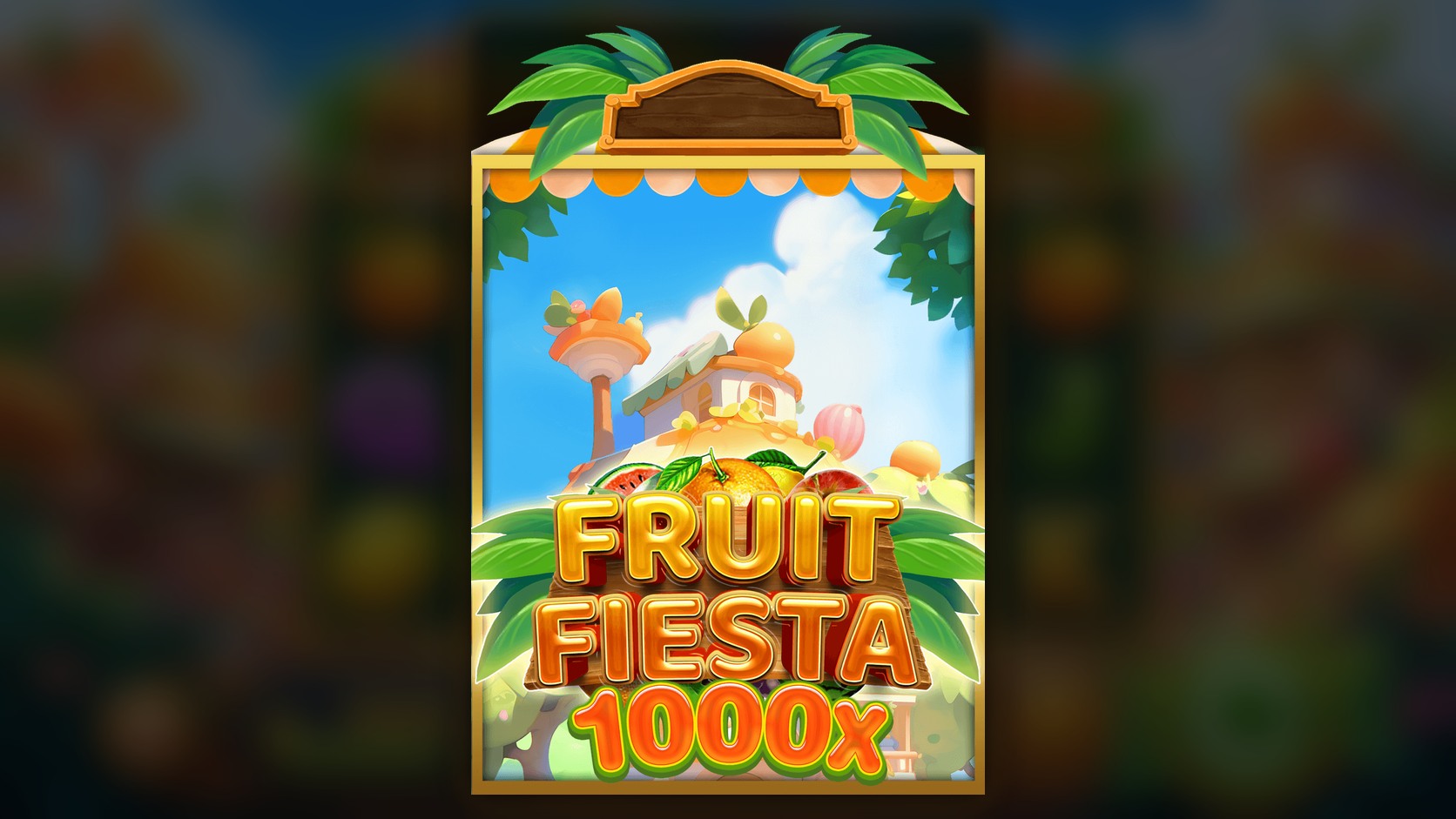
Fruit Fiesta 1000 does not need a long story to state its identity. The official key art frames an orange-roofed village with tropical leaves and the Fruit Fiesta 1000x logo. The first impression is sunny market-day momentum, with sky blue, leaf green, citrus orange and market-stall gold controlling the frame. The important work starts after that impression. Cosmo Play lists the title in its live game catalogue with game code 001A. Public material confirms the title and theme, but the full mathematical sheet was not exposed during this review. The external demo hand-off also stopped at its redirect page. Exact RTP, volatility, feature frequency and maximum award therefore remain version checks rather than facts to guess. This review studies the official identity, reel readability, mobile layout, likely rule questions and a safe method for auditing the deployed game. The three horizontal pictures use the official cover as their visual anchor. The first preserves the source art; the next two are editorial reconstructions for layout analysis and are not live wagering results.
The First Ten Seconds on the sunny fantasy fruit village
Fruit Fiesta 1000 opens with sunny market-day momentum. The fruit market itself rather than a human mascot and oranges, watermelons, lemons, grapes, cherries and fruit baskets are not background ornaments; they form a visual hierarchy that tells the eye where to look before any rule has been read. The reel area sits inside that hierarchy, so symbols remain distinct from the scenery instead of dissolving into it.
That first reading matters on a phone. A slot may spend heavily on illustration and still fail if the stake, spin control or settled result is hard to locate. Here the strongest idea is not mere decoration. It is the way sky blue, leaf green, citrus orange and market-stall gold separates the game board, framing art and controls into layers.
What the Official Material Actually Confirms
Cosmo Play lists the title in its live game catalogue with game code 001A. The official key art frames an orange-roofed village with tropical leaves and the Fruit Fiesta 1000x logo. Those points can be treated as sourced identity. They confirm the product name, studio and visual direction, but they do not establish the exact return setting, volatility band, reel mathematics or highest possible award in every casino build.
This distinction is the backbone of a serious review. A directory card proves that the title exists. It does not replace the information panel inside the running client. Operators can host separate certified configurations, local stake ranges and regional limits while using the same logo and artwork.
Why This Review Does Not Invent a Percentage
The public catalogue did not expose a full paytable during this check, and the external demo stopped at its redirect screen. Printing a familiar 96 percent figure would make the article look complete while adding unsupported data. The honest position is simpler: read the RTP inside the loaded version before placing a real-money stake.
The same rule applies to volatility and maximum win. A theme can suggest pressure or abundance, yet artwork has no mathematical authority. Until the client states those values, they remain unconfirmed. Readers gain more from a clear gap in the record than from a neat figure borrowed from another slot.
The 1000 in the Name Needs a Rule Behind It
The word 1000 is the headline hook. It raises an obvious question: does it describe a multiplier, a progression, a visual motif or simply the scale of the story? Only the help screen can answer that. A number or power word in a logo is not automatically the highest cash ratio for a paid round.
Before treating the title as a promise, locate the line that defines it. Check the triggering symbols, the stage at which the value applies, any stake multiplier, the cap on simultaneous wins and any separate cash ceiling. If those conditions are absent, the name should remain a marketing label rather than a calculation.
Reel Geography Before Symbol Values
Start by counting columns, rows and the method used to judge a win. A five-column picture can still use fixed lines, all-ways, clusters or another rule. Lines normally require a path from an edge. Ways usually need matching symbols on adjacent reels. Cluster systems depend on touching groups rather than a left-to-right route.
The editorial screen used here presents five vertical columns because that format makes the symbol discussion readable. It is a visual reconstruction based on the official key art, not proof of the certified grid. The active client remains the final source for row count, paylines and symbol adjacency.
A Symbol Ladder Built From oranges, watermelons, lemons, grapes, cherries and fruit baskets
The theme naturally divides the reel set into character or object symbols, special icons and rounded card ranks. oranges, watermelons, lemons, grapes, cherries and fruit baskets carry more visual weight than the letters and numbers. That weight usually signals premium status, but the paytable may rank two similar objects very differently. Size and shine are clues, never final values.
Read every payout in the unit used by the game. Some tables show bet-per-line units; others use total stake. A five-of-a-kind figure can appear ten or twenty times larger if the unit is misunderstood. The cash meter after a test spin is useful, but the written help panel should settle the conversion.
Why the Low Symbols Still Matter
rounded card ranks occupy a large share of ordinary reel time in the editorial layout. They create visual breathing room around the premium art and make small combinations quick to recognize. Their role in the mathematical model may be larger than their small paytable values suggest because frequency and value are separate parts of return.
A low-symbol hit can light the grid while returning less than the amount staked. That is a paid result, not necessarily a profitable round. The correct comparison is final credit divided by the full spin cost. Animation length, coin count and sound volume do not change that ratio.
Premium Art Should Not Hide the Payline
Large portraits and objects such as oranges, watermelons, lemons, grapes, cherries and fruit baskets can dominate the frame. The practical test is to follow one settled combination from its first symbol to its last without relying on flashing borders. Clear spacing between reels, consistent icon silhouettes and a visible route make the result easier to audit.
If several awards arrive together, open the win breakdown or history panel. One total may contain multiple lines, an anywhere payment and a modifier. Treating the largest symbol on screen as the sole cause can produce a false reading of the rule, especially when a substitute or multiplier is also present.
Wild Symbols Need Three Answers
A Wild description is incomplete until three points are known: which symbols it copies, where it can land and if it carries its own value or multiplier. It may exclude Scatters, bonus icons or jackpots. Some Wilds expand or stay in place; others do nothing beyond substitution. The artwork cannot settle those exceptions.
When a Wild appears, compare the marked winning path with the natural symbols around it. Then check if the game pays the best valid combination or adds a separate Wild award. This small audit prevents a common error in which every decorated emblem is assumed to copy everything on the board.
Scatter Is a Position Rule, Not Just a Picture
A Scatter generally counts across specified reels or anywhere on the grid, but the required count and eligible positions vary. Three matching icons might start a feature in one version and merely pay in another. Some titles require the first, third and fifth reels; others accept any three positions.
Record the full trigger screen before naming the rule. Count the symbols, note their reels and wait for the award message. If the next screen changes mode, check the starting counter and carried stake. One observed trigger explains a route; it does not estimate how often that route will happen.
Reading the 1000x progress meter Without Guesswork
The 1000x progress meter creates a visible sense of progress. Progress meters can represent collected symbols, increasing multipliers, bonus eligibility or only animation state. A partly filled gauge does not by itself mean that the next paid round has better odds. Its rule must say if progress persists, resets or is cosmetic.
Watch the meter across a complete cycle. Note what makes it move, what happens at the endpoint and what survives a page refresh. If it resets after every spin, it is probably summarizing one result. If it carries across spins, the rules should explain the stored state and any conditions attached to it.
The Base Game Has Its Own Job
Many reviews rush past the paid reels and treat the bonus as the only meaningful part. That misses the money path. Base spins create nearly all turnover, settle small and medium awards, and decide how long a balance remains available. A rare feature cannot repair a stake level that is too high for the intended session.
Fruit Fiesta needs ordinary results that are readable at a glance. A clean board lets the user distinguish a no-win, a partial return and a profit without waiting for a long count-up. That clarity is especially important when the surrounding sunny fantasy fruit village is busy and the screen uses strong motion.
What fruit-multiplier escalation Should Change
A named feature earns its place only when it changes a rule, not merely the background. fruit-multiplier escalation might alter symbol frequency, add a multiplier, hold positions, expand the grid or award extra spins. The rules panel should identify the change in plain terms and state when the mode ends.
During a test, compare one feature round with one ordinary round at the same stake. Look for changes in reel height, symbols, route count, meter behavior and win calculation. If the screen only adds effects while settlement stays the same, the feature is a presentation layer rather than a separate mathematical phase.
Multipliers Must Be Attached to Something
A multiplier can act on one symbol, one line, the current cascade, all wins in a free-spin round or the final feature total. Saying that a game has multipliers leaves the crucial calculation unanswered. The placement of the number and the wording of the win message usually reveal the scope.
Also check if several multipliers add or multiply together. Two visible 2x values could mean 4x, a combined 4x through addition, or separate modifiers on different awards. The history entry after settlement is the safest way to test. Never extrapolate the top result from a promotional badge alone.
A Large Win Animation Is Not the Win Cap
Clients often label results with tiers such as big, mega or super. Those labels are commonly based on the ratio between win and current stake. They do not prove that the result reached the mathematical ceiling. The count-up may also stop at a cash cap even when the theoretical symbol total is higher.
To calculate a genuine ratio, divide the credited result by the total stake removed for the paid round. Include free follow-up actions inside that same round unless the rules state otherwise. This method turns a loud presentation into a comparable number and avoids confusing coins on screen with peso value.
First Image: The Official Identity
The first picture keeps the official vertical key art intact and places it inside a horizontal frame. It is the best reference for the exact character, logo and theme. The blurred side field expands the composition without replacing the central artwork, so readers can recognize the catalogue card on a wide article layout.
It should not be used as a paytable. The art communicates sunny market-day momentum, but it contains no certified return value, reel map or probability. Its purpose is identity: it confirms that the discussion belongs to Fruit Fiesta 1000 rather than another title using a similar sunny fantasy fruit village.
Second Image: A Base-Game Reconstruction
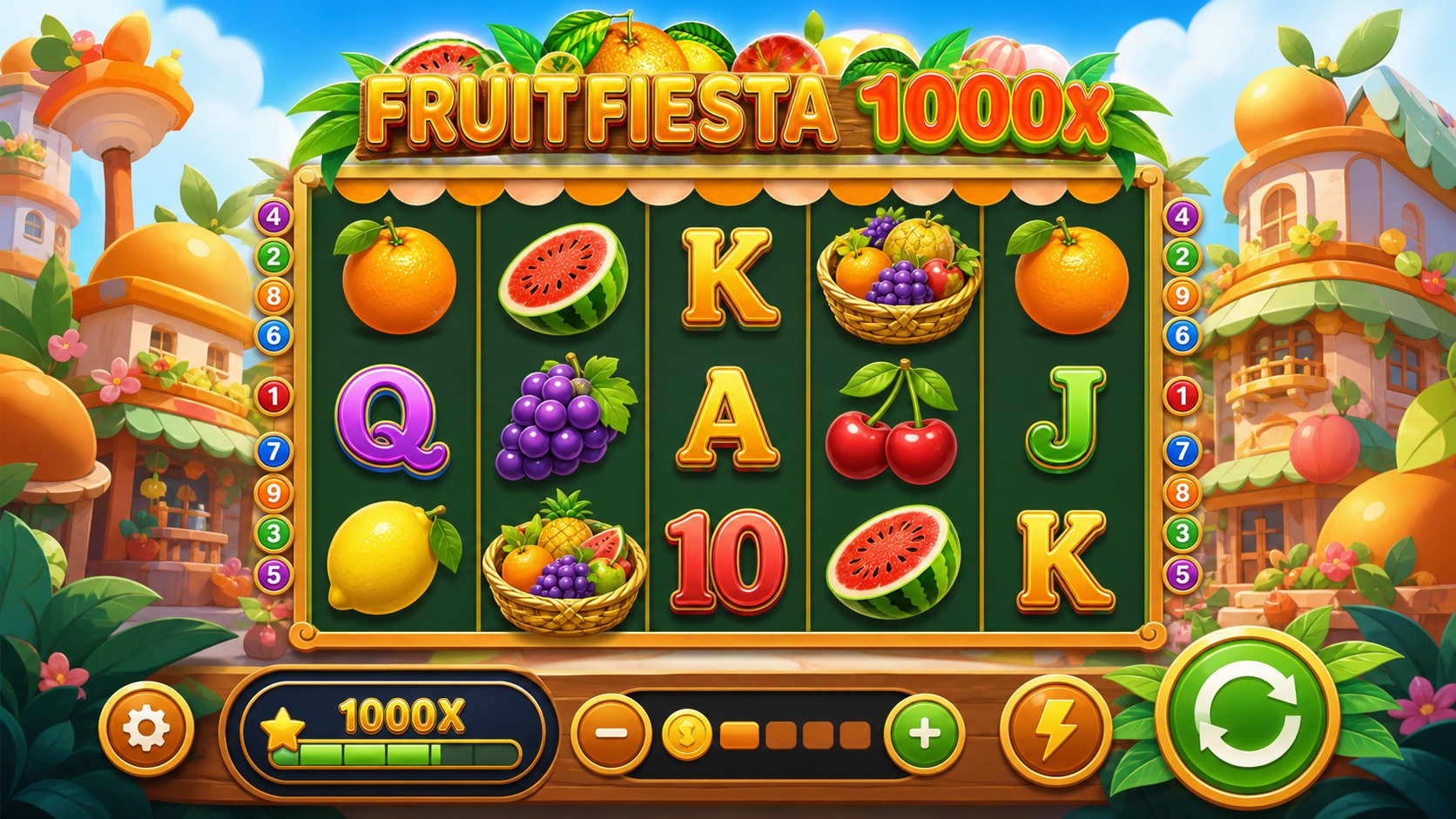
The second picture is an editorial reconstruction built from the official visual language. It demonstrates how oranges, watermelons, lemons, grapes, cherries and fruit baskets can sit around a central reel area in landscape mode. Controls, meters and symbols are arranged for analysis, not copied from a live real-money session.
That distinction protects the review from a false claim. The image helps readers picture symbol hierarchy, thumb reach and screen balance, while the written article reserves exact mechanics for the deployed help page. No balance, result or multiplier in the reconstruction should be treated as a recorded outcome.
Third Image: Studying a Feature State
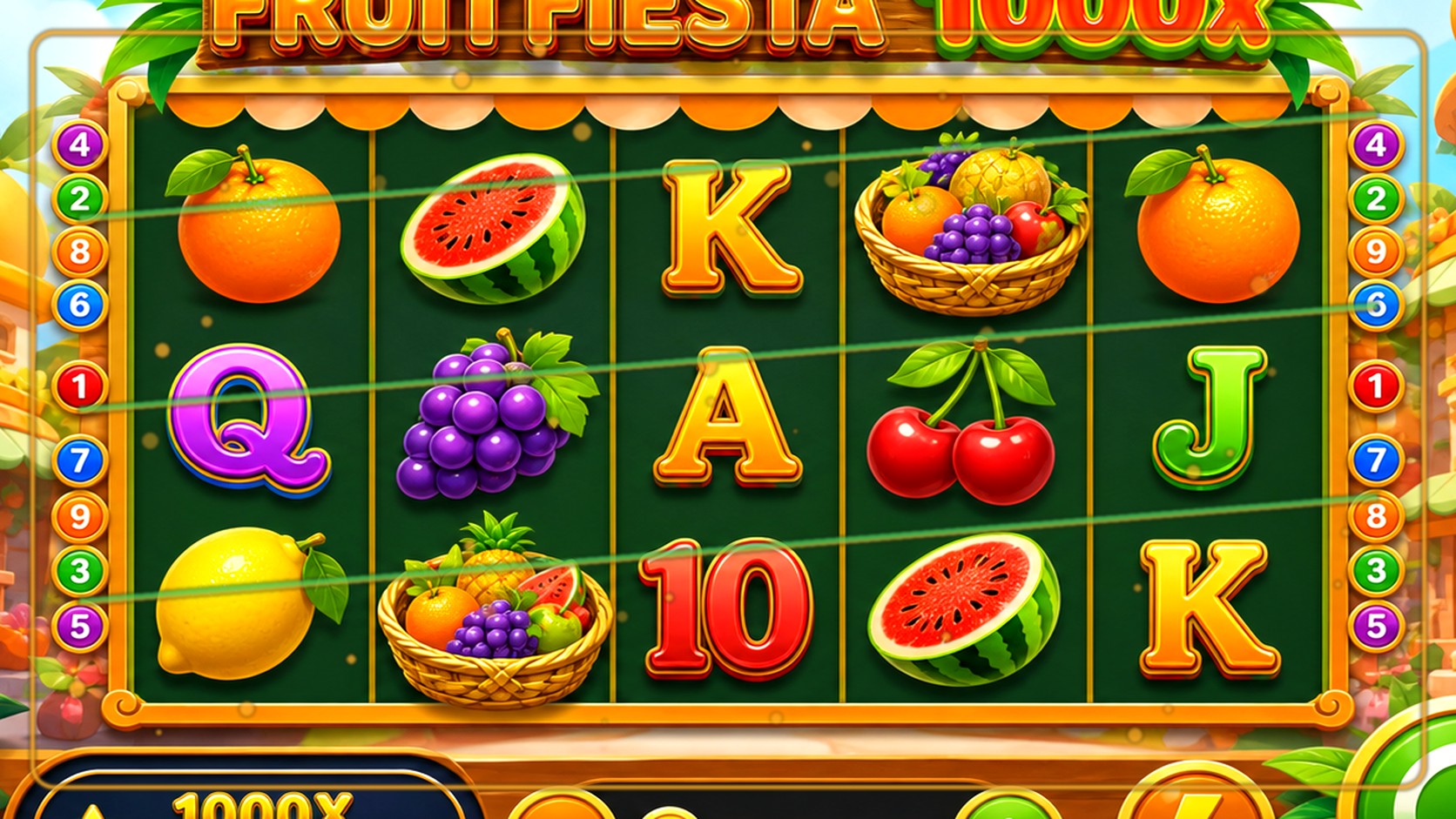
The third picture crops the reel field and adds highlighted paths to focus attention on settlement. It represents the moment when several symbols and modifiers demand a closer audit. The framing is useful for explaining why a total result may contain more than one component.
A live client should make this process even clearer through a history panel. The user needs to see the original stake, each component award, any multiplier and the final credit. If the interface hides those parts behind a single animation, take a screenshot before the next spin clears the evidence.
Sound Design and Perceived Pace
sunny market-day momentum can be strengthened through layered music, reel-stop cues and short feature stingers. Sound is useful when it marks a trigger or completed calculation. It becomes less useful when every partial return receives the same fanfare as a clear profit.
Try several rounds with audio lowered. If the board still communicates outcome, the interface is doing its job. If the result becomes ambiguous without a voice line or long count-up, the visual feedback needs more attention. Audio should confirm settlement, not replace the numbers.
Landscape Play and Thumb Reach
A horizontal phone gives the sunny fantasy fruit village room on both sides of the reels. The central board remains large while settings, stake controls and spin can occupy the lower band. This arrangement works best when the largest button sits away from the minus and plus controls.
Before rapid play, rotate the device, enter full screen and check the total-stake field after one adjustment. Browser bars and system gestures can cover edge controls. A test spin at the minimum setting confirms that the hit boxes match the visible buttons and that no accidental Max Bet control sits beneath the thumb.
Portrait Mode Is a Compromise
Portrait layout may scale the entire game down or reorganize controls beneath the grid. Tiny payline markers and condensed help text are the first casualties. The screen can remain playable, yet accurate rule reading becomes harder when the table requires repeated zooming or horizontal swipes.
Use portrait mode for quick navigation, not for the first rules check. Landscape is the better place to compare total stake, balance and win because all three can remain visible together. The relationship between those numbers matters more than keeping the device in one hand.
Performance on Mid-Range Phones
The artwork uses multiple layers, large character cutouts and particle effects. On a mid-range handset, watch for delayed button response after a count-up, audio falling out of step with the reels or a stake change taking effect one round late. Those are interface problems, not signs of altered probability.
Close other heavy apps and use a stable connection during the first session. If the client reconnects, verify balance and the last completed round in history before spinning again. A frozen animation can recover after the server has already settled the result, so the account record takes priority over the last visible frame.
Stake Controls Deserve More Attention Than the Mascot
The large 1000 branding can become the only number a reader remembers, even when the active rules attach conditions to it. The most useful habit is to read total stake after every change and before the first rapid sequence. Bet per line, coin value and total bet may occupy separate fields, and altering one can multiply the final debit.
A planned session should be written in money, spins and time. Divide the session amount by the intended number of paid rounds to find a workable average stake. Free actions do not add a new debit unless the client states a purchase. This arithmetic is dull, but it controls exposure more reliably than any theme-based hunch.
RTP Belongs to Turnover, Not a Short Run
Once the deployed RTP is known, interpret it as a long-run model ratio. If the help page lists 96 percent, theoretical cost is four units per hundred units of turnover. That sentence is an example of the calculation, not a claim that this version uses 96 percent.
Turnover equals total paid stake across accepted rounds. A hundred spins at one unit create one hundred units of turnover even if several free actions appear between them. A short session may finish far above or below the model ratio because random outcomes do not settle into a neat percentage on demand.
Volatility Is About Distribution
Volatility describes how payout value is spread across outcomes. A higher band usually places more weight in less common large results; a lower band usually returns more of its value through smaller payments. The label does not state when a feature will arrive or how long a losing sequence can last.
Without an official band, infer nothing from sunny market-day momentum. A calm fruit village can use severe math, and a battlefield can use a mild distribution. After the label is found, use it to size stake and session length, not to forecast the next reel stop.
Maximum Win Needs a Denominator
A maximum written as 1000x or 5000x must say what x means. It may refer to total bet, coin value, feature stake or a base amount before an ante. Some clients also apply a fixed cash ceiling. The lower of the mathematical award and cash cap may be the amount actually credited.
Check if the cap ends the feature immediately or allows remaining actions to play without added credit. Also check if simultaneous line, Scatter and jackpot awards share one cap. A headline number without these conditions is incomplete and should never be used to set a spending target.
A Clean Demo Test in Thirty Paid Rounds
Use the minimum fixed stake and create one row for each paid round. Record starting balance, debit, base credit, feature credit, ending balance and any meter change. Keep free actions inside the row of the spin that triggered them. This format exposes the money flow without treating a tiny sample as statistical proof.
Thirty rounds are enough to learn button behavior, symbol settlement and feature messages. They are not enough to estimate RTP or trigger frequency. The purpose is mechanical literacy. Stop the test once each major control has been checked; more spins do not turn an informal sample into certification.
How to Audit a Bonus From Start to Finish
Capture the trigger screen, starting counter, carried stake and opening multiplier. Then note each retrigger, held symbol, expanding reel or meter reset. At the end, compare the feature total with the history record and final balance. Every free action should trace back to one paid round.
If a purchase button exists, treat it as a separate bet mode. Record its price as the full stake for that round and read its RTP entry independently if the client lists one. A purchased feature may use the same animation while carrying a different cost structure.
Common Misreads Around Fruit Fiesta 1000
The first misread is assuming that 1000 states the unconditional top award. The second is assigning premium status solely from symbol size. The third is treating a filling 1000x progress meter as proof that a feature is due. The fourth is calling every substitute a multiplier Wild without checking the rules.
The fifth is copying an RTP from an unrelated review. The sixth is counting free actions as fresh paid spins. The seventh is judging profit from the win banner instead of balance movement. Each mistake disappears when the player keeps the stake field, history panel and help page in the same audit.
What Philippine Players Should Verify
A Philippine listing may use peso values, wallet credits or a converted coin display. Confirm the minimum and maximum total stake, not merely coin size. Check that the operator names Cosmo Play as the studio, and compare the logo with the official key art before assuming that a similarly named title is the same product.
Also read local rules for feature purchases, autoplay, session reminders and cash limits. These controls belong to the operator build and jurisdiction. A screenshot from another market can explain layout, but it cannot establish the available stake range or certified return in a Philippine account.
Who Gets the Most From This Theme
readers who prefer fruit symbols, a light daytime setting and an obvious number-led hook will find the presentation immediately legible. The theme also suits short review sessions because the visual hierarchy can be judged quickly. That does not make the mathematical profile suitable for every budget; the actual volatility and minimum total stake still control that decision.
Anyone who dislikes dense side art or loud event effects should test the sound and fast-play controls first. A strong theme can be a reason to open a demo, but it is not a reason to ignore the paytable. Interest in the artwork and comfort with the stake are separate choices.
A Practical Decision Checklist
Before real play, confirm the exact title, studio, RTP, volatility, win method, Wild exceptions, Scatter route, feature trigger, multiplier scope, maximum-win denominator and cash cap. Then set a total session amount and a stopping time. If any critical rule remains hidden, keep the title in demo mode.
During play, watch balance rather than animation. After play, compare opening balance, deposits, withdrawals and ending balance with the history log. This checklist does not change random results. It changes how clearly the cost and settlement can be seen.
Final Reading: Theme First, Math Before Money
The fruit village is clear, warm and easy to scan. The decisive issue is what 1000 means in the deployed rules, because a title number alone cannot establish a cap, multiplier path or reachable frequency.
Fruit Fiesta 1000 earns attention through sunny market-day momentum and a tightly coordinated sky blue, leaf green, citrus orange and market-stall gold palette. The next step is not a larger stake; it is the local information screen. Confirm the deployed math, test the controls at minimum value and treat every visual promise as a question that the rules must answer.
Separating Hit Rate From Profit Rate
A hit is any result the rules count as a payment. Profit requires the credited amount to exceed the full stake for that paid round. A title can register frequent small hits while the balance declines. Without an official hit-frequency figure, the only safe statement is that the two rates are not interchangeable.
For a demo log, mark return ratios below 1x, exactly 1x and above 1x in separate columns. This reveals how many recorded wins were partial returns. It still does not predict future play, but it gives a much clearer account of the sample than a simple count of flashing win messages.
Near Misses Are Animation, Not Progress
A bonus icon stopping just outside a payline or a premium symbol passing during reel motion can feel meaningful. Unless the written rule stores that event, it has no carry-over value. The next accepted round is not improved because the previous animation looked close.
The same caution applies to two trigger symbols when three are required. They may create suspense, yet their payment and stored effect depend entirely on the table. Record what was credited, then clear the image from the decision about the next stake.
Fast Play Changes Exposure Speed
Fast play shortens animation; it does not normally change the random model. Its financial effect comes from time. More paid rounds can fit into the same minute, so the balance may move faster even though the stake per round stays fixed.
Measure pace before enabling it. Ten ordinary rounds on standard speed and ten on fast speed reveal the difference in turnover per minute. If the faster rate breaks the planned session limit, lower the stake or return to standard timing rather than relying on attention alone.
Autoplay Needs Stop Conditions
Where autoplay is available, set a round count and use any loss, win or single-award limits shown by the client. Read those fields carefully because some are cash values while others are stake multipliers. An empty field may mean no automatic stop for that condition.
Remain present during automated rounds. Network reconnection, a feature choice or a changed balance can pause the sequence. Autoplay is a convenience control, not a budget system, and it does not make a long sample more likely to follow the theoretical return.
Responsible Play in Plain Numbers
Set a sum that can be lost without affecting bills, savings or debt payments. Do not borrow to play, do not chase a prior loss and do not treat a rare large result as income. Time reminders and deposit limits are useful because strong game art can blur the length of a session.
If play stops feeling optional, close the client and use the operator exclusion or limit tools. The clearest review of any slot ends with the same fact: outcomes are random, the house keeps a mathematical margin over long turnover and no visual pattern creates a reliable edge.