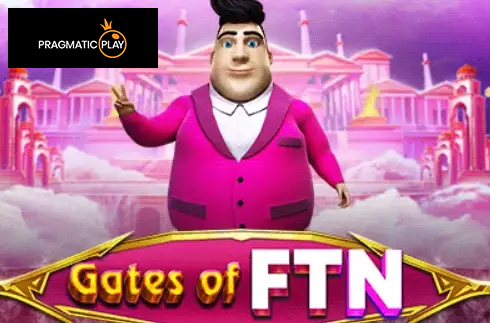






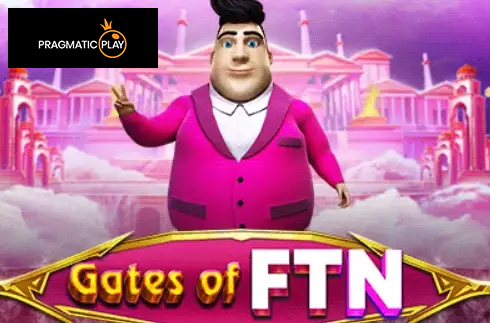

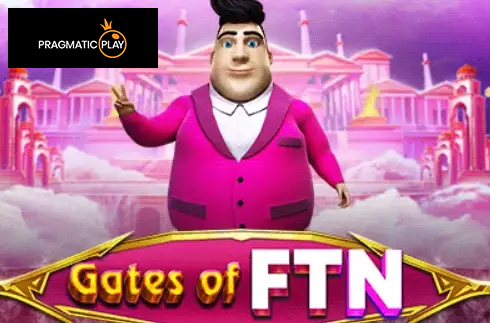
Gates of FTN takes a familiar mathematical engine and gives it a very specific face. The white-bearded ruler from Gates of Olympus is gone. In his place stands a broad, black-haired host in a hot-pink suit, framed by rose-colored clouds, gold gates, and a palace that looks more like a private celebration than Mount Olympus. The change is immediately visible, but the deeper identity of the slot still sits in its 30 positions, tumbling symbols, and winged multiplier spheres.
That distinction matters because Gates of FTN is not best understood as a separate mechanical invention. It is a customized Pragmatic Play release built around the proven Gates formula. The screen asks for eight or more matching symbols anywhere on a 6×5 board. A qualifying group disappears, replacements fall, and the process repeats until the grid can no longer form another payment. Multiplier symbols may then transform the value of the entire tumble sequence.
The game was released in late 2023, with public catalogs usually showing either 15 November or 8 December. The difference most likely reflects an early distribution date and a wider catalog date rather than two separate games. The commonly listed figures are 96.50 percent RTP, high volatility, a 5,000× maximum, and stakes beginning around 0.20. The upper stake changes across currencies and operators, so the active information panel remains the final authority.
The FTN Name Changes the Host, Not the Core Calculation
The strongest first impression comes from the presenter. He is dressed for a modern pink-carpet event, not a Greek throne room. His oversized proportions, sculpted black hair, and open-handed pose make him read like a celebrity host who has been promoted to palace owner. The setting follows him: magenta light replaces the blue-white lightning usually associated with Zeus, while the gold architecture keeps the Gates connection recognizable.
Under that surface, the game behaves like the original Gates of Olympus framework. It uses a six-column, five-row board with pays-anywhere counting. It has no ordinary left-to-right line requirement, no need for touching clusters, and no Wild symbol. A group pays because enough copies of one regular symbol are present among the 30 cells, regardless of where they sit.
The phrase cluster pays is often attached to the game in directories, but it is not the most exact description. In a strict cluster slot, matching symbols normally need horizontal or vertical contact. Gates of FTN counts scattered copies across the whole grid. A crown in the upper-left corner can join another crown in the lower-right corner. Eight crowns divided into several isolated pockets still reach the first payment band.
This also explains why the grid feels more legible after a few rounds. The relevant question is not where a line starts. It is how many copies of a symbol exist. The location matters only indirectly because winning symbols disappear, and the survivors shape the next tumble.
The FTN skin therefore changes tone more than structure. Someone familiar with the standard Gates engine will recognize the board logic almost immediately. Someone arriving for the pink-suited character must still learn that the charming host presides over a high-volatility model with a large distance between ordinary boards and the strongest multiplier sequences.
Thirty Positions Are Counted as One Field
Each paid spin begins with 30 symbol positions. The regular symbols are divided into royal artifacts and lower-value jewels. A payment starts at eight matching copies. The second band is reached at ten or eleven. The highest regular band begins at twelve and extends all the way to a theoretical full-board result.
The anywhere rule removes a common source of confusion. Symbols do not need to sit on adjacent reels, form a rectangle, or connect through a central tile. If eight matching blue gems land in eight separate places, they still qualify. Seven matching symbols do not pay, even if they form a neat shape. Quantity is decisive.
Once the board contains one or more qualifying groups, every winning symbol is removed. Non-winning symbols remain where gravity carries them, new symbols enter from above, and the entire 30-position field is checked again. Another group of eight or more creates another payment and another drop. There is no fixed number of tumbles attached to the original stake. The sequence ends only when the refreshed board has no paying count.
Several symbol groups can pay on the same evaluation. If the board contains eight blue gems and eight green gems, both amounts are included before those symbols disappear. The large removal leaves fourteen other positions occupied and sixteen openings for replacements. That amount of empty space can produce a very different second board.
Survivors are important. Suppose the first screen contains eight blue gems and six purple gems. The blue group pays and disappears; the purple group does not. If two more purple gems fall into the openings, the six survivors become an eight-symbol payment on the next evaluation. The first result created room for a second result that was already partly assembled.
This is the main source of continuity between tumbles. New symbols are random, but the board is not fully redrawn after every payment. Non-winning copies remain. A weak-looking group can become relevant after another symbol family clears space.
The screen can also create very visible near misses. Seven crowns may occupy almost a quarter of the board and still return nothing as a crown group. That can feel harsher than missing a hidden payline because the failed count is easy to see. The rule is transparent, but transparency does not make the threshold forgiving.
The Paytable Has Three Very Different Levels
The regular paytable uses nine symbols in the established Gates family. The premium artifacts are the crown, hourglass, ring, and chalice. The lower group consists of red, purple, yellow, green, and blue jewels. Values are measured against the total stake for the spin.
The crown sits at the top. Eight or nine crowns pay 10×, ten or eleven pay 25×, and twelve or more pay 50×. This makes the first crown band meaningful before any multiplier arrives. It also makes the jump from seven to eight unusually severe: seven crowns pay nothing, while the eighth crosses directly into a double-digit multiple.
The hourglass pays 5×, 15×, or 25× across the three count bands. The ring pays 3×, 10×, or 15×. The chalice pays 2×, 5×, or 12×. These artifacts can build a substantial sequence through ordinary tumble arithmetic, especially when a premium win removes a large part of the grid and another premium count follows.
The red jewel leads the lower group at 0.5×, 2×, or 5×. Purple pays 0.4×, 1.5×, or 4×. Yellow pays 0.3×, 1×, or 3×. Green pays 0.25×, 0.75×, or 2×. Blue pays 0.25×, 0.5×, or 2×.
These values explain why animation length is a poor measure of result quality. A tumble chain containing several eight-symbol blue groups may last longer than a single crown payment, yet its cash total can remain much smaller. Count, symbol identity, and multiplier timing matter more than the number of drops shown on screen.
The upper bands also create sharp value changes. Twelve purple jewels are worth ten times the eight-symbol purple payment. Twelve red jewels are worth ten times the eight-symbol red payment. Removing another two or four symbols does not merely enlarge the picture; it can move the group into a much stronger paytable tier.
There is no Wild to bridge gaps because there are no line gaps to bridge. Adding a Wild to a pays-anywhere count would change the probability structure substantially. Gates of FTN instead reserves its special-symbol budget for Scatters and multiplier spheres.
A Tumble Is One Accounting Sequence
It helps to separate a spin, an evaluation, and a tumble sequence. The spin is the paid action. An evaluation is one check of the 30 positions. The tumble sequence contains the first evaluation plus every replacement drop created by payments from that spin.
Regular symbol wins from all evaluations are added together. If the first board pays 0.5×, the second pays 2×, and the third pays 10×, the unmodified sequence total is 12.5×. The stake is not charged again for the second and third boards. They belong to the original spin.
The distinction becomes crucial when multiplier symbols appear. A multiplier sphere does not multiply only the nearest symbol group. It is tied to the completed winning sequence. Multiple spheres are added to each other, then their combined value is applied according to the mode in play.
Consider a base-game sequence with regular payments of 0.5×, 2×, and 10×. If a 5× sphere and a 10× sphere participate in that winning sequence, their values combine to 15×. The 12.5× regular total becomes 187.5×. The multipliers are added, not multiplied by one another. Treating 5×10 as 50 would overstate the result.
The game waits until the sequence has finished before the final multiplication animation. That delay is part of the tension. A sphere may be visible while more symbols fall, but its true value depends on the regular wins accumulated underneath it.
Base-Game Multipliers Can Be Huge and Still Pay Nothing
Winged multiplier symbols are the most recognizable part of the Gates engine. Public rules list values from 2× up to 500×. The documented set commonly includes 2×, 3×, 4×, 5×, 6×, 8×, 10×, 12×, 15×, 20×, 25×, 50×, 100×, 250×, and 500×.
A large printed number is not automatically a payment. The tumble sequence must contain a regular-symbol win. A 500× sphere on a board with no group of eight is visually dramatic but financially inert. It disappears with the dead board because there is no sequence amount to multiply.
The same limitation applies to a multiplier arriving after a tumble. If replacement symbols fail to create another regular win, the sphere has no qualifying sequence result to affect. This is one reason the slot can produce memorable false alarms. The rare-looking object is present, yet the other half of the equation is absent.
If more than one sphere lands during a winning sequence, their values are summed. A 2×, 10×, and 25× set creates 37×. The game does not apply one multiplier after another. This additive method puts the true emphasis on a useful regular-symbol total and a collection of spheres appearing in the same sequence.
Multiplier timing has a different meaning in the base game than it first appears. Because the final combined multiplier applies after the completed winning tumble sequence, an orb that joins later can still affect the regular wins collected earlier in that sequence. It does not need to sit on the opening board. What matters is that the spin remains alive through payments and that the multiplier is counted as part of the active sequence.
The strongest base-game pattern is therefore not simply a large sphere. It is a long enough winning chain to accumulate a useful regular total while one or more multiplier symbols join before the chain ends. A modest sphere paired with a premium-symbol sequence can be worth more than a 100× sphere attached to a 0.25× blue-gem payment.
Four Scatters Open the Main Round
The Scatter uses the host or branded emblem, depending on the client build. Four or more Scatters on one board open 15 free spins. The Scatters do not need to touch, and their location does not matter.
The Scatter symbols also carry direct awards. The familiar Gates schedule pays 3× for four, 5× for five, and 100× for six. The six-Scatter jump is intentionally steep. It adds a large immediate amount before the free-spin calculation begins.
Fifteen spins is a larger starting count than many modern slots use, but the number alone does not predict the round. The core multiplier may remain low for much of the feature, or a strong value may arrive early and affect a series of later wins. Two bonus rounds with the same spin count can therefore finish very far apart.
Three or more Scatters inside the feature add five free spins. The retrigger threshold is lower than the entry threshold. Repeated retriggers are possible, subject to the rules and maximum-win cap of the installed build. The extra spins matter most after the running multiplier has already grown, because each later regular win then receives the accumulated figure.
Some clients include a direct purchase button. The common price is 100× the selected stake for immediate entry into the same 15-spin round. This is not a richer version of the bonus. It changes the route into it. Local regulations may remove the purchase control entirely.
Free Spins Turn Separate Orbs Into a Persistent Total
The most important rule change occurs after the four-Scatter trigger. In the base game, multipliers belong to one winning tumble sequence and disappear afterward. In free spins, qualifying multiplier values feed a running total that remains active through the rest of the feature.
When a multiplier sphere lands as part of a winning spin or tumble, its value is added to the bonus total. If the meter has reached 12× and a 25× sphere is collected, the total becomes 37×. A second sphere worth 10× on the same sequence raises it to 47×. The resulting total applies to the associated win, then remains available for later winning spins.
This persistence changes the value of time. A 50× sphere on the second free spin has many remaining chances to multiply regular payments. The same sphere on the final free spin may affect only one result. The number printed on the orb is identical, but its position within the round changes its practical reach.
The bonus can begin quietly because it has not yet collected much multiplier strength. Early jewel payments under a small total may feel ordinary. If the meter rises, even an eight-symbol low jewel group can become meaningful. A 0.5× red-jewel payment under a 100× total becomes 50×. A 10× crown payment under the same total becomes 1,000×.
An orb still needs a winning event. A free-spin board displaying 500× with no regular group does not automatically add 500 to the meter under the standard rules. The multiplier must be attached to a winning spin or tumble. This condition prevents every orb sighting from permanently raising the bonus.
Multiple orbs on one winning sequence are added before the running total is applied. The reconstructed image below illustrates the logic with 2×, 10×, 25×, and 50× spheres. Those values sum to 87×. In an actual round, the meter may already contain an earlier amount, in which case the 87 would be added to that existing figure rather than replacing it.
Why Early Multiplier Growth Changes the Whole Round
Imagine a feature whose first winning spin creates 2× in regular-symbol payments and collects a 10× sphere. That spin is worth 20×, and the running multiplier remains at 10×. A later 3× regular result becomes 30× even if no new sphere appears.
Now suppose a 25× sphere joins a third winning spin. The meter rises from 10× to 35×. A 4× regular total on that spin becomes 140×. Every later winning event uses 35× until another collected sphere raises the figure again.
This creates a staircase rather than a reset. The round does not need a multiplier on every spin once a useful total exists. It needs ordinary wins to exploit the total already stored. Conversely, a huge meter near the end can remain underused if the remaining boards fail to reach eight matching symbols.
Retriggers interact with this structure directly. Five extra spins awarded after the meter reaches 100× are not mathematically equivalent to five extra spins at the start. The later set begins with the accumulated 100× still active. That is why a modest three-Scatter retrigger can become one of the most important events in a strong feature.
The 5,000× cap imposes a hard boundary. Once the maximum is reached, the game pays the capped amount and ends the round, even if free spins remain. A screen containing arithmetic that appears capable of passing the cap does not raise the final payment above the certified limit.
Ante Bet Changes Trigger Frequency, Not Symbol Values
Where local rules permit it, the Ante Bet raises the price of each spin by 25 percent. Its stated purpose is to double the chance of landing the free-spin round by adding more Scatters or using a modified reel set. The crown does not suddenly pay more. The multiplier range does not move beyond 500×. The extra cost is directed toward feature access.
This distinction is often blurred by short descriptions that call Ante Bet a higher-paying mode. The ordinary paytable remains expressed against the total amount charged, and the visible change is mainly the improved Scatter frequency. A reader should compare the displayed total stake before and after activation, not assume the denomination stayed constant.
The purchase button and Ante Bet are separate routes. A purchase skips the trigger chase for a fixed multiple of the chosen stake. Ante Bet keeps ordinary spinning in place but alters the chance of reaching four Scatters. Some installations disable one control when the other is active.
Neither route guarantees a strong feature. Fifteen free spins can finish with a small multiplier total, sparse regular wins, or both. Direct access removes waiting; it does not remove variance. The same certified random model governs the feature after entry.
RTP Is a Configuration, Not a Session Forecast
The figure most often attached to Gates of FTN is 96.50 percent. That is a theoretical long-run return for a specific mathematical configuration, calculated across a very large number of rounds. It is not a statement that 100 units played in one session should leave 96.5 units behind.
High volatility concentrates a meaningful share of the model in selective events: premium groups, repeated tumbles, multiplier symbols attached to wins, free-spin entry, and persistent bonus multipliers. A short sample can miss most of those events. Another short sample can hit one sequence large enough to dominate everything before it.
Pragmatic Play titles are frequently distributed in more than one certified RTP setting. An operator may install a lower-return configuration while retaining the same artwork and mechanics. The live help screen is therefore more reliable than a generic review page. It identifies the percentage for the exact client being played.
Mode-specific percentages may also appear. Standard play, Ante Bet, and direct bonus entry can have separate listed values. The headline 96.50 percent should not be copied onto every version without checking the in-game rules.
The 5,000× maximum is similarly specific. It is measured against the qualifying total bet, not against a single coin line. At the commonly listed maximum stake of 100, the theoretical cash ceiling would be 500,000 in the same currency. Some directories list an upper bet of 125 and a cash exposure of 625,000. That discrepancy reflects stake configuration rather than a different 5,000× multiplier cap.
The Visual Reskin Has More Personality Than the Rule Changes
The FTN edition is strongest as a character-led reskin. The hot-pink suit gives the host an immediately identifiable silhouette. Black lapels, a white shirt, and high sculpted hair stand against the pale palace and rose clouds. He looks less like a god and more like an entertainer who has acquired divine real estate.
Gold is used as a structural color. It frames the grid, outlines the title, decorates the gates, and identifies the premium artifacts. Magenta occupies the sky and interface panels. The lower jewels retain distinct shapes as well as hues, which is important on a board that asks the eye to count eight or more copies quickly.
The crown, hourglass, ring, and chalice separate cleanly from the simpler jewel group. Their outlines are larger and their gold surfaces carry more detail. The hierarchy is visible before the paytable is opened. A screen heavy with artifacts looks more significant because the icons themselves signal their premium rank.
Tumble animation removes every member of a winning group together. That visual sweep teaches the anywhere rule better than a payline diagram could. A scattered collection disappears at once, showing that distance and adjacency were irrelevant.
Multiplier spheres use wings, thick gold trim, and large numerals. The values are readable at phone size, and their round shape prevents confusion with ordinary jewels. The free-spin meter receives the same magenta-and-gold treatment, keeping the stored multiplier visible while the grid changes beneath it.
The sound design follows the Gates blueprint: airy palace ambience, hard chimes for artifacts, descending impacts as symbols land, and a rising cue when a multiplier joins a payment. The host reaction adds spectacle, but the most useful audio information is mechanical. The sound marks removal, replacement, multiplier collection, and final sequence settlement as separate stages.
Landscape Mobile Play Fits the Layout
The six-column grid naturally favors a horizontal phone orientation. The board can occupy most of the center while the host remains visible at one side and the spin control sits along the bottom. A portrait wrapper may compress the host or move controls, but the underlying 6×5 field still needs enough width for the symbols to remain countable.
Large icon silhouettes help on smaller displays. Crown points, hourglass curves, ring openings, and chalice stems remain identifiable without reading tiny labels. The colored jewels also use different cuts, reducing dependence on hue alone.
The multiplier numeral is the most important small-screen element. A 2× sphere and a 250× sphere create radically different possibilities, so the number must remain legible during a fast tumble. Pragmatic Play's established interface gives the numeral priority over decorative detail.
Turbo and autoplay controls vary by market. Faster animation reduces waiting but can also make multi-stage accounting harder to follow. The win meter and multiplier meter remain better evidence than the speed of the visual celebration. Local responsible-play rules may remove autoplay or impose mandatory pauses.
The bottom bar normally groups stake controls, information, sound, and the main spin button. The selected total stake deserves attention when Ante Bet is active because the 25 percent surcharge changes the charged amount. A denomination label alone may not reflect the final per-spin cost.
What the Game Does Particularly Well
The first success is mechanical readability. Eight symbols anywhere is a rule that can be checked with the eye. Tumbles make the surviving board relevant. The absence of a Wild keeps the count literal. Multiplier spheres are visually separate and numerically explicit.
The second is the difference between base and bonus multiplier behavior. Base-game spheres create a sharp one-sequence event. Free-spin spheres build a persistent total. The same object therefore gains a second meaning without requiring another side game or wheel.
The third is the paytable hierarchy. Crowns entering at 10× make premium concentration matter before multiplication. Low jewels can still clear large areas and feed longer tumble chains, but they do not pretend to carry the same raw value as artifacts.
The FTN host also gives a widely copied mathematical format a distinct visual anchor. Many custom casino skins change little more than a logo. Here, the character, suit, sky, palace, and interface palette work together. The result is recognizable even in a small thumbnail.
Finally, the 5,000× cap is reachable through more than one conceptual route. A premium-symbol sequence with a strong base multiplier can approach it, while a free-spin round can build a large persistent total and apply it to later wins. The cap is fixed, but the path toward it is not confined to a single bonus animation.
Where the Pink Palace Feels Severe
The threshold of eight can produce long stretches of visually close boards. Six or seven matching symbols occupy plenty of space yet return nothing. Because all copies are visible at once, the near miss is easy to count and hard to ignore.
Multiplier spheres can intensify that frustration. Seeing 100× or 500× without a regular-symbol win is one of the defining disappointments of the format. The sphere is not a cash symbol. It is an amplifier waiting for an amount, and sometimes that amount never appears.
Base-game tumbles can also look larger than they pay. Several small jewel groups may create repeated removal animations while the unmodified total remains under 2×. A low multiplier does not transform such a chain into a major result.
The bonus has a second failure mode. It can collect a respectable running multiplier but produce too few later wins to use it. A 150× meter displayed during several dead spins is mathematically inactive. The feature needs both multiplier growth and regular-symbol concentration.
The custom skin does not substantially change these weaknesses. Anyone who disliked the original Gates model because of empty-looking multiplier appearances or highly uneven free spins will find the same structural pressure here. The pink host changes atmosphere, not volatility.
Public information around the release is also thinner than for the global Gates titles. Dates differ, stake ceilings differ, and some catalogs use cluster terminology while others use pays anywhere. The safest description separates verified shared mechanics from operator-specific settings.
Common Misreadings of the Screen
The first mistake is searching for paylines. The artifacts and jewels do not need to start on the leftmost column. A winning count can be spread across all six columns in any pattern.
The second is requiring symbols to touch. Eight isolated crowns pay exactly because the board counts copies anywhere. A compact block is not stronger than a scattered group if both contain the same symbol and the same quantity.
The third is treating a multiplier sphere as an instant prize. It needs a regular-symbol payment. A dead board with a large sphere is still dead.
The fourth is multiplying multipliers by one another. A 5× and 10× pair becomes 15×, not 50×. Their sum is then applied to the applicable win calculation.
The fifth is assuming the free-spin meter resets after each spin. It persists through the feature. New collected values are added to the existing total, which is why an early sphere can affect many later payments.
The sixth is assuming every printed RTP online belongs to the installed client. The help screen may show a different certified setting. Artwork does not reveal return percentage.
The final mistake is reading demo history as a prediction. A long sequence of dead demo spins does not make a feature due, and a recent 500× sphere does not make another less likely in a way a player can exploit. Each outcome comes from the certified random generator.
How Gates of FTN Sits Beside Other Gates Releases
The closest comparison is the original Gates of Olympus. Both use the 6×5 board, eight-symbol minimum, tumble system, 2× to 500× spheres, 15-spin feature, persistent bonus multiplier, high volatility, and 5,000× cap. FTN mainly changes the presenter and the surrounding art.
Gates of Olympus 1000 raises the ceiling and changes multiplier emphasis, so its risk profile should not be copied back onto FTN. Super Scatter editions add direct Scatter prizes that belong to their own rules. Fortune of Olympus moves to a 7×7 cluster arrangement and a 10,000× cap. Shared branding does not mean identical mathematics.
This makes FTN one of the purer custom-skin branches. It does not need a second meter, collector, hold-and-spin panel, or separate wheel. Its identity rests on the host and the pink palace while the classic Gates calculation remains visible underneath.
For readers comparing reviews, the decisive markers are simple: 30 positions, eight or more matching symbols anywhere, 500× maximum multiplier symbols, four Scatters for 15 spins, and a 5,000× win limit. A page that describes adjacent clusters, three-Scatter entry, or a 15,000× cap is probably mixing FTN with another release.
The Philippine Mobile Context
Gates-style games are easy to recognize on Philippine-facing mobile lobbies because the vertical list often shows only a title tile and studio badge. FTN's pink suit stands apart from the blue-and-gold Zeus artwork used by several neighboring titles. That thumbnail distinction is commercially useful in a catalog crowded with Gates variants.
Currency display may appear in Philippine pesos, but the mathematics remains stake-relative. A 10× crown payment means ten times the selected total stake in pesos, dollars, or any other supported currency. The operator sets available denominations and the final upper limit.
Local access rules matter more than the device. Some sites expose demo play, some require an account, and some disable the direct feature purchase. Those differences belong to the operator layer. They do not imply that the 6×5 grid or multiplier logic has changed.
Landscape play is the practical fit for common Android screens. It keeps the host, board, and meter visible together. A stable connection matters during visual playback, but completed round results are normally determined on the server; reconnect behavior depends on the casino client.
Final Verdict: The Suit Is New, the Pressure Is Familiar
Gates of FTN succeeds by knowing what to change and what to keep. The white-bearded god is replaced by a cheerful host in an unmistakable pink suit. Rose clouds and gold gates give the game its own lobby identity. The central calculation remains the hard, widely understood Gates model.
Thirty positions are counted as one field. Eight matching symbols begin a payment. Winning groups disappear, survivors remain, and replacements fall until the sequence stops. Premium artifacts can return up to 50× before multiplication, while winged spheres range from 2× to 500×.
The base game settles multiplier values against one completed winning tumble sequence. The free-spin round stores collected values in a running total that survives from spin to spin. That single contrast accounts for most of the game's depth. Early multiplier growth, later regular wins, and retriggers can reinforce one another; any one of them can also arrive without the others.
The weaknesses are just as clear. Seven matching symbols do nothing. A 500× sphere may land on a board with no payment. Fifteen free spins may build little, or a high meter may run out of useful boards. High volatility is not a label pasted onto the help screen; it is visible in the dependencies required for a large result.
As a custom Pragmatic Play release, Gates of FTN is more than a logo swap but less than a new mathematical species. Its personality comes from the presenter and pink palace. Its identity as a slot comes from pays-anywhere counting, tumbling survivors, additive multipliers, and a persistent bonus meter. The host smiles throughout, but the grid remains strict: eight symbols, a live tumble, and a multiplier attached to an actual win are the conditions that matter.