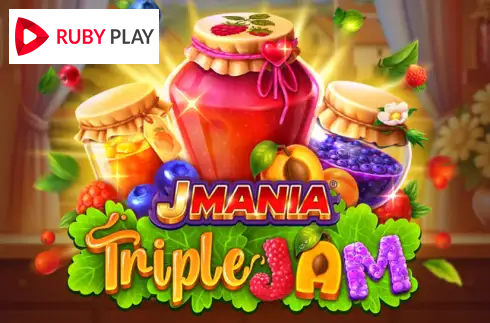







J Mania Triple Jam looks almost too small to carry a serious bonus system. There are only three reels, three rows, and 27 ways to win. The screen resembles a sunny country kitchen rather than a high-pressure casino floor. Jam pots sit beside berries and playing-card suits, while four jackpot meters hang above the reels like handwritten prices at a farm shop.
Then the center square starts to matter.
That single position becomes a sticky Wild in one mode and a collecting jar in another. A separate pick round can award one of four jackpots. A special Trigger Chance symbol may open any of those three routes without waiting for a standard scatter combination. The result is a compact slot whose real structure is hidden behind an unusually plain 3x3 layout.
Some casino lobbies place the title inside a PT or Playtech category. The official product page identifies RubyPlay as the developer, so this review treats PT as a lobby or aggregation label rather than the studio credit. That distinction matters because the rules, statistics, and artwork below come from RubyPlay material.
The numbers before the jam starts boiling
Developer: RubyPlay
Lobby label seen on some platforms: PT or Playtech category
Layout: 3 reels and 3 rows
Win system: 27 ways
Published RTP: 96.36%
Volatility: High
Published hit frequency: 37%
Maximum win: 5,000 times the stake
Main modes: Free Games, J Mania, and Jackpot Pick
Bonus purchase: 100 times the current total bet where the option is enabled
Those figures describe a slot with two very different faces. The 37% hit frequency suggests that some result appears fairly often, yet the high-volatility label and 5,000x ceiling point to a payout curve that is far less gentle than the small grid implies. Frequent contact with a win is not the same as frequent profit. A low-value three-symbol route can count as a hit while doing little to repair several empty spins.
The listed 96.36% RTP is the long-run mathematical setting published for the game. It does not predict the return of a short session, and a casino may run an approved configuration that differs from the headline version. The local information panel is the right place to confirm the active figure before wagering.
Nine positions, twenty-seven routes
The base screen uses all nine positions efficiently. Each reel has three possible landing spots, creating 3 x 3 x 3, or 27, possible routes across the grid. There are no sprawling reel sets and no need to trace a web of printed paylines. The result is immediately readable: matching symbols across the reels settle the spin, the central win panel updates, and the board clears for the next result.
The symbol set fits the kitchen theme without becoming visually noisy. Hearts, spades, and diamond-shaped pieces occupy the lower end. Gooseberries, blueberries, raspberries, jam spoons, and red cooking pots carry more visual weight. The top symbols are large enough to recognize on a phone, which is especially important on a 3x3 slot because every position must remain distinct at a glance.
Base-game wins are not the central reason to study this title. Their job is rhythm. Small combinations keep the compact machine moving while the feature symbols decide when the structure changes. That separation is easy to feel: ordinary spins resolve quickly, but a trigger can replace the kitchen with an orchard, change the purpose of the middle cell, or move into a pick screen.
The minimal reel count also makes misses look blunt. On a larger grid, near-matches can be scattered across several columns and partially hidden by motion. Here, a broken route is obvious. Two useful symbols can sit in place while the third reel refuses to cooperate.
Anyone who prefers a busy screen filled with small simultaneous events may find the base phase sparse. Anyone who values fast visual accounting will probably see that same simplicity as a strength.
A trigger system built around uncertainty
J Mania Triple Jam has two roads into its main modes. Three Scatter symbols guarantee a randomly selected feature. The Trigger Chance symbol can also activate one of the three at random. The important word is random: the trigger does not necessarily lead to the mode a player wants most.
That design prevents the bonus cycle from becoming completely predictable. A player may be watching for J Mania and receive Free Games, or hope for the pick board and enter the collector round instead. The uncertainty gives each trigger a second reveal after the reels stop. First comes the fact that a bonus has started; then comes the identity of the bonus.
There is a practical downside. The three modes are not interchangeable. Free Games builds around sticky Wild collection, J Mania counts Prize symbols through a Collector, and Jackpot Pick resolves through matching tiles. Preference matters. A player who dislikes pick bonuses cannot disable Jackpot Pick, and someone chasing the collector mechanic cannot direct a natural trigger toward it.
This random assignment also complicates casual comparisons between sessions. Two people can trigger the same number of bonuses yet see very different play. One may spend most of the time in Free Games; another may encounter the shorter, more abrupt Jackpot Pick board. Trigger count alone says little about the quality or duration of those sessions.
Free Games turns the center into an anchor
The Free Games round begins with eight spins according to the accessible game documentation, and the central position carries a sticky Wild. That Wild remains fixed while the surrounding eight cells keep spinning.
On a three-reel board, a guaranteed substitute in the exact middle has more influence than its small footprint suggests. It can take part in routes using the middle row of the second reel and help link symbols arriving on the outer reels.
The round tracks collected Wilds. Every set of three raises the persistent multiplier by two, with the ladder capped at x128. Persistent is the crucial property. The multiplier does not disappear after one win; it stays in force for the remaining free spins. An early increase therefore has far more time to work than one reached near the final spin.
This creates a clear internal arc. The first few spins are partly about establishing the multiplier. The closing spins are about applying whatever level has been built. A round that collects Wilds early can look completely different from one that reaches the same count just before the counter expires.
Three Scatters during the round add four more free games. Extra spins carry two kinds of value: they add more outcomes and give the multiplier tracker more time to climb. That makes a retrigger most useful when it arrives after some Wild progress but before the spin supply has nearly vanished.
There is another bridge inside this mode. Collected Wilds can lead into Jackpot Pick. The bonus system is therefore not made of three sealed rooms. Free Games can open a door to the jackpot board, allowing one trigger to cover two different rule sets.
The x128 cap looks enormous on paper, but it should not be read as a normal destination. Reaching it requires repeated collection within a limited round, and a large multiplier still needs a meaningful underlying win. The strongest sequence is not simply a high tracker. It is a high tracker reached early enough to meet valuable symbols several times.
J Mania is the sharper half of the design
The named J Mania round moves the action into an apple orchard and changes the central square into a sticky Collector. Three respins begin the sequence. Gold Prize symbols may land around the Collector, and each collected value is added to its running total.
A new Prize or Collector restores the counter to three, following the familiar hold-and-respin tension without expanding beyond the nine-cell board.
The official screenshot above shows why the layout works. Prize discs carrying 20, 6, 4, and 2 surround a central Collector displaying 32. A second Collector sits below it, while the multiplier has already reached x2. Nothing important is hidden in a side panel; the state of the round can be read directly from the grid.
Every three Prize symbols collected increases the multiplier by two, again moving toward a maximum of x128. The round therefore counts more than the printed coin values. A modest Prize can complete a group of three, raise the multiplier, and affect the final collected amount. Symbol timing becomes almost as important as symbol size.
Additional Collectors can appear. This is where a tiny grid produces its most complicated decisions for the math engine. A single central jar gathers nearby Prize value into one total. Multiple Collectors create more collection events and can change the value of every new gold disc. The visible numbers may remain small, but duplication and multiplication can reshape the final sum quickly.
The best sequences tend to combine four conditions: an early stream of Prize symbols, enough new landings to keep resetting the respins, extra Collectors, and multiplier growth before the board runs out of time.
Missing any one of those conditions can flatten the result. Large printed values with no reset end the round too soon. Many resets with weak values create duration without much money. A rising multiplier reached on the final landing has little room to influence later collection.
This mode also explains the high-volatility classification more convincingly than the base reels do. The collector can end after a short, thin sequence, or it can keep reviving while totals and multipliers stack. Both outcomes start from the same three-spin counter. The gap between them is wide, and the player cannot steer which branch appears.
J Mania is the most coherent part of the slot because its theme and arithmetic point in the same direction. Fruit becomes jam, Prize values pour into the central jar, and the jar becomes more valuable as collection groups accumulate. The mechanism is easy to read without feeling mechanically empty.
Jackpot Pick changes the tempo completely
Jackpot Pick removes the reels and presents twelve covered tiles. The task is to reveal three matching jackpot symbols. Four tiers are available: Mini, Minor, Major, and Grand. The first set of three matching symbols determines the award.
Random multipliers may attach to jackpot symbols, so matching a tier does not always settle at the plain displayed level. An official screenshot shows a Grand tile carrying x2, illustrating how the board can modify the jackpot result after the tier has appeared.
The jackpot meters shown above the base game move with the selected stake. In official media using a total bet of 1.00, the display reads Mini 10.00, Minor 20.00, Major 50.00, and Grand 500.00. Those screen values should be read in relation to that wager, not copied as universal cash prizes across every currency and bet size.
This round is far shorter than the two collection systems. It has no multiplier ladder to build over several spins and no respin counter to rescue. Its drama comes from the sequence of revealed icons. Two Grand symbols create a strong possibility, but the third match may still complete a lower tier first.
The selection itself does not create a repeatable skill edge. Once the tiles are presented, tapping a different position changes the reveal order, not the underlying expected return. The value of the round lies in suspense and tier variance rather than decision-making.
Placing Jackpot Pick beside Free Games and J Mania is a smart pacing choice. The first bonus is a persistent-Wild sequence, the second is a collector respin, and the third is a compact match-three reveal. Repeated triggers do not merely reskin the same calculation.
The 100x button buys access, not control
Where local regulations permit it, the Buy Feature button costs 100 times the current total bet. A 1.00 stake therefore displays a 100.00 purchase price. The purchase immediately starts either J Mania or Free Games.
It does not let the buyer choose between those modes, and the official description does not list Jackpot Pick as a direct purchase outcome. That distinction should be stated plainly because the button can otherwise look like a menu for all three bonuses. It is a random ticket to one of two longer modes.
The lack of selection changes how the price should be interpreted. Someone paying specifically to see J Mania may instead receive Free Games. The purchase removes the wait for a natural trigger, but it does not remove bonus identity variance or result variance inside the selected round.
The 100x cost also magnifies the contrast between the modest base grid and the bonus economy. One press represents the price of one hundred standard spins at the same stake. A weak collector or quiet Free Games round can therefore feel severe even if its result would have looked acceptable after a natural trigger.
Availability and mathematical settings can vary by market. Some casinos remove bonus purchases entirely. When the button is absent, that is normally a jurisdiction or operator configuration rather than a broken interface.
Reading the 96.36% RTP and 37% hit rate together
RTP, hit frequency, volatility, and maximum win answer different questions. Combining them gives a more accurate picture than treating any one figure as a quality score.
The 96.36% RTP concerns a very large theoretical sample. The 37% hit frequency concerns how often some paying result occurs under the published model. High volatility describes the uneven distribution of value. The 5,000x maximum sets the upper boundary for a single result.
Taken together, these figures suggest regular small contact with the pay system alongside concentrated bonus value and rare top-end outcomes. The 3x3 board may register plenty of minor combinations, but those hits do not force the balance upward. Much of the serious potential sits behind collectors, persistent multipliers, jackpot matching, and unusually strong symbol timing.
The maximum win is substantial for such a small slot, though it is lower than the 10,000x or 50,000x headlines attached to some modern releases. That restraint fits the compact model. The game aims for sharp bonus swings without pretending that every ladder ends in an astronomical ceiling.
A visible 37% hit rate may tempt readers to describe the slot as forgiving. That would be misleading. Hit frequency does not measure average hit size, the length of losing runs, or the chance of entering a particular bonus. A sequence of low returns can satisfy the statistic while still producing a steep net loss.
The art is doing practical work
The kitchen is more than decoration. Its shelves, window, jars, and bowls create a fixed frame around the small reel set. Jackpot meters occupy the upper corners, the feature purchase sits on the left, and the spin control remains isolated on the lower right. Even before reading the help screen, the hierarchy is clear.
Bonus backgrounds act as state markers. The warm kitchen belongs to standard play. The apple orchard belongs to J Mania. Other fruit-garden scenes support Free Games and Jackpot Pick. A background change tells the player that the rules have shifted before any instruction panel is read.
Sound follows the same compact approach. Base spins use short kitchen-friendly cues, while collection and jackpot events receive heavier accents. The audio does not need to simulate an epic adventure; it needs to mark a Prize landing, a counter reset, a multiplier step, or a jackpot reveal. That narrower job suits the game.
On a phone held sideways, the layout remains legible because there are only nine symbol cells. The numbers printed on Prize discs are large, the Collector total sits in the center, and the multiplier occupies a separate badge. The wide landscape screenshots also show adequate spacing around the controls, reducing the chance that the feature button and normal spin button are confused.
The largest presentation weakness is thematic familiarity. Fruit, jam, hearts, and rural kitchens are safe choices. There is no character arc or narrative surprise. The visual identity depends on polish and mechanical clarity rather than an unusual setting. That is enough for a short-session slot, but players seeking a darker or more cinematic theme will find little to hold onto outside the bonus rules.
Where the design succeeds and where it pinches
The strongest decision is giving the middle position a different role in different modes. In Free Games it is a sticky substitute. In J Mania it is a sticky accumulator. That reuse makes the rules easy to remember and gives the 3x3 geometry a real identity.
The three bonuses also differ meaningfully. Many small slots repeat one hold-and-respin pattern under several names. Triple Jam separates persistent Wild collection, Prize accumulation, and jackpot matching. A bonus trigger changes the way the screen is read, not merely the background art.
The main pressure point is random feature assignment. Natural triggers do not grant a choice, and the 100x purchase still selects between J Mania and Free Games. Someone who strongly favors one mechanism may spend much of a session entering the other.
Base play can feel thin during a cold stretch. There are only 27 routes and little secondary action when no trigger appears. The Trigger Chance symbol helps break that monotony, but it does not guarantee that every session develops a satisfying rhythm.
The multiplier caps are attention-grabbing, yet their upper levels require a very specific chain of collection. The game is at its best when the tracker rises early and the remaining spins or respins stay alive. When progress comes late, the same mechanism can feel like a glimpse of value arriving just after it can matter.
Final read
J Mania Triple Jam earns its identity through structure rather than scale. Nine reel positions are enough because the center square keeps changing jobs, and the three bonus modes ask the player to watch three different kinds of progress. Free Games builds a persistent Wild multiplier, J Mania turns Prize symbols into a growing collected total, and Jackpot Pick compresses the result into a four-tier match race.
The published 96.36% RTP is competitive, but the high-volatility model should carry more weight when judging the likely session feel. A 37% hit frequency can produce plenty of small reel contact while meaningful value remains concentrated in bonus chains. The 5,000x cap gives the math room for a major result without turning the entire identity into a maximum-win advertisement.
Its weakest moments occur between meaningful symbols. The base grid is clean but spare, and random bonus assignment can send a trigger toward a mode the player did not want. The 100x purchase retains that uncertainty instead of selling direct access to a chosen round.
Still, the game understands the advantage of a small board: every important landing is visible. A gold Prize appears, the center jar collects it, the counter resets, and the multiplier reacts. There is no clutter to hide the cause and effect.
J Mania Triple Jam is a tightly built high-variance slot for readers who prefer clear mechanics, short base spins, and bonus rounds whose state can be understood from a single glance.