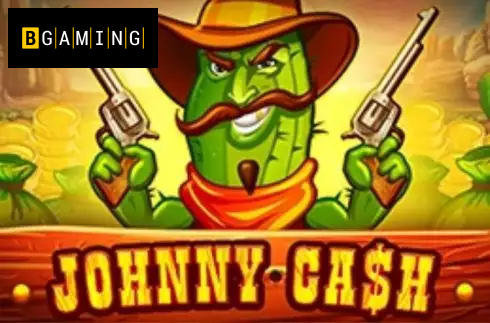







Johnny Cash has nothing to do with the American singer. BGaming instead gives the name to a gun-toting cactus with a curled moustache, two revolvers, and an appetite for gold. That joke tells you almost everything about the tone. This is not a serious frontier drama and it does not spend time building a complicated story. A rocky desert sits behind a wooden reel frame, tequila bottles and cowboy hats fill the grid, and a bundle of dynamite marks the route into the bonus round.
The important part lies underneath the cartoon. Johnny Cash uses five reels, three rows, and 20 fixed paylines. Its base game is traditional, while its free-spin round changes the value of every Wild that lands. Wild badges lock in place for the rest of that round, so a weak opening can turn into a far stronger closing sequence. There are no expanding grids, coin collectors, or paid feature shortcuts in the original 2020 release. The whole design rests on one clear question: how many Wild positions will be secured before the free spins run out?
That narrow focus works in the slot's favor. The rules are readable, the bonus has visible progress, and the difference between an ordinary round and a promising one is easy to spot. It also exposes the game's limitations. Base-game spins are mostly a waiting room, the listed hit rate is modest, and a bonus with few early Wilds may end without much drama. Johnny Cash is therefore best judged as a compact sticky-Wild slot, not as a modern mechanic showcase.
Quick Facts Before the First Spin
BGaming released Johnny Cash on October 30, 2020. The studio's current catalog lists a 95.98 percent theoretical return, medium-high volatility, 20 paylines, a top multiplier of 2077 times the stake, and a maximum monetary win of 249,240 euros under the displayed reference configuration. The same catalog shows a hit-rate field of 4.41 and an FS Rate of 157. Those two numbers need careful wording. BGaming does not explain their units on the public product page, so they should not be turned into promises about a short session. FS Rate is commonly read as an average of roughly one free-spin trigger per 157 paid rounds, while 4.41 is commonly treated as a percentage-based hit figure. Both are long-run mathematical indicators, not a countdown.
Several older review pages list an RTP near 96.2 percent. The current first-party figure is 95.98 percent, so that is the number used throughout this review. The gap may come from rounding, an earlier math file, or a configuration distributed in a particular market. An operator may also run a different approved version. The information screen inside the loaded game is the final reference for the version on a specific casino site.
Public reviews commonly show a stake range beginning at 0.20 and ending at 50 in the selected currency. The official public rules page leaves its minimum and maximum fields as technical placeholders, so a universal range cannot be claimed from that page alone. Currency, operator limits, and regional settings may alter the available steps. The safest description is that the original game is built around a total-bet selector and 20 fixed lines; the exact lowest and highest buttons must be checked after the game loads.
Johnny Cash does not have a progressive jackpot. Its 2077-times ceiling is tied to the math model rather than a shared prize meter. There is also no standard bonus-buy control in the original rules. Some jurisdictions remove autoplay, quick spin, or the post-win Gamble screen, so two casino lobbies may carry the same game while showing slightly different controls.
A Western Parody With a Clear Visual Hierarchy
The main screen is built like a wooden notice board planted in the desert. Five tall parchment strips act as reels. Red cliffs, cacti, blue sky, scattered coins, and weathered planks frame the useful area without crowding it. The title is carved across a wooden sign above the grid. This arrangement keeps symbols easy to read even when the screen has been reduced for a phone.
Johnny himself is a cactus shaped like a swaggering outlaw. His face appears on a standard high-paying icon and again on a Wanted poster. The two designs are deliberately distinct: the full cowboy cactus carries revolvers, while the poster uses a portrait layout. A green money bag, crossed guns, a hat, tequila, and a cigar fill out the Western set. Card ranks occupy the lower end of the paytable. The Wild is a gold sheriff badge, and the Scatter is a stack of red dynamite.
The artwork favors thick outlines and broad blocks of red, gold, green, and brown. It resembles an animated television comedy more than a gritty Western film. That choice suits the central pun and makes the special symbols hard to confuse. Dynamite has its own red frame and Scatter label. Wild badges are large, gold, and almost square. In the bonus, locked badges remain visually dominant, which matters because the state of the reel grid must be readable at a glance.
Sound follows the same playful direction. Guitar-led frontier music establishes the scene, reel stops have short mechanical accents, and character reactions add personality without forcing a long cinematic break after every routine payout. The soundtrack may become repetitive during an extended session, but separate music and sound controls are available. Muting the score does not make the bonus harder to follow because the important state changes are also shown on screen.
There is small environmental detail around the grid, including desert plants and drifting frontier imagery, but it stays outside the mathematical area. That restraint is useful. Many newer slots fill the screen with side meters, progress bars, purchasable modes, and several coin types. Johnny Cash has none of that. Balance, total stake, information, settings, autoplay where permitted, and the spin control sit along the bottom. A new visitor can understand the screen before opening the help menu, though the paytable should still be read before staking real funds.
How the 20-Line Base Game Actually Pays
Each paid round uses all 20 fixed paylines. A winning line begins on the leftmost reel and carries matching symbols across consecutive reels from left to right. Gaps break the combination. A symbol on reel one, the same symbol on reel two, and a different symbol on reel three do not qualify for a three-symbol result farther to the right. The chain must remain unbroken from the first reel.
If more than one line wins, the values are added. Only the highest qualifying combination is paid on each individual line. Line payouts are multiplied by the stake allocated to that line, while Scatter awards use the total stake. These details sound routine, yet they matter when reading the paytable. A listed symbol value may be expressed in line-bet units, so comparing it directly with the total amount staked across 20 lines can create an inflated impression.
The standard Wild substitutes for every regular pay symbol but not for the dynamite Scatter. A Wild may bridge a line between matching icons, and the final line is assessed according to the highest valid result. It does not create a Scatter trigger, and it does not carry a multiplier. Its job is substitution only.
In the paid game, the cowboy icons create the main line-win peaks. The Johnny cactus sits at the top of the ordinary symbol ladder, followed by items such as the Wanted poster and money bag, then the guns, hat, tequila, and cigar. Card ranks make up the lower tier. Exact paytable amounts should be read in the loaded game because stake display and math presentation can differ between builds. The practical ranking, however, is clear from the artwork: character and cash imagery matter more than letters and numbers.
The base game has no cascade, mystery transformation, persistent meter, or random expanding symbol. Every spin resolves once, pays any completed lines, and returns control. That creates a brisk rhythm but also leaves little to analyze between bonuses. A good base result normally comes from several lines sharing a strong central arrangement, often helped by Wild substitution. A single isolated premium symbol cannot do anything by itself.
Reading the Symbols Rather Than Chasing the Artwork
The reels use a familiar value ladder, but the composition is worth examining because it explains why some screens look richer than they pay. A cluster of cowboy hats across the right side can fill the board with Western imagery and still miss every line if reel one has no matching hat. Five money bags scattered across nonconsecutive reels may also produce nothing. Payline structure, not visual density, decides the result.
Johnny's full cactus portrait is the premium standard icon. It carries more weight than the Wanted poster even though the poster may look larger on the reel. The money bag fits naturally beside it as another upper symbol. Guns and hats occupy the middle of the themed set. Tequila bottles and cigars bridge the themed and low-value groups. The bright card ranks remain readable against the parchment but are intentionally less important.
The Wild badge deserves special attention because its reel behavior changes between the two parts of the game. In ordinary paid spins it works as a temporary substitute and disappears with the next spin. In free spins it can appear only on reels two, three, and four according to the official rules, and every such badge locks until the round ends. Reels one and five therefore remain the outer anchors. A strong middle does not pay by itself; reel one still needs to start a valid line, and reel five is needed for a full five-symbol chain.
That restriction explains the bonus balance. If Wilds could lock on all five reels, a few early badges could create near-automatic full-width lines. Keeping them on the three center reels builds tension without removing the role of normal symbols. It also means nine is the practical maximum number of locked Wild positions at one time: three rows across reels two, three, and four.
The dynamite Scatter follows a separate rule. Three, four, or five dynamite symbols anywhere on the grid start ten free spins. They do not need to sit on one line, and Wild badges cannot stand in for them. Scatter wins, where applicable, are added to ordinary line wins. Seeing dynamite on the first two reels therefore has no mathematical memory after the spin ends; only the completed landing matters.
Because each icon has a clear job, the information screen is relatively short. It is still worth checking before play. The visual order of symbols does not tell you every payout, the current RTP, the stake interval, or local control restrictions. A thirty-second rules check is more useful than trying to infer those items from a few demo results.
The Ten-Spin Round Is a Race for Central Positions
Three or more dynamite Scatters award ten free spins. The bonus uses the same stake and line setup as the triggering round. That is the simple part. The important change is that any Wild landing on reels two, three, or four becomes sticky. It stays in that cell for all remaining free spins.
This mechanic creates a natural three-stage shape. The opening spins determine the round's base. A Wild on the first or second free spin has time to affect many later outcomes. The middle spins reveal if the grid is developing into a useful pattern. The last few spins either exploit an established block of badges or expose an empty board that never gathered enough support.
Position matters as much as quantity. A single badge in the middle row of reel three may join many standard paylines, while a corner position can touch fewer. Two badges aligned across adjacent middle reels may be more useful than three isolated badges that rarely share the same route. The bonus therefore has visible quality long before its total is known. You can look at the locked pattern and estimate how many lines have gained substitution help, though the actual result still depends on the symbols arriving on reels one and five.
Early Wilds do not guarantee a large return. They only expand the number of reel outcomes capable of forming lines. Low icons may still land, reel one may fail to begin a match, or reel five may break the strongest chain. Conversely, a round with few Wilds may still land a premium line at the right moment. Sticky positions change the distribution of possible results; they do not turn the sequence into a skill game.
Retriggers add another layer. Landing three, four, or five dynamite Scatters inside the free-spin round adds ten more spins. The official rules state that the maximum number of free spins is unlimited. In practice that means the rules do not impose a fixed retrigger ceiling, not that an endless round should be expected. Each retrigger is another random event, and repeated retriggers become progressively rarer as a sequence grows.
The most valuable retrigger is not merely ten extra no-cost rounds. It also extends the life of every Wild already locked. A badge collected on the second original spin may influence the remaining original spins plus all added rounds. That compounding relationship is the heart of Johnny Cash. A retrigger after several central cells have been secured can matter far more than the same Scatter event on an almost empty grid.
Why Sticky Wilds Change the Pace Without Changing the Odds Mid-Round
Sticky symbols create a strong sense of building momentum. Once a badge locks, the screen is objectively more useful for later line formation because that cell no longer needs a specific regular icon. It is easy to turn that visible improvement into a false prediction that another Wild or a large payout is now due. Nothing in the rules supports that conclusion. Future reel outcomes remain governed by the certified random number generator.
The bonus has memory in its state but not in its random draw. The game remembers which cells are locked because the mechanic requires it. It does not need to compensate for a quiet start, and it does not punish a strong one. This distinction is especially important near the end of a round. Nine empty or weak spins do not make the tenth more likely to rescue the result. A nearly full central block does not force premium symbols onto the outer reels.
The visible state still has analytical value. It helps explain why two bonuses with the same number of Wilds may pay very differently. A vertical stack on reel three touches many routes but still needs help on reel two or four for broader coverage. A diagonal arrangement can connect several zigzag lines. Badges on reels two and four with an empty reel three may leave more breaks than their count suggests. The fixed payline map determines which shapes are productive.
This is also why Johnny Cash feels more transparent than a hidden multiplier wheel. Each improvement stays on the grid. You do not need to remember a meter or wait for a later reveal. The round's strength is visible in the locked cells, although its final cash total is never known until the last evaluation.
From a design standpoint, the mechanic gives a ten-spin bonus a beginning, middle, and end. Without sticky badges, ten free rounds would resemble the base game with a different background. With them, each landed Wild changes every later spin. The system is compact but carries more narrative weight than its rule count suggests.
Its weakness is equally clear. A round that collects no Wilds, or receives them only at the end, feels close to ten ordinary spins. There is no guaranteed Wild at entry and no meter that fills after a dry spell. The bonus can therefore miss the very mechanic that defines it. Medium-high volatility is visible here: access to the feature does not ensure that the feature develops well.
The Gamble Screen Is a Separate Risk, Not a Bonus Multiplier
After a paid-game win, some versions show a Gamble button beside the spin control. Entering it moves the current win into a card-guessing round. Choosing red or black doubles the staked win if correct. Choosing one of the four suits raises it fourfold if correct. A wrong guess loses the amount placed into that gamble.
The current win becomes the stake, which means the decision does not alter the underlying reel result. The slot has already paid. Gamble is a new random wager layered on top of that payment. Red and black present the smaller step, while a suit guess carries a larger jump and a lower chance of success. Neither choice repairs a weak spin or raises the RTP of the reel game through player skill.
BGaming's rules place a ceiling on repeated card guesses. Gamble remains available until the accumulated amount reaches one quarter of the maximum win. If the next possible step would exceed the allowed maximum, the round closes and the existing amount is credited. This prevents an unlimited doubling chain.
Some operators disable this screen under local rules. Its absence does not mean the slot is broken, nor does its presence mean it must be used. Collecting keeps the confirmed reel payout. Entering Gamble trades that certain value for another chance-based result. For review purposes, it should be treated as an optional side wager rather than part of the sticky-Wild engine.
The card screen also changes the emotional rhythm. A small line win can suddenly feel significant after several correct guesses, but the same process can erase it instantly. That drama can overshadow the actual slot math. Anyone evaluating Johnny Cash should separate reel performance from card outcomes; otherwise a fortunate guessing streak may make the base game look stronger than it is.
RTP, Hit Rate, Feature Rate, and What Each Number Can Actually Say
The current BGaming page lists 95.98 percent RTP. In theoretical terms, that is the share of total stakes returned across a very large number of game rounds under the specified model. It is not a target for one evening, one thousand spins, or one account. A short sample may finish far above or far below that percentage because individual outcomes vary widely.
RTP also does not describe the shape of returns. Two slots with the same theoretical figure can feel completely different if one pays many small amounts and the other places more value in rare bonus sequences. Johnny Cash assigns much of its identity to free spins with accumulated Wilds. A session that does not reach that mechanism, or reaches it in a weak form, may bear little resemblance to the long-run average.
The official page's hit-rate field reads 4.41. If interpreted as a percentage, that suggests a paying event on roughly one round in 22.7 over the mathematical sample. That is much less frequent than the broad hit figures often advertised for light-volatility slots. However, the catalog does not define the field on that page. It is more accurate to report the number as published and describe the common reading than to present a calculated interval as a guaranteed frequency.
FS Rate 157 is more intuitive. It is generally read as one free-spin trigger per 157 paid rounds on average. Random spacing means bonuses can arrive close together or remain absent for far longer. The number does not start a hidden counter, and changing the stake does not make the trigger overdue.
The maximum multiplier is 2077 times the stake in BGaming's current listing. Older pages sometimes mention 1000 times, which may reflect an earlier presentation, a prior math file, or an incomplete calculation. The current first-party listing takes priority here. The maximum monetary figure of 249,240 euros is a reference cap tied to a particular stake and currency setup; it should not be read as the amount available at every operator. The multiplier is the cleaner way to compare versions, while the loaded rules remain decisive.
The medium-high volatility label matches the structure. Long gaps and ordinary line wins are balanced against a bonus that can grow much stronger when central Wilds arrive early and retriggers extend their life. That label still covers a wide range. It does not tell you the size of a normal losing run or the value of a typical bonus. It is a broad risk description, not a session forecast.
What a Demo Session Can and Cannot Prove
A free-play mode is useful for learning controls, payline behavior, symbol recognition, and the visual sequence of the bonus. It lets you see that dynamite lands anywhere, that Wilds remain fixed in free spins, and that the card gamble is separate from the reel calculation. It is also the safest place to learn how total stake changes and where the information menu sits.
A demo cannot establish personal winning odds from a small sample. Twenty quick spins with several wins do not show a high hit rate, just as two hundred quiet spins do not prove that the published math is false. The sample is too small relative to the possible outcome space. Bonus timing is especially easy to misread because the official FS Rate is a long-run average with wide random variation around it.
Demo credit also changes behavior. Virtual losses carry no financial cost, so stake buttons may be raised casually and Gamble may be used on every win. That style can make the slot appear faster or more dramatic than a real-money session at a fixed budget. The game itself may use the same certified math, but the person's decisions often change once the balance represents real funds.
The official demo could not be directly controlled in the research environment used for this article because its launch control returned to the product page instead of exposing the playable frame. For that reason, this review does not claim a personal spin sample. Rules, screenshots, and numerical data come from BGaming's own game and rules pages, with secondary pages used only to identify disputed stake and legacy RTP figures.
That distinction matters. It is better to state that a demo could not be operated than to manufacture a spin count or describe a bonus that was never observed firsthand. The official screenshots clearly show the reel layout and sticky-Wild presentation, but promotional scenes are selected examples, not statistical evidence.
Mobile Landscape Play and Interface Practicality
Johnny Cash scales well to a phone because the grid is only five symbols wide and three high. In landscape orientation, the reels occupy most of the screen while the control bar stays along the lower edge. The wide Western scenery fits naturally around the board, and the large symbol outlines remain readable on a smaller display.
Portrait layouts may rearrange controls or reduce the visible desert background, depending on the casino wrapper. The core reel geometry does not change. Fixed paylines also mean there is no line-count menu competing for space. The main recurring actions are choosing total stake, spinning, opening information, and entering autoplay where allowed.
The Wild and Scatter labels are helpful on small screens. A gold badge is easy to distinguish from a money bag, and the red dynamite bundle does not resemble any normal pay icon. Locked Wilds stay bright during the bonus, so their positions can be tracked without zooming.
Performance depends partly on the operator's page, browser, connection, and device memory. The original 2020 art is less demanding than many later 3D slots, but a casino lobby may add banners or pop-ups around the game frame. Closing unused tabs and using a stable connection can reduce interface lag, though it cannot influence random outcomes.
Quick spin may appear in settings, subject to local requirements. It shortens animation time but does not change the reel result, theoretical return, or feature rate. Autoplay has similar limits: it automates repeated stake placement and may contain stop conditions for a win, a bonus, balance movement, or a chosen single-win threshold. BGaming notes that autoplay and quick spin may be removed in some licensed markets.
The balance and total stake should be checked after any interruption. The official rules state that unfinished rounds are handled under the game's settlement process, but the casino account history is the practical record if a connection drops. A reconnect should resume or settle an interrupted state rather than create a second result.
The Philippine Player View: Familiar Controls, Important Local Checks
The Western theme is globally recognizable and does not rely on English dialogue to explain the rules. For a player in the Philippines, the main practical questions are not cultural. They concern access, currency display, operator authorization, and the exact version loaded through the casino lobby.
BGaming may show euros in its public screenshots, while a local site may display Philippine pesos or another account currency. A peso label changes the denomination, not the multiplier logic. A 2077-times ceiling remains stake based, but the operator may impose its own maximum payout rule. Reading the casino terms and the in-game information screen is necessary before treating the public euro figure as relevant to a local account.
Stake range is another area where copied reviews can mislead. A 0.20-to-50 range reported in one currency does not translate mechanically into the same numeric range in pesos. The casino may use preset steps built for its wallet system. Look at the total stake shown beside the spin control, not a third-party number written for another region.
Feature availability can also vary. Autoplay, turbo-style speed settings, and Gamble may be missing because of license rules. The absence of one control does not imply a different free-spin mechanic, but the RTP itself should still be checked. If the information page shows a value other than 95.98 percent, that loaded value governs the actual version.
Johnny Cash is a fictional cactus outlaw, not a licensed presentation of the musician. This distinction helps avoid a common search error. Pages discussing music rights, singer imagery, or tracks associated with the real Johnny Cash may refer to another product or may simply be inaccurate. The BGaming game reviewed here uses the cartoon cactus, a 5×3 board, 20 lines, dynamite Scatters, and sticky sheriff badges.
Local players should also treat any casino-specific free-spin promotion separately from the slot's internal ten-spin round. A site bonus may carry turnover conditions and wallet restrictions, while the dynamite feature is part of the game rules. They may share similar wording but are not the same product.
Session Shape: Where the Game Feels Strong and Where It Feels Thin
Johnny Cash is strongest once the bonus has collected several Wilds. Each later stop becomes easier to read because the central locked positions frame the remaining question: which matching symbols will land on the outer reels? A retrigger at that stage extends a pattern that already has value. The round gains a sense of accumulation without adding a second screen or a complicated set of meters.
The base game is thinner. It has substitution, line wins, and the optional card gamble, but no persistent process carries from one paid spin to the next. A near miss with two dynamite bundles has no future value. Several quiet rounds do not fill a meter. People who prefer a visible base-game progression may find the wait flat.
The listed hit figure reinforces that impression. Routine payouts are not meant to arrive on every few spins, and many visual arrangements fail because the first reel does not start a consecutive line. Medium-high volatility does not require the game to be harsh in every sample, but it does mean the balance can move in uneven steps.
The top prize of 2077 times stake is substantial yet restrained beside newer releases advertising five-figure or six-figure multipliers. That lower ceiling can be viewed two ways. It may disappoint anyone choosing games mainly by headline maximum. It also keeps Johnny Cash centered on the actual sticky-Wild round rather than a remote jackpot-style target. The game does not pretend that every feature is a route to an enormous cap.
Presentation remains readable after many spins because there are few overlays. The cowboy gag, Western music, and crisp icon set give it personality, but they cannot disguise repetitive base play. The question is therefore less about theme preference and more about tolerance for waiting. If a ten-spin sticky-Wild round is enough to carry the session, the design stays coherent. If several layered mechanics are required, this 2020 title will feel spare.
Common Mistakes When Reading Johnny Cash
The first mistake is assuming the name refers to the singer. It does not. This is BGaming's cactus outlaw and should not be confused with licensed music-themed casino products.
The second is treating every group of matching icons as a win. Johnny Cash uses fixed paylines, not cluster pays or all-ways evaluation. Symbols must align on one of the 20 routes and connect from the leftmost reel across consecutive reels.
The third is counting Wilds as Scatters. Sheriff badges substitute for regular symbols only. They cannot replace a missing dynamite bundle when the game checks for three or more Scatters.
The fourth is assuming sticky Wilds remain after the bonus. They lock only for the current free-spin round. The base game starts fresh once that round has been settled.
The fifth is believing that all five reels can fill with locked Wilds. Official rules restrict bonus Wild appearances to reels two, three, and four. The outer reels must still land normal matching symbols for complete full-width lines.
The sixth is reading FS Rate 157 as a schedule. It is an average reference, not a promise that a bonus arrives by spin 157. Random sequences can be much shorter or much longer.
The seventh is treating 95.98 percent RTP as a personal rebate. It belongs to a very large theoretical sample. A single balance has no requirement to return that fraction.
The eighth is using the Gamble screen as if it improves the reel math. The card decision is another wager. A correct color guess doubles the selected win, while a wrong guess removes it. The underlying slot result remains unchanged.
The ninth is copying an old 96.2 percent figure without checking the loaded information page. BGaming's current product listing reads 95.98 percent. A casino may host another approved build, so the value inside that game session is the relevant one.
The tenth is confusing Johnny Cash with Gold Rush with Johnny Cash or Train Heist Johnny Cash. Those later BGaming titles use different layouts, math, and mechanics. This review covers only the original 2020 five-reel game.
A Clearer Way to Assess the Slot Before Real Stakes
Start by confirming the title screen and character. The correct game shows the moustached cactus cowboy and the plain Johnny Cash name. If the title includes Gold Rush or Train Heist, it is a different release.
Open the information panel before spinning. Check RTP, total stake steps, maximum-win wording, payline diagram, and any local changes to autoplay or Gamble. This avoids relying on figures copied from another operator.
Use demo credit to learn line geometry. Pick several payline diagrams and trace how they cross the three rows. This makes later results easier to understand and prevents a scattered group of matching icons from being mistaken for a missed payment.
Watch one free-spin round for position rather than total alone. Note how badges on reels two, three, and four stay fixed, and see which lines cross those cells. The point is not to predict the next outcome. It is to understand why certain locked arrangements create more matching routes than others.
Keep the optional card gamble separate during evaluation. If every small win is risked, the resulting balance path reflects card guesses as much as reel behavior. Collecting the initial awards gives a cleaner picture of the slot itself.
Check mobile controls in the orientation you expect to use. Make sure the total-stake selector is not hidden behind the casino wrapper and that information text remains legible. A layout that looks clear on desktop may feel cramped inside a phone browser with extra site bars.
Finally, compare the design with your actual preference. Johnny Cash asks for patience through a plain base game in return for a bonus that accumulates Wild positions. No amount of theme appreciation changes that structure. Understanding it in demo mode is more useful than chasing a lucky sample.
Strengths That Come From Restraint
The strongest part of Johnny Cash is rule clarity. Five reels, 20 lines, dynamite entry, ten free spins, and locked central Wilds can be explained without a long tutorial. Yet the placement of those Wilds gives the bonus enough variation to avoid feeling identical every time.
The art supports the rules. Special symbols look different from normal icons, locked positions are prominent, and the desert frame leaves the pay area readable. The cactus cowboy also gives the game a recognizable identity without depending on an outside franchise.
Retriggers have real structural value because they extend existing sticky positions. Ten added spins on an empty grid are useful, but ten added spins behind several locked badges are far more meaningful. That interaction creates the best moments in the design.
The Gamble screen gives an optional layer to base-game wins where regional rules permit it. Because it is separated from the reels, people who dislike it can collect and return to normal play. Its risk is clear: guessed color, guessed suit, or loss of the staked win.
Mobile scaling is another practical strength. A three-row board, broad symbols, and a simple lower control bar translate well to landscape phone play. The 2020 graphics remain crisp without the heavy cinematic sequences found in some newer titles.
The listed 2077-times maximum is also easier to place in context than a huge promotional ceiling. It is not a jackpot and does not grow across a network. The main path remains the same mechanic shown on the help screen.
Weak Points That the Cowboy Cannot Hide
The paid game has almost no progression. Every nonbonus spin resets the visual state, so a long wait for dynamite can feel repetitive. Wild substitution and the card gamble add activity, but neither builds a lasting reel feature.
The free-spin round can fail to gather early Wilds. When that happens, the defining mechanic has little time to matter. Ten rounds may finish as a lightly altered version of the base game, and there is no guaranteed badge to create a minimum level of development.
The name can cause confusion. Anyone expecting music, photography, or references to the American performer will find a cactus joke instead. The game makes the parody clear once loaded, but search results frequently mix it with unrelated content.
Published numbers are not perfectly consistent across the web. Older pages commonly cite 96.2 percent RTP and a 1000-times peak, while BGaming's current listing reads 95.98 percent and 2077 times. This is manageable if the in-game panel is checked, but it makes copied summaries unreliable.
The official hit-rate and FS-rate fields are concise to the point of ambiguity. Values are displayed, yet the public product page does not fully define their units. A more detailed first-party explanation would make comparison easier.
Finally, the ceiling is modest beside many current high-volatility slots. That does not make the math poor, but it narrows the appeal for people who focus on very large advertised multipliers. Johnny Cash is built around a readable sticky-Wild story, not a record-setting maximum.
Final Judgment: A Straightforward Bonus With More Shape Than Its Base Game
Johnny Cash earns its identity through one well-matched mechanic. The sheriff badge already fits the Western setting, and turning it sticky during free spins gives the symbol a role that is both thematic and mathematically visible. Each early badge changes the rest of the round, while retriggers preserve the entire locked pattern for ten more spins.
The tradeoff is a bare base game. Outside free spins, there is little beyond fixed lines, ordinary substitution, and an optional post-win card risk. The desert comedy keeps the screen pleasant, but it does not create mechanical depth between feature triggers. Sessions can therefore feel sharply divided between waiting and building.
For factual comparison, the current reference points are clear: release date October 30, 2020; five reels and three rows; 20 fixed paylines; 95.98 percent listed RTP; medium-high volatility; 2077-times listed maximum; ten free spins from three or more dynamite Scatters; retriggers of ten; and sticky Wilds limited to the three middle reels during the feature. The loaded information panel should settle any operator-specific difference.
The slot makes most sense for someone who values a bonus that can be understood from the reel state. It makes less sense for someone wanting frequent base-game events, several purchasable modes, or a vast top multiplier. Its best rounds tell a compact story: central territory is claimed one badge at a time, then the outer reels decide how much that territory is worth.
That is the honest measure of Johnny Cash. It is not a revolution in Western slots, and it does not need to be. It is a focused 2020 design with a memorable cactus lead, a readable board, and a sticky-Wild round that becomes stronger when fortune places the right badges early. When those badges stay scarce, the limitations are equally visible. Few slots reveal both their strength and their weakness so plainly on the same five-reel frame.