






Worm Kingdom starts with a title that makes the theme clear before a reel turns. The available listing identifies a worm-and-tank theme, while the pictures in this article are editorial reconstructions rather than client captures. That gives the article a visual direction, but not permission to fill missing rules with assumptions. A public secondary directory associates Worm Kingdom with AIS Gaming and indexes a May 2026 release, a 10-way format and a 96 percent return, but no first-party product sheet or working demo loaded during this check. Exact RTP, volatility, feature frequency and maximum-award conditions therefore remain version checks wherever the public record is incomplete or contradictory. All three horizontal pictures are editorial reconstructions based on the exact title, named studio and directory theme. They are not AIS Gaming screenshots, certified rules or records of real-money results.
Down the First Tunnel
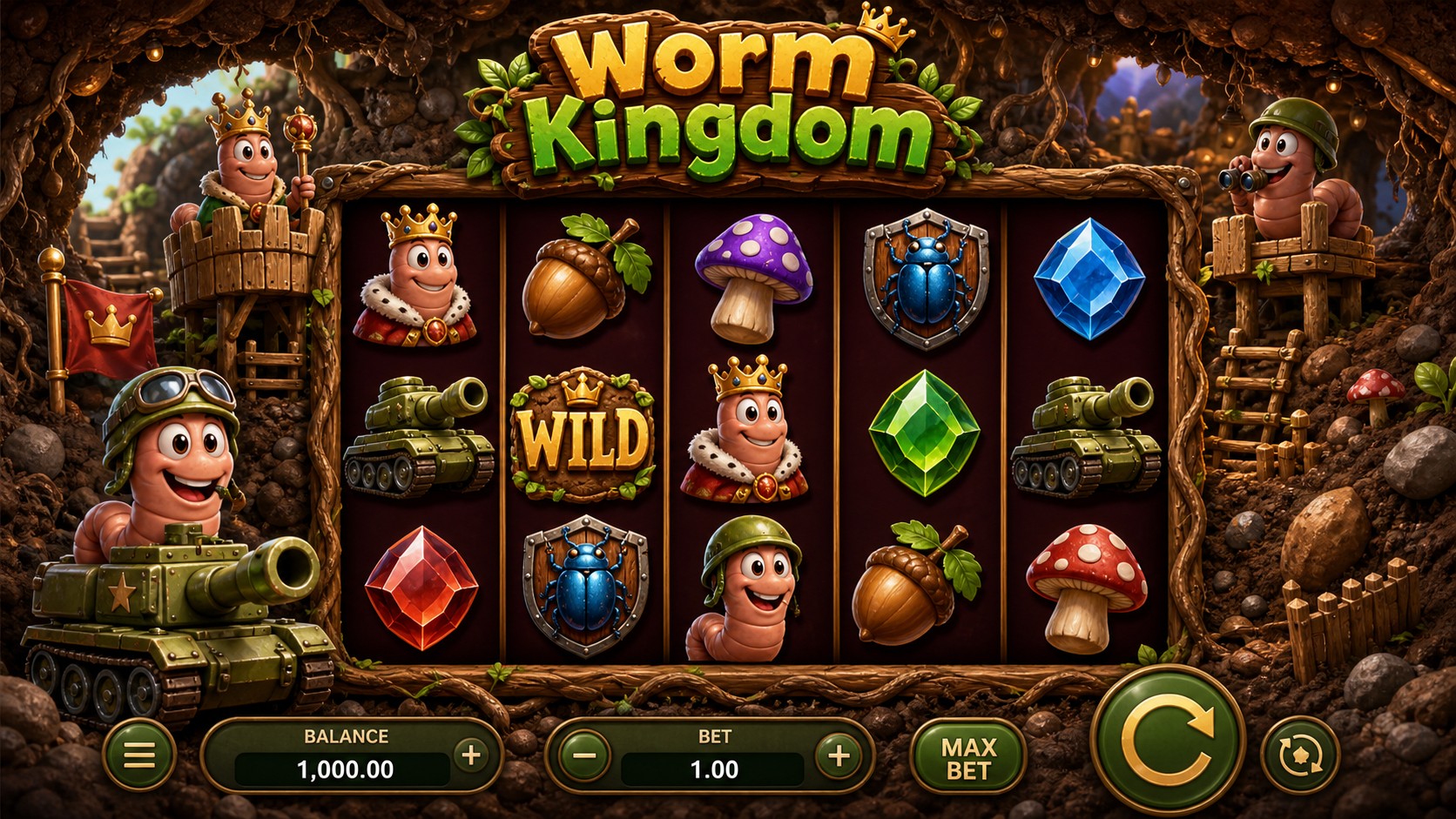
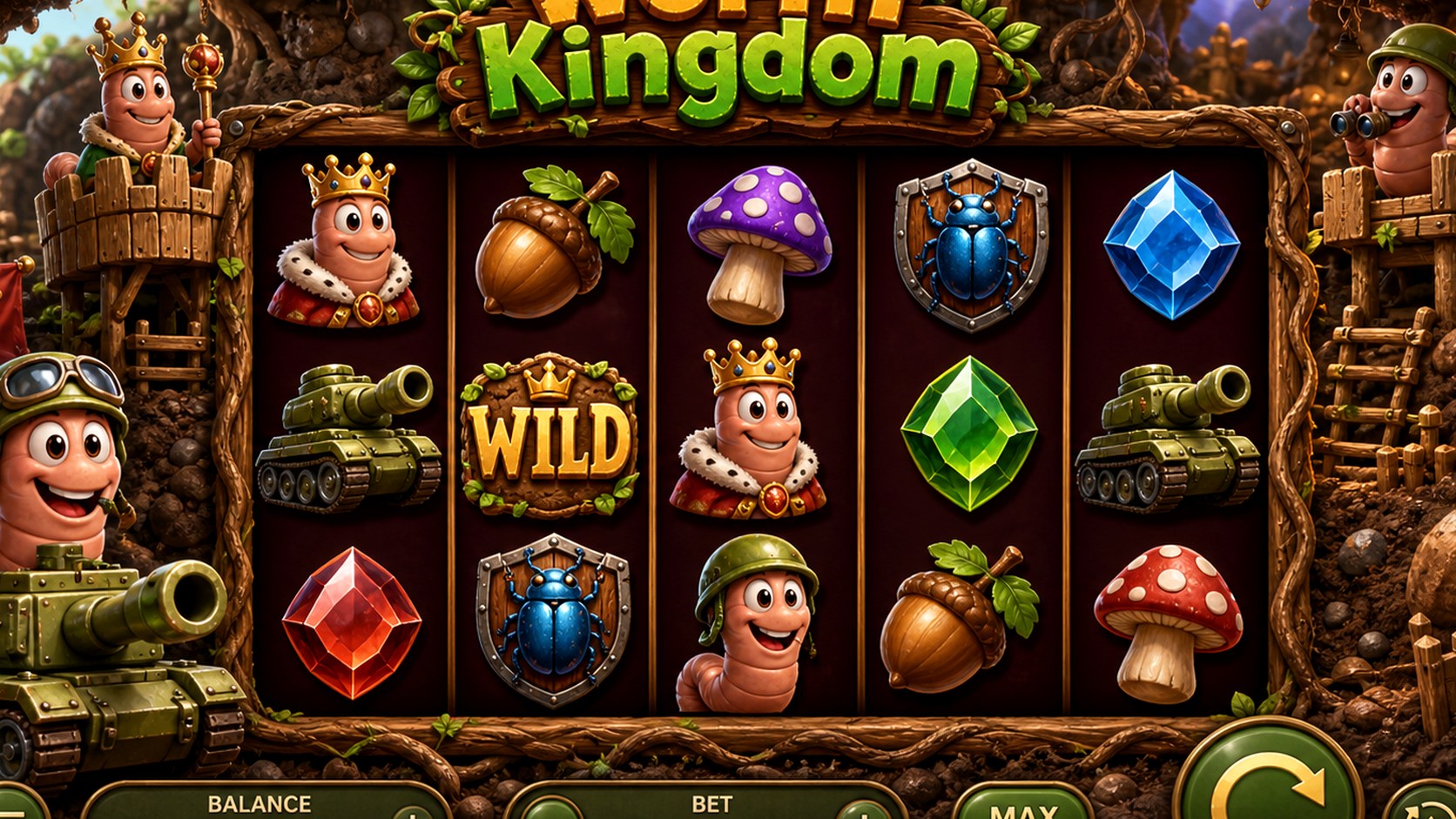
Worm Kingdom opens with comic underground rivalry. The crowned cartoon worm commander and worms, toy tanks, acorns, mushrooms, beetle shields and gemstones are not background ornaments; they form a visual hierarchy that tells the eye where to look before any rule has been read. The reel area sits inside that hierarchy, so symbols remain distinct from the scenery instead of dissolving into it.
That first reading matters on a phone. A slot may spend heavily on illustration and still fail if the stake, spin control or settled result is hard to locate. Here the strongest idea is not mere decoration. It is the way earth brown, moss green, burgundy and old gold separates the game board, framing art and controls into layers.
What the Directory Actually Identifies
A public secondary directory associates Worm Kingdom with AIS Gaming and indexes a May 2026 release, a 10-way format and a 96 percent return, but no first-party product sheet or working demo loaded during this check. The available listing identifies a worm-and-tank theme, while the pictures in this article are editorial reconstructions rather than client captures. This is the firm boundary of the evidence used here.
A catalogue image can establish identity and art direction. It cannot establish the exact RTP setting, volatility band, reel mathematics, bet limits or highest award in every operator build. Those facts belong to the information panel of the version actually loaded.
The 96 Percent Claim Stays Underground
No exact RTP is printed here because a first-party mathematical sheet for the deployed Philippine build was not available for direct inspection. Repeating a familiar percentage from another site would turn an information gap into false precision.
The same restraint applies to volatility, hit frequency, bonus frequency and maximum win. A secondary directory may list figures, but the running help page and operator rules take priority because certified configurations and regional limits can differ.
What Kingdom Means in the Manual
The word Kingdom is the headline hook. It raises an obvious question: does it describe a multiplier, a progression, a visual motif or simply the scale of the story? Only the help screen can answer that. A number or power word in a logo is not automatically the highest cash ratio for a paid round.
Before treating the title as a promise, locate the line that defines it. Check the triggering symbols, the stage at which the value applies, any stake multiplier, the cap on simultaneous wins and any separate cash ceiling. If those conditions are absent, the name should remain a marketing label rather than a calculation.
Mapping the Burrow Board
Start with the shape of the board and the rule used to recognize a result. A wide image can represent fixed paylines, adjacent ways, clusters, symbol counts or another method. The visible columns alone do not answer the question.
The reconstruction uses five vertical reels for readability. The directory describes 10 ways, but only the deployed help screen can show how those ways are formed, which reels qualify and if the layout changes during a feature.
Worms, Tanks and Woodland Objects
The theme naturally divides the reel set into character or object symbols, special icons and compact gem and woodland icons. worms, toy tanks, acorns, mushrooms, beetle shields and gemstones carry more visual weight than the letters and numbers. That weight usually signals premium status, but the paytable may rank two similar objects very differently. Size and shine are clues, never final values.
Read every payout in the unit used by the game. Some tables show bet-per-line units; others use total stake. A five-of-a-kind figure can appear ten or twenty times larger if the unit is misunderstood. The cash meter after a test spin is useful, but the written help panel should settle the conversion.
Small Symbols in a Busy Tunnel
compact gem and woodland icons occupy a large share of ordinary reel time in the editorial layout. They create visual breathing room around the premium art and make small combinations quick to recognize. Their role in the mathematical model may be larger than their small paytable values suggest because frequency and value are separate parts of return.
A low-symbol hit can light the grid while returning less than the amount staked. That is a paid result, not necessarily a profitable round. The correct comparison is final credit divided by the full spin cost. Animation length, coin count and sound volume do not change that ratio.
Following a Route Through the Soil
Large portraits and objects such as worms, toy tanks, acorns, mushrooms, beetle shields and gemstones can dominate the frame. The practical test is to follow one settled combination from its first symbol to its last without relying on flashing borders. Clear spacing between reels, consistent icon silhouettes and a visible route make the result easier to audit.
If several awards arrive together, open the win breakdown or history panel. One total may contain multiple lines, an anywhere payment and a modifier. Treating the largest symbol on screen as the sole cause can produce a false reading of the rule, especially when a substitute or multiplier is also present.
Wild Rules Need More Than a Crown
A Wild description is incomplete until three points are known: which symbols it copies, where it can land and if it carries its own value or multiplier. It may exclude Scatters, bonus icons or jackpots. Some Wilds expand or stay in place; others do nothing beyond substitution. The artwork cannot settle those exceptions.
When a Wild appears, compare the marked winning path with the natural symbols around it. Then check if the game pays the best valid combination or adds a separate Wild award. This small audit prevents a common error in which every decorated emblem is assumed to copy everything on the board.
Scatter Positions Across the Burrow
A Scatter generally counts across specified reels or anywhere on the grid, but the required count and eligible positions vary. Three matching icons might start a feature in one version and merely pay in another. Some titles require the first, third and fifth reels; others accept any three positions.
Record the full trigger screen before naming the rule. Count the symbols, note their reels and wait for the award message. If the next screen changes mode, check the starting counter and carried stake. One observed trigger explains a route; it does not estimate how often that route will happen.
A Battle Gauge Is Not a Forecast
any burrow or battle counter shown by the client should be treated as an interface question, not a prediction. If the deployed client displays it, the help page must say what moves it, when it resets and if any progress survives the next paid round.
Watch one complete cycle before assigning meaning. A circle, gauge or counter may show collected symbols, a one-round modifier, a bonus threshold or only decorative state. A nearly full graphic does not prove that a feature is due.
Paid Rounds Beneath the Action
Many reviews rush past the paid reels and treat the bonus as the only meaningful part. That misses the money path. Base spins create nearly all turnover, settle small and medium awards, and decide how long a balance remains available. A rare feature cannot repair a stake level that is too high for the intended session.
Worm Kingdom needs ordinary results that are readable at a glance. A clean board lets the user distinguish a no-win, a partial return and a profit without waiting for a long count-up. That clarity is especially important when the surrounding root-filled underground kingdom is busy and the screen uses strong motion.
What a Kingdom Mode Must Change
any kingdom battle mode named in the rules earns a separate name only if it changes a rule. It might alter the grid, symbol set, multiplier scope, number of actions or settlement method. A new background and louder sound are presentation changes, not new math.
Compare the help text before and after the mode begins. Record any carried stake, starting counter, retrigger condition and cap. If none of these elements changes, describe the event as an animation state rather than a distinct bonus mechanism.
Where a Multiplier Lands
A multiplier can act on one symbol, one line, the current cascade, all wins in a free-spin round or the final feature total. Saying that a game has multipliers leaves the crucial calculation unanswered. The placement of the number and the wording of the win message usually reveal the scope.
Also check if several multipliers add or multiply together. Two visible 2x values could mean 4x, a combined 4x through addition, or separate modifiers on different awards. The history entry after settlement is the safest way to test. Never extrapolate the top result from a promotional badge alone.
A Victory Parade Is Not the Cap
Clients often label results with tiers such as big, mega or super. Those labels are commonly based on the ratio between win and current stake. They do not prove that the result reached the mathematical ceiling. The count-up may also stop at a cash cap even when the theoretical symbol total is higher.
To calculate a genuine ratio, divide the credited result by the total stake removed for the paid round. Include free follow-up actions inside that same round unless the rules state otherwise. This method turns a loud presentation into a comparable number and avoids confusing coins on screen with peso value.
Picture One: The Editorial Burrow
The first picture converts the worm kingdom and toy-tank idea into a wide game-review visual. It establishes scale, palette and mascot hierarchy without claiming that AIS Gaming uses the same artwork.
The picture belongs to the visual review only. It must never be used as a substitute for a paytable, probability statement or operator-specific stake range.
Picture Two: Reel Cabinet Close-Up
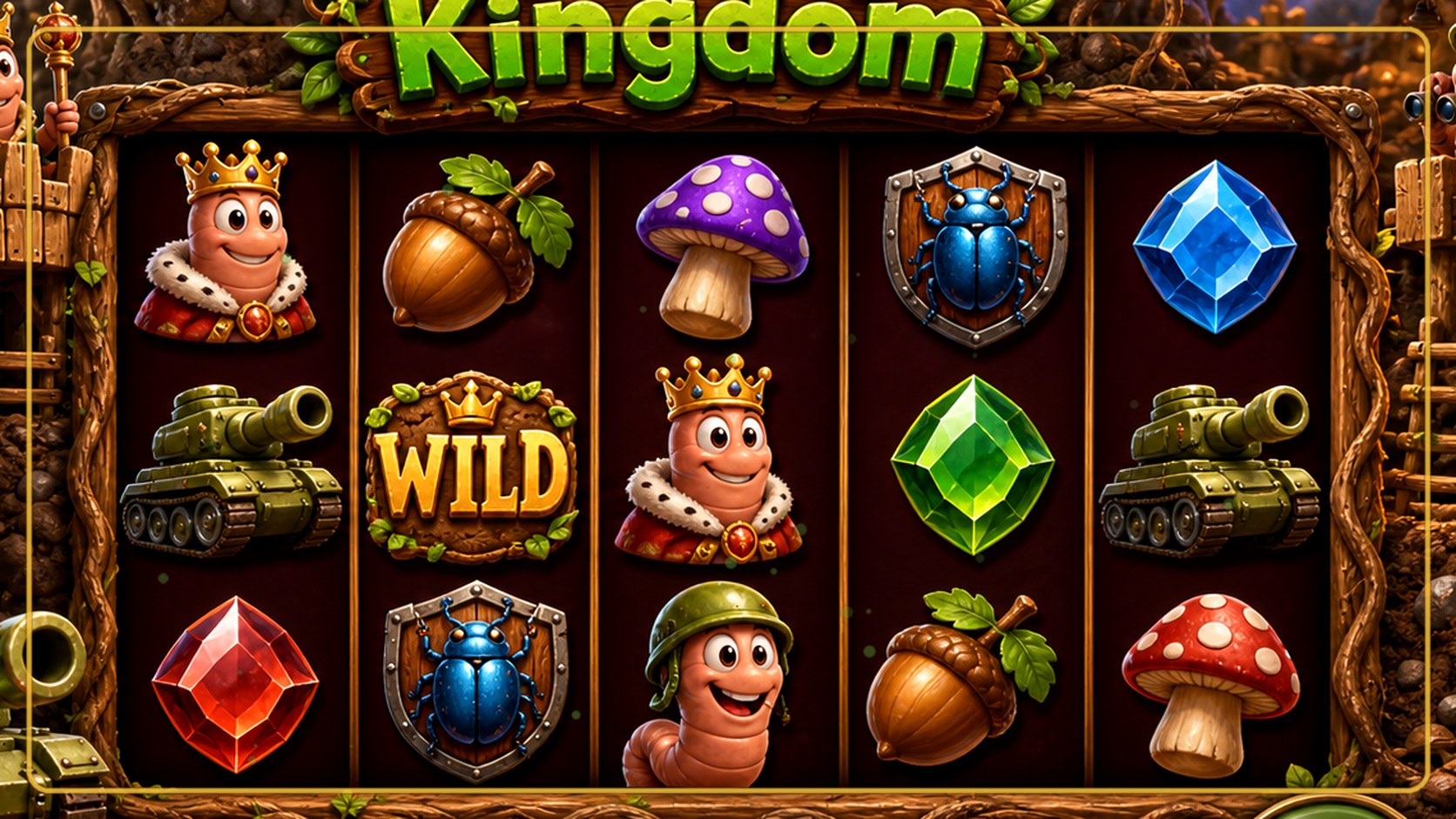
The second picture moves closer to the imagined reel panel and controls. The visible stake, balance and symbols are layout props, not values taken from a functioning game session.
Its job is to make phone layout, symbol hierarchy and control placement easier to discuss. The written rules remain the authority for every cash calculation.
Picture Three: Symbol Field Study
The third picture enlarges crowned worms, acorns, mushrooms, beetle shields, gemstones and the editorial Wild tile. It is a legibility study rather than evidence of an actual winning combination.
A live history panel should show more than any promotional still: original stake, component awards, modifiers and final credit. That record is the correct place to audit settlement.
Burrow report 19: Sound Design and Perceived Pace
comic underground rivalry can be strengthened through layered music, reel-stop cues and short feature stingers. Sound is useful when it marks a trigger or completed calculation. It becomes less useful when every partial return receives the same fanfare as a clear profit.
Try several rounds with audio lowered. If the board still communicates outcome, the interface is doing its job. If the result becomes ambiguous without a voice line or long count-up, the visual feedback needs more attention. Audio should confirm settlement, not replace the numbers.
Burrow report 20: Landscape Play and Thumb Reach
A horizontal phone gives the root-filled underground kingdom room on both sides of the reels. The central board remains large while settings, stake controls and spin can occupy the lower band. This arrangement works best when the largest button sits away from the minus and plus controls.
Before rapid play, rotate the device, enter full screen and check the total-stake field after one adjustment. Browser bars and system gestures can cover edge controls. A test spin at the minimum setting confirms that the hit boxes match the visible buttons and that no accidental Max Bet control sits beneath the thumb.
Burrow report 21: Portrait Mode Is a Compromise
Portrait layout may scale the entire game down or reorganize controls beneath the grid. Tiny payline markers and condensed help text are the first casualties. The screen can remain playable, yet accurate rule reading becomes harder when the table requires repeated zooming or horizontal swipes.
Use portrait mode for quick navigation, not for the first rules check. Landscape is the better place to compare total stake, balance and win because all three can remain visible together. The relationship between those numbers matters more than keeping the device in one hand.
Burrow report 22: Performance on Mid-Range Phones
The artwork uses multiple layers, large character cutouts and particle effects. On a mid-range handset, watch for delayed button response after a count-up, audio falling out of step with the reels or a stake change taking effect one round late. Those are interface problems, not signs of altered probability.
Close other heavy apps and use a stable connection during the first session. If the client reconnects, verify balance and the last completed round in history before spinning again. A frozen animation can recover after the server has already settled the result, so the account record takes priority over the last visible frame.
Burrow report 23: Stake Controls Deserve More Attention Than the Mascot
Toy tanks, cheering worms and busy soil tunnels can make several quick paid rounds feel like one long cartoon battle. The most useful habit is to read total stake after every change and before the first rapid sequence. Bet per line, coin value and total bet may occupy separate fields, and altering one can multiply the final debit.
A planned session should be written in money, spins and time. Divide the session amount by the intended number of paid rounds to find a workable average stake. Free actions do not add a new debit unless the client states a purchase. This arithmetic is dull, but it controls exposure more reliably than any theme-based hunch.
Burrow report 24: RTP Belongs to Turnover, Not a Short Run
Once the deployed RTP is known, interpret it as a long-run model ratio. If the help page lists 96 percent, theoretical cost is four units per hundred units of turnover. That sentence is an example of the calculation, not a claim that this version uses 96 percent.
Turnover equals total paid stake across accepted rounds. A hundred spins at one unit create one hundred units of turnover even if several free actions appear between them. A short session may finish far above or below the model ratio because random outcomes do not settle into a neat percentage on demand.
Burrow report 25: Volatility Is About Distribution
Volatility describes how payout value is spread across outcomes. A higher band usually places more weight in less common large results; a lower band usually returns more of its value through smaller payments. The label does not state when a feature will arrive or how long a losing sequence can last.
Without an official band, infer nothing from comic underground rivalry. A calm fruit village can use severe math, and a battlefield can use a mild distribution. After the label is found, use it to size stake and session length, not to forecast the next reel stop.
Burrow report 26: Maximum Win Needs a Denominator
A maximum written as 1000x or 5000x must say what x means. It may refer to total bet, coin value, feature stake or a base amount before an ante. Some clients also apply a fixed cash ceiling. The lower of the mathematical award and cash cap may be the amount actually credited.
Check if the cap ends the feature immediately or allows remaining actions to play without added credit. Also check if simultaneous line, Scatter and jackpot awards share one cap. A headline number without these conditions is incomplete and should never be used to set a spending target.
Burrow report 27: A Clean Demo Test in Thirty Paid Rounds
Use the minimum fixed stake and create one row for each paid round. Record starting balance, debit, base credit, feature credit, ending balance and any meter change. Keep free actions inside the row of the spin that triggered them. This format exposes the money flow without treating a tiny sample as statistical proof.
Thirty rounds are enough to learn button behavior, symbol settlement and feature messages. They are not enough to estimate RTP or trigger frequency. The purpose is mechanical literacy. Stop the test once each major control has been checked; more spins do not turn an informal sample into certification.
Burrow report 28: How to Audit a Bonus From Start to Finish
Capture the trigger screen, starting counter, carried stake and opening multiplier. Then note each retrigger, held symbol, expanding reel or meter reset. At the end, compare the feature total with the history record and final balance. Every free action should trace back to one paid round.
If a purchase button exists, treat it as a separate bet mode. Record its price as the full stake for that round and read its RTP entry independently if the client lists one. A purchased feature may use the same animation while carrying a different cost structure.
Burrow report 29: Common Misreads Around Worm Kingdom
The first misread is assuming that Kingdom states the unconditional top award. The second is assigning premium status solely from symbol size. The third is treating a filling any burrow or battle counter shown by the client as proof that a feature is due. The fourth is calling every substitute a multiplier Wild without checking the rules.
The fifth is copying an RTP from an unrelated review. The sixth is counting free actions as fresh paid spins. The seventh is judging profit from the win banner instead of balance movement. Each mistake disappears when the player keeps the stake field, history panel and help page in the same audit.
Burrow report 30: What Philippine Players Should Verify
A Philippine listing may use peso values, wallet credits or a converted coin display. Confirm the minimum and maximum total stake, not merely coin size. Check that the operator names AIS Gaming as the studio, and compare the logo with the official key art before assuming that a similarly named title is the same product.
Also read local rules for feature purchases, autoplay, session reminders and cash limits. These controls belong to the operator build and jurisdiction. A screenshot from another market can explain layout, but it cannot establish the available stake range or certified return in a Philippine account.
Burrow report 31: Who Gets the Most From This Theme
Readers who like cartoon battle themes, underground scenery and unusually small heroes on a wide mobile screen will find the presentation immediately legible. The theme also suits short review sessions because the visual hierarchy can be judged quickly. That does not make the mathematical profile suitable for every budget; the actual volatility and minimum total stake still control that decision.
Anyone who dislikes dense side art or loud event effects should test the sound and fast-play controls first. A strong theme can be a reason to open a demo, but it is not a reason to ignore the paytable. Interest in the artwork and comfort with the stake are separate choices.
Burrow report 32: A Practical Decision Checklist
Before real play, confirm the exact title, studio, RTP, volatility, win method, Wild exceptions, Scatter route, feature trigger, multiplier scope, maximum-win denominator and cash cap. Then set a total session amount and a stopping time. If any critical rule remains hidden, keep the title in demo mode.
During play, watch balance rather than animation. After play, compare opening balance, deposits, withdrawals and ending balance with the history log. This checklist does not change random results. It changes how clearly the cost and settlement can be seen.
Burrow report 33: Final Reading: Theme First, Math Before Money
Worm Kingdom has a memorable scale joke and a clear visual identity. The indexed 96 percent and 10-way claims still need confirmation inside the operator build before they belong in a cash calculation
Worm Kingdom earns attention through comic underground rivalry and a tightly coordinated earth brown, moss green, burgundy and old gold palette. The next step is not a larger stake; it is the local information screen. Confirm the deployed math, test the controls at minimum value and treat every visual promise as a question that the rules must answer.
Burrow report 34: Separating Hit Rate From Profit Rate
A hit is any result the rules count as a payment. Profit requires the credited amount to exceed the full stake for that paid round. A title can register frequent small hits while the balance declines. Without an official hit-frequency figure, the only safe statement is that the two rates are not interchangeable.
For a demo log, mark return ratios below 1x, exactly 1x and above 1x in separate columns. This reveals how many recorded wins were partial returns. It still does not predict future play, but it gives a much clearer account of the sample than a simple count of flashing win messages.
Burrow report 35: Near Misses Are Animation, Not Progress
A bonus icon stopping just outside a payline or a premium symbol passing during reel motion can feel meaningful. Unless the written rule stores that event, it has no carry-over value. The next accepted round is not improved because the previous animation looked close.
The same caution applies to two trigger symbols when three are required. They may create suspense, yet their payment and stored effect depend entirely on the table. Record what was credited, then clear the image from the decision about the next stake.
Burrow report 36: Fast Play Changes Exposure Speed
Fast play shortens animation; it does not normally change the random model. Its financial effect comes from time. More paid rounds can fit into the same minute, so the balance may move faster even though the stake per round stays fixed.
Measure pace before enabling it. Ten ordinary rounds on standard speed and ten on fast speed reveal the difference in turnover per minute. If the faster rate breaks the planned session limit, lower the stake or return to standard timing rather than relying on attention alone.
Burrow report 37: Autoplay Needs Stop Conditions
Where autoplay is available, set a round count and use any loss, win or single-award limits shown by the client. Read those fields carefully because some are cash values while others are stake multipliers. An empty field may mean no automatic stop for that condition.
Remain present during automated rounds. Network reconnection, a feature choice or a changed balance can pause the sequence. Autoplay is a convenience control, not a budget system, and it does not make a long sample more likely to follow the theoretical return.
Burrow report 38: Responsible Play in Plain Numbers
Set a sum that can be lost without affecting bills, savings or debt payments. Do not borrow to play, do not chase a prior loss and do not treat a rare large result as income. Time reminders and deposit limits are useful because strong game art can blur the length of a session.
If play stops feeling optional, close the client and use the operator exclusion or limit tools. The clearest review of any slot ends with the same fact: outcomes are random, the house keeps a mathematical margin over long turnover and no visual pattern creates a reliable edge.